
People · China / Western Han
Wei Qing: The General Beyond the Victory List
卫青
From a mounted attendant to Grand General, with the people and costs beyond his victories.
Historical account. Based on the cited historical text. The prose is an independent retelling; portraits, clothes and environments are interpretive illustrations rather than surviving likenesses.
Listen to the story
Take the audio path
The episode will try to begin when the page opens. Browser settings may require you to press Play.
The two voices are AI generated from an edited dialogue script. Music credit appears below.
The illustrated story
Read the story
Follow the full English narrative, with scenes placed alongside the passages they illustrate.
01 / 04
Before the title
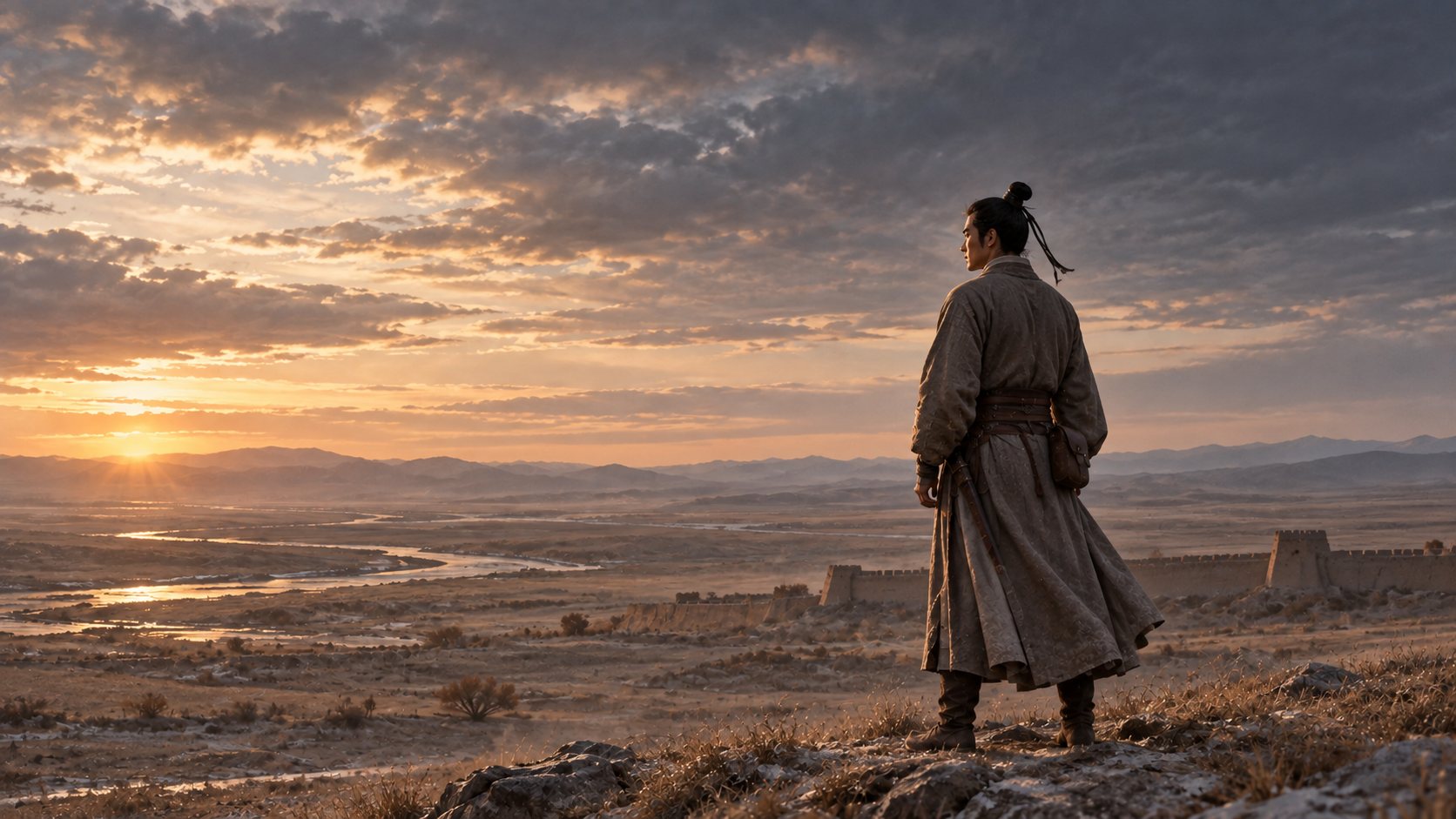
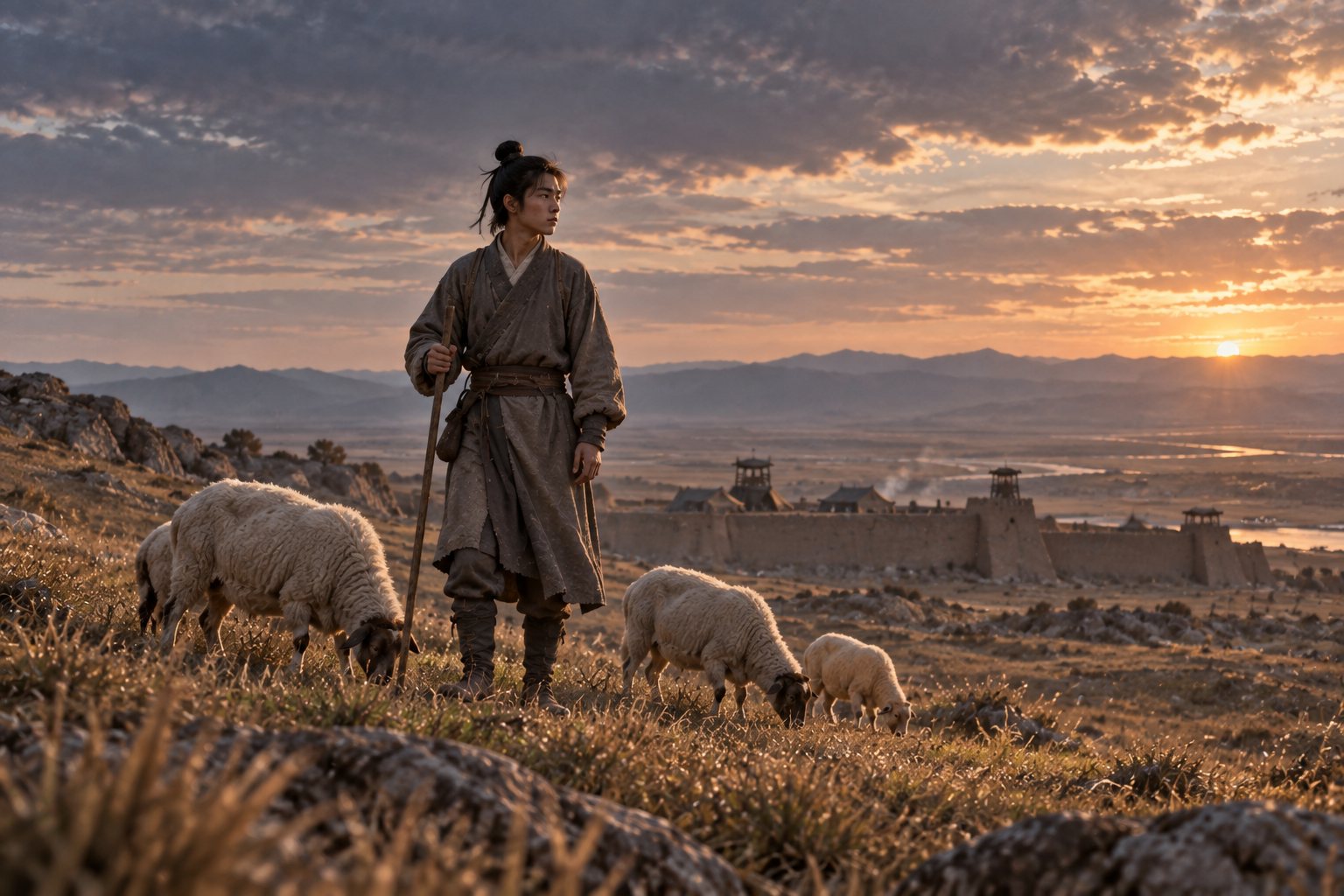
Wei Qing became a Grand General of the Western Han. The biography that gives us his campaigns begins somewhere less grand: the household of the Marquis of Pingyang. As a boy, the text says, he was sent to tend sheep. As a young man he served as a mounted attendant to Princess Pingyang. His sister Wei Zifu later entered Emperor Wu's palace, but family proximity did not remove danger. The *Shiji* says Wei Qing was seized by court rivals, and his friend Gongsun Ao rescued him. The emperor then called Wei into service. A political connection opened a door; it did not make the path safe. [1]
His first recorded command came during a four-pronged campaign against the Xiongnu in the fifth year of Yuanguang. Wei rode out from Shanggu and reached a place the text calls Longcheng. He returned with a victory while other Han commanders failed or lost men. The chronicle gives no precise scene of his tactics there. We cannot confidently picture a duel, a banner seized at a gate, or a speech before the charge. The small entry matters because it marks the beginning of a much larger military career. [1]
02 / 04
The bend in the river
The strategic geography of his next major campaign is easily misunderstood in English. Wei's force moved from Yunzhong westward toward Gaoque and took territory the *Shiji* calls the “Henan land”: south of the great bend of the Yellow River, far from today's Henan Province. The Han established Shuofang Commandery there and enfeoffed Wei as Marquis of Changping. The record says a subordinate, Su Jian, was tasked with building Shuofang's city. The campaign was Wei's command; the construction had its own responsible officer. [1]
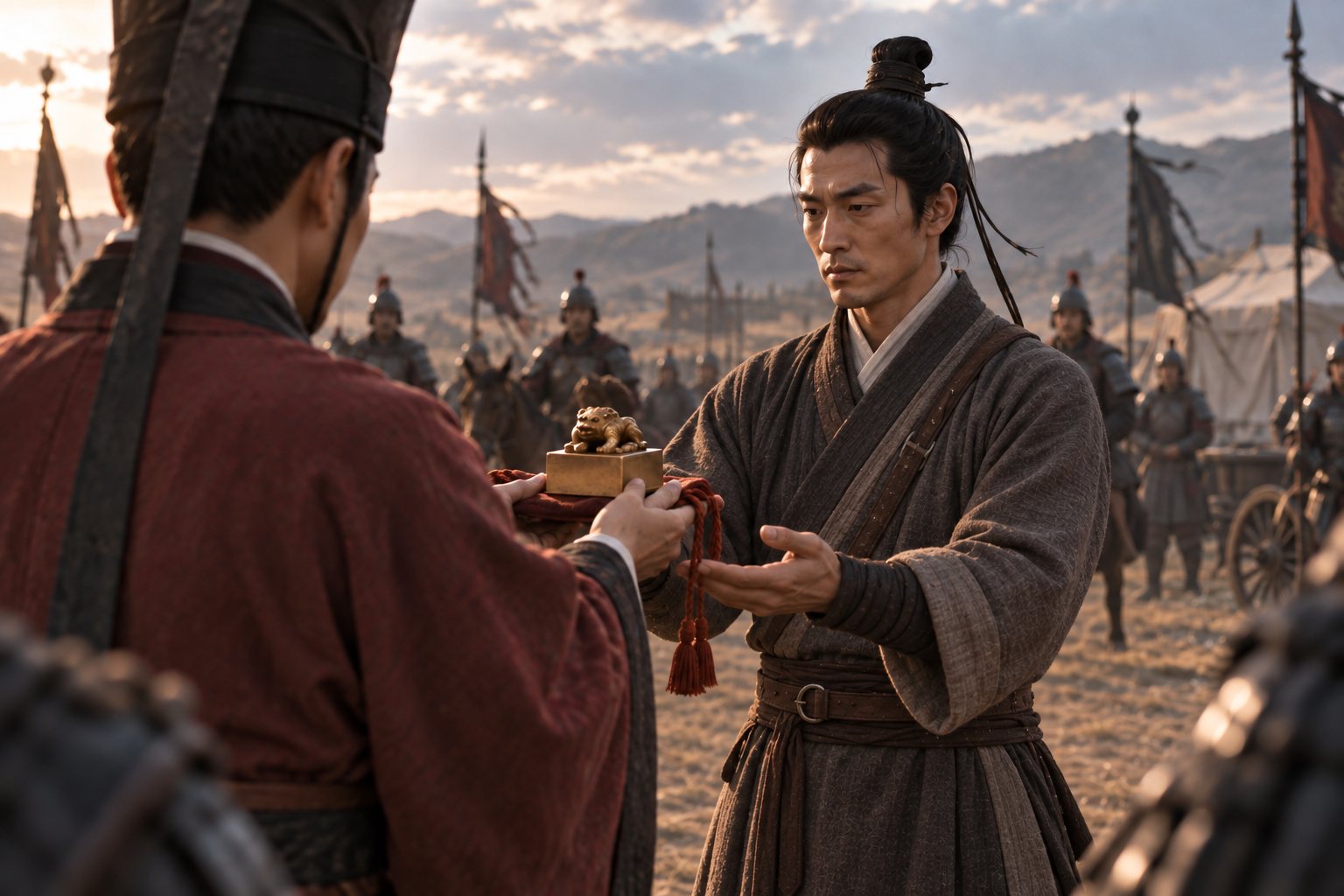
In the fifth year of Yuanshuo, Wei's army reached the camp of the Xiongnu Right Wise King by night. The Right Wise King escaped, but the Han took captives. As Wei returned to the frontier, an imperial messenger brought the seal of Grand General directly to the army. The other commanders were placed under him. It was a moment of institutional change as well as personal promotion. [1]
The emperor offered titles to Wei's three small sons. According to the *Shiji*, Wei objected that infants had earned no military merit and pointed to his officers' work. The emperor proceeded to reward those officers too. The exchange is preserved in a historical biography, not a recording of an exact conversation. Still, the issue it frames is clear: who receives credit when a large army wins? [1]
03 / 04
A defeated commander returns
The biography does not present an unbroken run of triumph. On another campaign, Su Jian and Zhao Xin led a smaller force into the Chanyu's main army. Zhao Xin defected; Su Jian lost his troops and returned alone. Wei's advisers disagreed. One argued that execution would show authority. Others noted that Su Jian had fought against a much larger force and that killing a man who came back could discourage any defeated commander from returning in the future. [1]
Wei did not make the final decision in the field. As the *Shiji* reports his answer, he needed no execution to prove his prestige and would not claim the power to settle the matter himself. He sent Su Jian to the emperor. Su Jian was pardoned and reduced to common status after redeeming his penalty. The precise speeches belong to Sima Qian's account; the decision in the narrative raises a practical question about military command: what authority should a general keep, and what should he return to the court? [1]
04 / 04
Beyond the desert
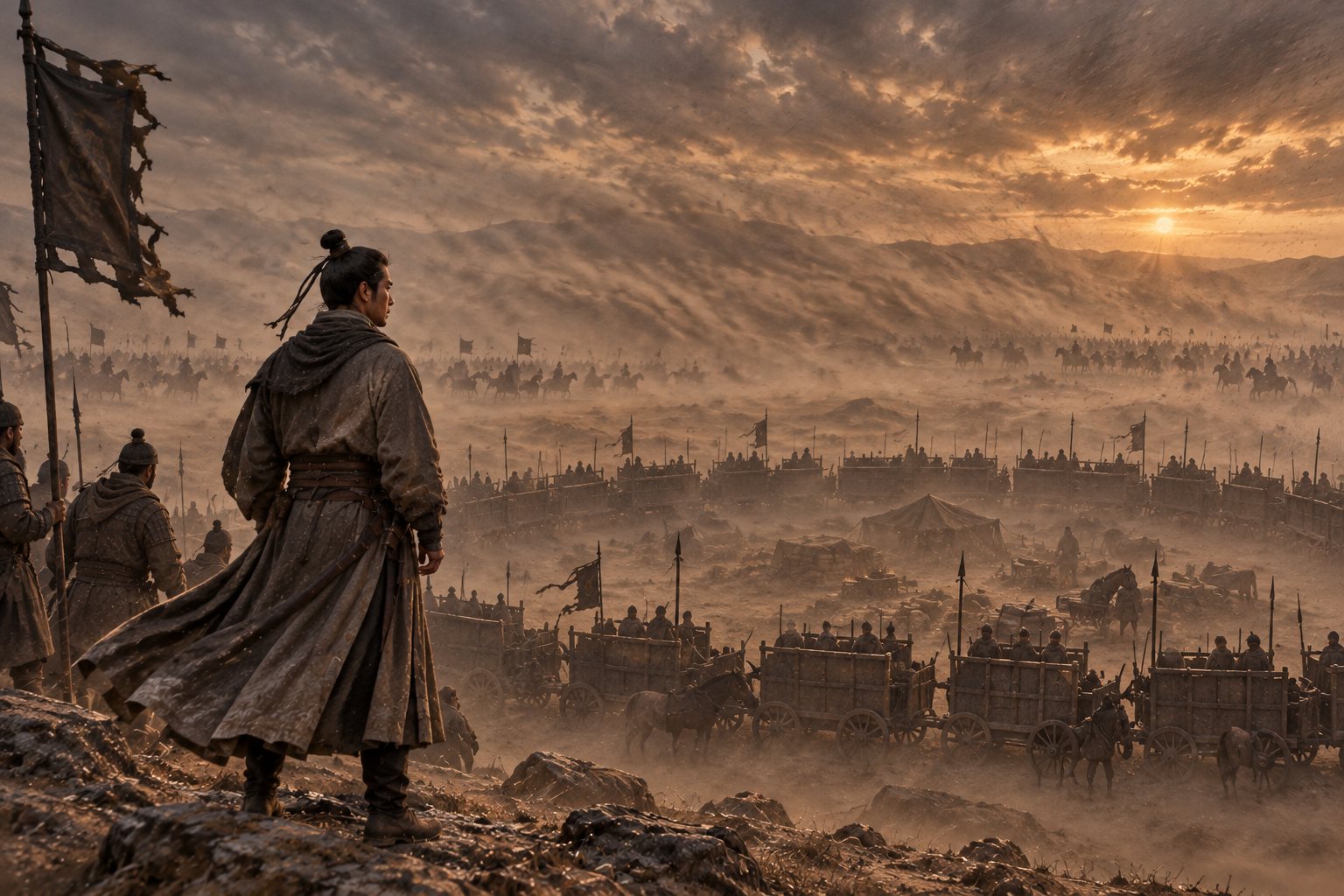
In the fourth year of Yuanshou, Wei Qing and his nephew Huo Qubing each commanded a large army. Their routes and opponents must be kept distinct. Wei's army crossed the desert and encountered the Chanyu. He arranged heavy wagons in a ring for a camp and sent five thousand cavalry forward. At sunset a wind drove sand into the combatants' faces, obscuring their view. The Han sent cavalry around both wings. The Chanyu escaped at night with a small escort. Wei's pursuit did not catch him. [1]
The text also records the difficulty hidden by the word “victory.” Li Guang's detached force lost its way and arrived too late. Li Guang later died by suicide amid the inquiry into his failure to join the battle. The *Shiji* reports that the two Han armies reviewed 140,000 government and privately owned horses before the expedition and that fewer than 30,000 returned. Those figures are ancient reports, not numbers we can audit by modern methods. They nevertheless keep the cost of campaigning in view. [1]
The court then created the rank of Grand Marshal for both Wei and Huo. Later the narrative says Huo's standing rose while Wei's receded. Wei died some years after Huo and received the posthumous name Marquis Lie. It does not supply a verifiable scene of Wei retiring through illness, serving as Grand Commandant in the capital, or directing a later Huo campaign from home. [1]
To tell Wei Qing's life only as a sequence of victories is to miss the people who made those victories possible and bore their costs. Gongsun Ao helped him early on. Su Jian built a frontier city and later returned from defeat. Officers fought under his command; Huo Qubing fought on a separate route. The history even pauses over Wei's decision to send one commander's fate back to the court. That is a more useful story than a heroic speech we cannot verify. [1]
The spoken version
Podcast transcript
Read the full podcast transcript
Storyteller: This is Eastward Stories. Today's story begins with a boy made to tend sheep and ends with one of the most powerful military offices of the Western Han. His name was Wei Qing. The story is also about the people and costs that disappear when we describe a life as a string of victories.
Guide: Western Han means roughly two thousand years ago. What source are we using?
Storyteller: Chiefly Sima Qian's Records of the Grand Historian, chapter 111. It is an ancient historical biography, close to the world it describes but still a crafted text. It preserves court reports and speeches, and it makes judgments. We can trace our claims to it. We cannot treat it like a camera placed at every battlefield.
Guide: What does it say about Wei's childhood?
Storyteller: That he belonged to the household of the Marquis of Pingyang, and that his father sent him to herd sheep. Later he served Princess Pingyang as a mounted attendant. His sister Wei Zifu entered the emperor's palace. Court politics drew the family closer to power, but also brought Wei danger: the biography says rivals had him seized, and his friend Gongsun Ao rescued him.
Guide: So the “humble boy becomes general” version misses the political network.
Storyteller: Exactly. It also misses that a connection could expose him before it helped him. Emperor Wu later called him into service. The biography offers no reliable window into every motive at court, so our story keeps to the sequence it reports.
Guide: When did Wei first command troops?
Storyteller: In a four-pronged Han campaign against the Xiongnu. Wei went out through Shanggu and reached a place the history calls Longcheng. He had a success; other commanders failed or suffered losses. That first result made him noticeable.
Guide: Can we say how he won? The particular formation, the dramatic moment?
Storyteller: No. The account is very brief. A painting can suggest an army on open ground, but a caption must not invent a battle plan. This is a recurring discipline for the series: dramatic images may be artistically useful, while the specific actions in them remain unverified.
Guide: What did his later campaign change on the map?
Storyteller: One campaign moved from Yunzhong toward Gaoque and took territory called “Henan” in the source. That means land south of the Yellow River's great northern bend, not the modern province named Henan. The Han set up Shuofang Commandery in that region. Wei received the title Marquis of Changping.
Guide: I have seen a sentence saying Wei built the frontier city himself.
Storyteller: The Shiji says his subordinate Su Jian was assigned to build Shuofang city. Wei led the campaign; Su Jian had the recorded building assignment. Confusing those two is a small-looking shortcut that erases the work of another person.
Guide: The title Grand General came later?
Storyteller: Yes. In the fifth year of Yuanshuo, Wei's force reached the Xiongnu Right Wise King's camp by night. The Right Wise King escaped; the Han took captives. As Wei returned to the border, an imperial messenger arrived with the seal of Grand General. Other commanders were placed under his command.
Guide: Why emphasize “Right” Wise King?
Storyteller: Because there were Left and Right titles in the Xiongnu hierarchy. Substituting one for the other changes whom the text says he faced. It is a useful reminder that even when an episode sounds familiar, the primary passage has to be checked.
Guide: The source also has an unusual scene about Wei's sons.
Storyteller: The emperor proposed giving titles to all three of Wei's young sons. According to Sima Qian, Wei said the boys were still infants and had not earned military merit. He pointed to the officers who had fought. The emperor proceeded to honor officers too.
Guide: Should we quote his answer as though someone recorded it in camp?
Storyteller: We should say the history presents him saying it. Ancient speeches can tell us how a historian understood character and power, even when their exact words cannot be independently confirmed. The question is still sharp: who receives a victory's reward when hundreds or thousands did the work?
Guide: Was his command always successful after that?
Storyteller: No. A smaller force led by Su Jian and Zhao Xin encountered the Chanyu's army. Zhao Xin defected. Su Jian lost his unit and came back alone. Wei's advisers disagreed about the punishment. One urged execution to display authority; others warned that killing a commander who returned after a hard fight would teach future defeated men not to come back.
Guide: What did Wei decide?
Storyteller: As the Shiji tells it, he refused to claim final authority over the man's life in the field. He sent Su Jian to the emperor. The emperor eventually pardoned Su Jian and reduced him to common status after a penalty. That is a moment of restraint within a violent military system, not proof that every one of Wei's choices was benevolent.
Guide: Now we reach the desert campaign, the one people often mix with Huo Qubing's.
Storyteller: In the fourth year of Yuanshou, Wei and his nephew Huo each led a major army, on separate routes. Wei encountered the Chanyu after crossing the desert. The source says he placed heavy wagons in a ring to make a camp and sent five thousand cavalry forward. Near sunset a wind blew sand into faces and obscured sight. Han cavalry moved around the wings. The Chanyu escaped at night with a small escort.
Guide: So Wei defeated the army but did not capture the Chanyu.
Storyteller: Correct. His forces pursued him and failed to catch him. Huo's operation was another campaign, not a second phase of Wei's personal fight. A map or illustration that merges the two armies would be misleading.
Guide: Did everyone under Wei reach the battle?
Storyteller: No. Li Guang's detached route got lost, and his force arrived too late. The inquiry that followed ended in Li Guang's suicide. Sima Qian includes this painful part of the story. If we remember only the number of enemies reported killed or captured, we lose the fracture among the Han commanders themselves.
Guide: The biography also gives a staggering number of horses lost.
Storyteller: It says the two armies had reviewed 140,000 government and private horses before leaving and that fewer than 30,000 returned. We cannot audit a Han campaign register today as if it were a modern spreadsheet, but even as an ancient report it directs attention to the scale of resources consumed. There were people, animals and supply systems behind every celebrated general.
Guide: What happened to Wei after that?
Storyteller: The court established the rank of Grand Marshal for both Wei and Huo. Later, Sima Qian says Huo became more favored while Wei's standing receded. Huo died young; Wei died some years later and received the posthumous name Marquis Lie. The source does not give us a verified retirement scene in which Wei directs Huo's army from the capital or announces a policy of peace.
Guide: Then what is the strongest image of Wei Qing's life?
Storyteller: For me, it is not one charge through the sand. It is the contrast between a seal brought to a victorious camp and a defeated officer sent back for judgment. Both moments show how military power was made, rewarded and limited. Wei's biography also keeps naming people around him: his rescuer Gongsun Ao, the builder and later defeated commander Su Jian, and his nephew Huo Qubing on a separate front.
Guide: The man becomes easier to understand when the other names remain in the frame.
Storyteller: There is another reason to keep those names. Sima Qian's chapter joins Wei Qing and Huo Qubing, yet it does not give them the same route or the same career. Wei's rise had already changed command at court before Huo's most famous campaigns. Huo was his nephew, but the historian still assigns each army its own movement. When a modern summary folds every northern victory into one family legend, it becomes almost impossible to see who actually went where.
Guide: And that matters even if we are telling a character story rather than drawing a military map.
Storyteller: It does. In the Mobei campaign the Shiji first explains a change of plan. The Han had intended a different placement for the two commanders, then intelligence about the Chanyu's position led the emperor to adjust their routes. This reminds us that ancient campaigns were contingent. The armies did not simply march toward an ending that later readers already know. They made choices with incomplete information, and the historical account itself is selective about what those commanders knew.
Guide: The sandstorm is a vivid part of the source. Why not make it the center of the episode?
Storyteller: It could be a powerful image, and we use one interpretive illustration. But if we linger only on weather and cavalry, we miss the less cinematic decisions around the battle. Wei made a ring of heavy wagons before sending cavalry out. After the Chanyu escaped, pursuit continued without capturing him. The detached force of Li Guang did not arrive on time. The final report therefore contains success, uncertainty, and an inquiry into failure. The sand does not erase the people whose stories became painful after the victory.
Guide: That sounds like the same care we used with Su Jian. His loss and return are in the record, but we do not know every thought behind Wei's choice.
Storyteller: Exactly. The advisers' debate about Su Jian is unusually revealing because the ancient text shows a disagreement over incentives. One position wanted a severe example. Another feared that executing a defeated commander would make future soldiers choose death or flight over returning to report. Wei sent the case to the emperor. It tells us how this source frames a command decision. It does not give us permission to turn Wei into a modern management hero with a tidy slogan about compassion.
Guide: And the Xiongnu should be more than a backdrop for his rise.
Storyteller: Absolutely. The biography is written from a Han perspective; it names Xiongnu offices and reports military encounters. We should not turn an entire polity into a faceless enemy in our telling. The Right Wise King and the Chanyu are different figures in different episodes. Their decisions matter in the source, even though we do not have their first-person accounts in this chapter. Saying that limitation aloud is more honest than filling the silence with invented speeches.
Guide: So what is the strongest image of Wei Qing's life now?
Storyteller: Still the contrast between a seal brought to a victorious camp and a defeated officer sent back for judgment. One image marks the expansion of a commander's power; the other shows a boundary on what he chose to decide in the field. Around both stand the people a victory list would omit: Gongsun Ao, Su Jian, Li Guang, Huo Qubing, the soldiers, and the horses. The Shiji is neither a modern documentary nor an invitation to invent what it omits. It gives us enough to tell a rich story if we resist making every scene a legend. You can read the full bilingual account and the exact source passage at Eastward Stories.
Research notes
Sources & adaptation
- Shiji 111, Biography of General Wei and the Champion Marquis
Wei Qing section: childhood, campaigns, rewards, Su Jian and Mobei.
What was adapted
- [*Shiji*, chapter 111, “Biography of General Wei and the Champion Marquis”](https://zh.wikisource.org/zh-hant/%E5%8F%B2%E8%A8%98/%E5%8D%B7111). This is an original English narrative, not a translation of the Hanqing article. Visual settings and faces are artistic representations. Ancient battle figures are reported as the source gives them.
Music credit
“At The End Of All Things” — Scott Buckley · CC BY 4.0。 Track details CC BY 4.0 license
Original Chinese feature: Read on WeChat