
Myths & Ideas · China / Han-era classical text
Nüwa Mends the Sky
女娲补天
Stones, a mythic turtle and reed ash answer a world coming apart.
Traditional retelling. Original retelling of an ancient text; source events and invented visualization are labeled in the story and captions.
Listen to the story
Take the audio path
The episode will try to begin when the page opens. Browser settings may require you to press Play.
The two voices are AI generated from an edited dialogue script. Music credit appears below.
The illustrated story
Read the story
Follow the full English narrative, with scenes placed alongside the passages they illustrate.
01 / 05
When the world would not hold
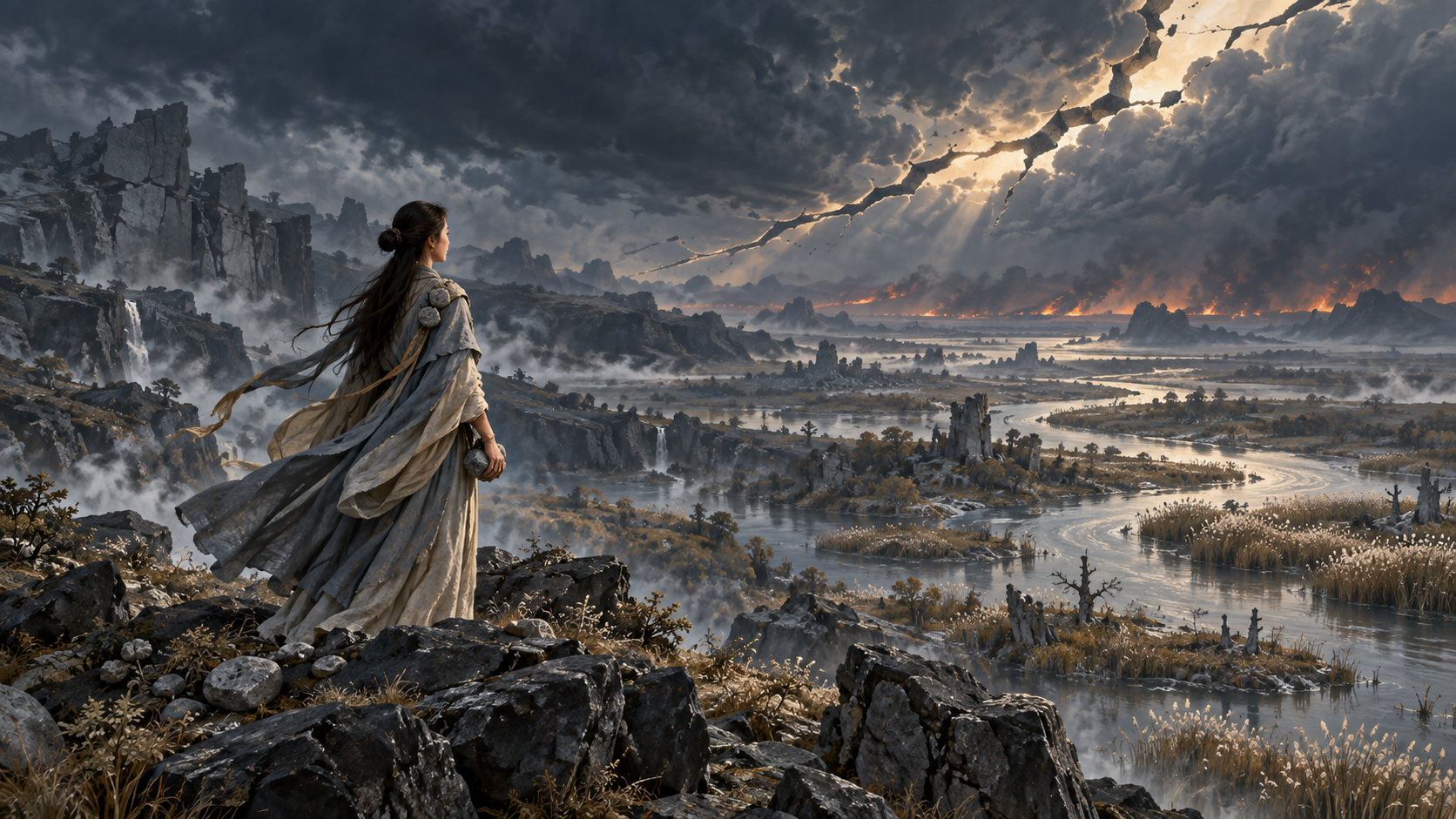
An old Chinese text begins with a world that can no longer support itself. Its four extremities have failed. The land has split. The sky no longer covers everything beneath it, and the earth no longer carries what stands upon it. Fire burns without stopping. Water spreads without finding an edge. Fierce creatures threaten ordinary people; predatory birds seize the vulnerable. The passage does not give us a date, a map or a single village. It gives us the terrifying idea of a world whose protections have come apart. [1]
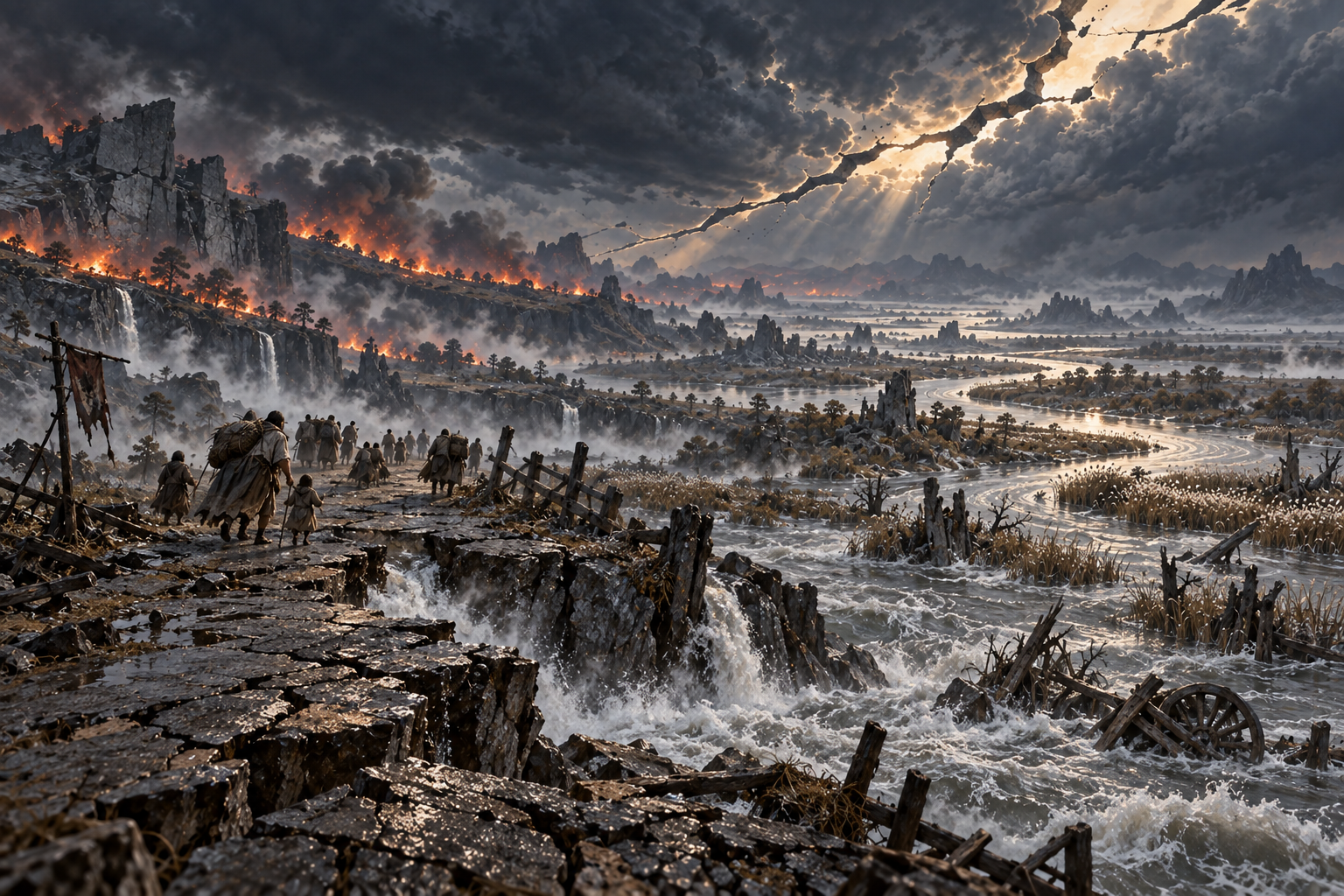
In our illustration, a road disappears under floodwater while flames remain on the far ridge. That road is invented. It gives a human scale to the old text's paired disasters of fire and water. No one in this version calls the disaster a battle that a single weapon can win. The problem reaches from the ground to the sky. [1]
02 / 05
Stones for the sky
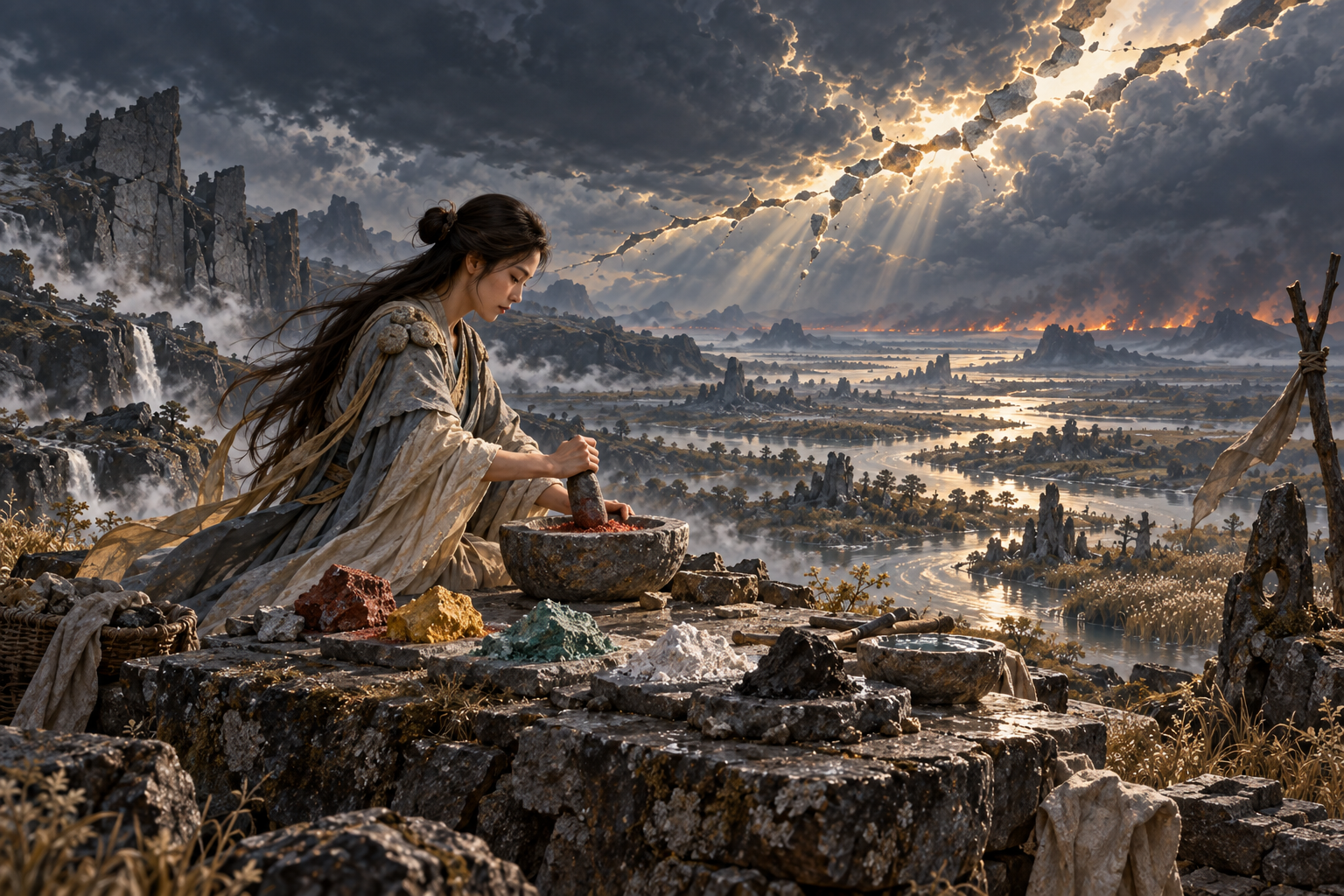
Nüwa answers by mending what has broken above. She refines five-colored stones and uses them to repair the blue sky. The sentence in Huainanzi is brief and exact about the act. It does not tell us where she found the stones, what furnace she used, or which five colors a painter should put on the page. The mineral colors and the place where we show her working belong to our visual interpretation. [1]
03 / 05
Four directions to hold
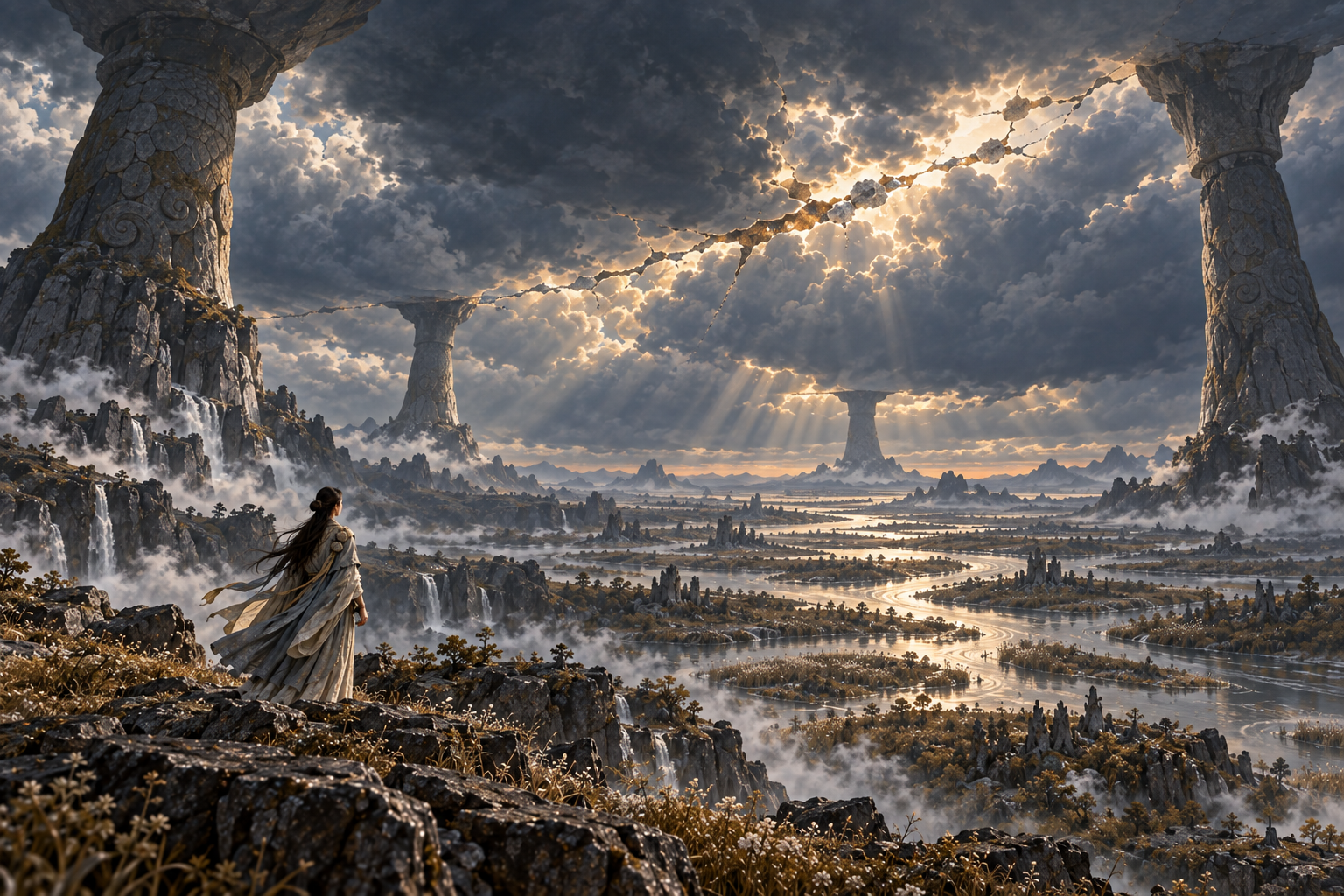
Repairing the sky is only one part of the work. The four extremities need support again. Nüwa cuts the legs of an ao, a huge turtle of myth, and sets them beneath the four directions. The text does not describe a conversation with the creature or explain its history. We leave those imagined scenes out. The image should show the vast scale of the supports without asking the reader to mistake a mythic figure for an animal known to zoology. [1]
04 / 05
The work below
The passage then turns back toward the lives in danger. Nüwa kills a black dragon to bring relief to Ji Province. She piles up reed ash to stop the overflowing water. Those two actions are in the source. A river valley, the movement of workers and the precise way the flood recedes are not. In our story, the camera follows the waterline rather than inventing a speech for Nüwa. [1]
The ending is quieter than the beginning. The sky is mended; the four supports stand; the flood drains; the afflicted place becomes calm. People survive. We picture exposed ground with watermarks still visible. There may be footsteps near the shore, but the old text does not supply their names. Its concern is the return of a world that can once again hold life. [1]
The passage goes on to say that Nüwa does not display her achievement or proclaim her name. We keep that restraint in the final scene: no triumphal monument, only land becoming usable again. [1]
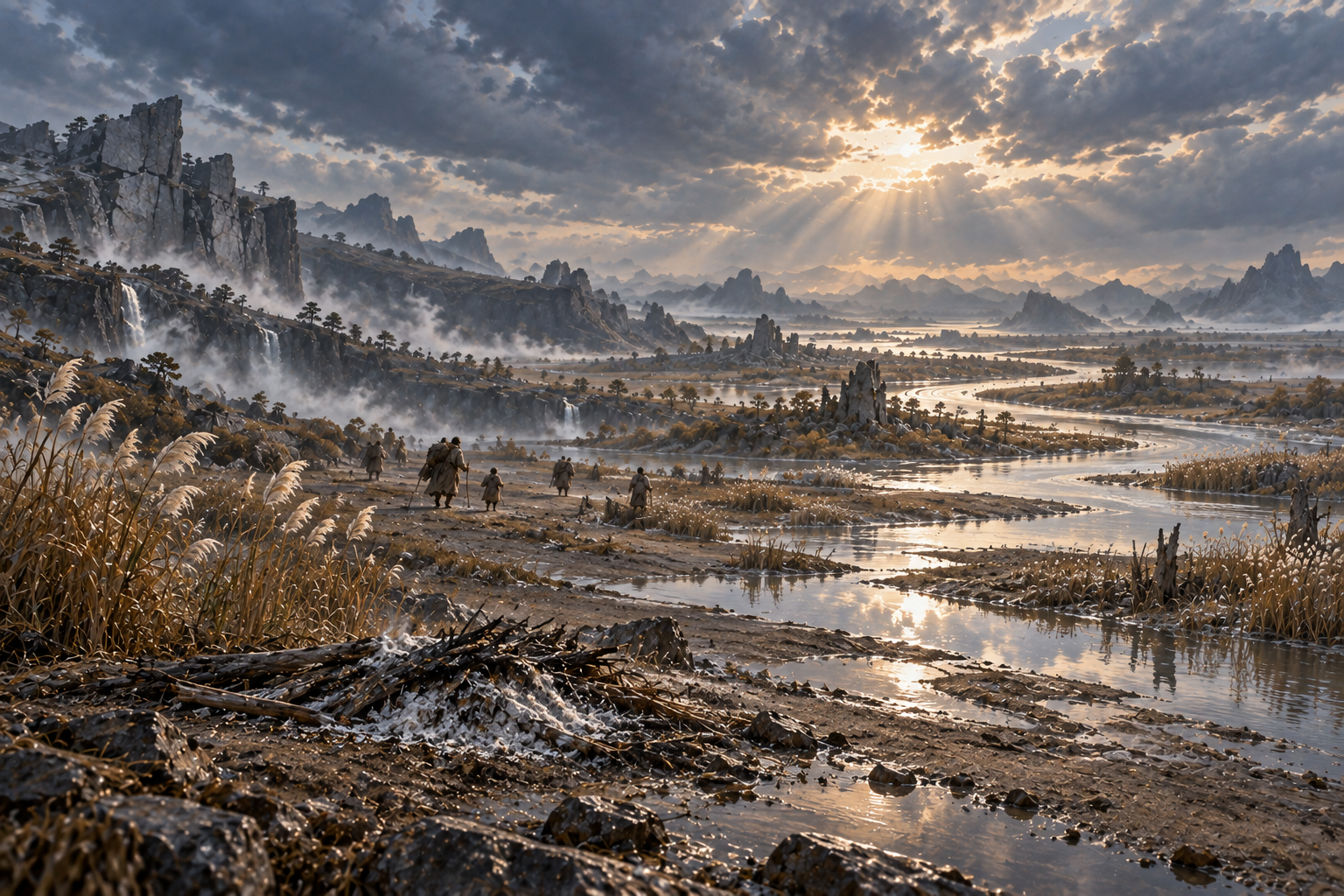
05 / 05
After the waters
Nüwa's repair moves from sky to ground. The five-colored stones close a breach overhead. The turtle's legs steady the four directions. The black dragon and reed ash answer dangers closer to home. We need not treat these actions as a recoverable engineering project to understand the story. Its scale lets an ancient writer imagine what it would take to make a damaged world livable again.
The spoken version
Podcast transcript
Read the full podcast transcript
Storyteller: Welcome to Eastward Stories. Today we are telling a story about repair. Not a broken cup or a damaged house, but a world that can no longer hold itself together. In an old Chinese text, Nüwa takes up the work of mending the sky.
Guide: I know the name, but mostly from pictures. Is there one fixed ancient version of this story?
Storyteller: There are traditions that differ. For this episode our anchor is a particular passage in the Huainanzi, in the chapter called “Surveying the Obscure,” or Lanming xun. We will follow the actions it actually names, then make it clear where our own staging begins.
Guide: What does that passage say has gone wrong?
Storyteller: It begins on an immense scale. The four extremities fail; the land splits. The sky can no longer cover everything below, and the earth can no longer carry everything upon it. Fire burns without stopping, and water spreads without stopping. Fierce beasts attack people. Predatory birds seize the old and the weak.
Guide: That sounds less like one catastrophe and more like all the protections of life failing at once.
Storyteller: Exactly. The text does not give us a date, a district map or a family whose farm was flooded. It gives us a world in which there is nowhere dependable to stand. For the illustrated story we imagine a road cut by water, with a line of fire far away. That road and that viewpoint are ours. The paired danger of fire and flood is in the source.
Guide: People often tell me a god called Gonggong struck Mount Buzhou and broke the sky. Is that part of this passage?
Storyteller: No. That is a familiar association from other accounts and later retellings. The Huainanzi passage we are using starts with damage already present. It does not say in these lines that Gonggong caused it. We are keeping that distinction visible, especially because a vivid cause can easily feel as if it came from the same ancient sentence.
Guide: So what does Nüwa do first?
Storyteller: She refines five-colored stones and mends the blue sky. The old line is compressed: it gives the material and the act but no quarry, furnace design or precise color list. A film or picture needs to choose those details, yet the choice remains a visual invention. We can show mineral light across a cracked canopy without pretending anyone recovered a blueprint for heaven.
Guide: Why stones? Could the five colors have a symbolic meaning?
Storyteller: Readers can explore that question, and later interpreters do. For this episode, our source only requires us to say that the stones are five-colored and that Nüwa refines them to repair the sky. We should resist giving a confident explanation for every color where the passage does not supply one. The mystery is part of the old story's scale.
Guide: Does a mended sky settle everything?
Storyteller: It does not. Nüwa cuts the legs of a giant mythical turtle, an ao, and uses them to establish the four extremities. Think of the movement of the story: first close the breach above, then steady the world at its edges. That is a way to hear the ancient sequence, not an engineering diagram.
Guide: The turtle part is striking. Does the text tell us what the creature says, or why it is there?
Storyteller: It does not. We will not invent a dialogue and then make it sound like a recovered legend. The figure belongs to mythic scale. In the pictures, the supports may be enormous and partly obscured, but there should be exactly four directional supports, and the visual note will say this is our interpretation.
Guide: Then the story turns back toward people on the ground?
Storyteller: Yes. The passage says Nüwa kills a black dragon to bring relief to Ji Province. It then says she piles reed ash to stop the overflowing water. Those actions can surprise a reader who expects only the famous stone. Here the sky, the four directions, a threatening creature and the flood are linked as parts of one repair.
Guide: Is the black dragon an enemy we should picture in a long battle?
Storyteller: The source names the action but does not narrate a long duel. We can show the threat at a distance and the land it endangers. We should not turn an unwritten combat scene into an alleged passage of the Huainanzi. The same applies to the reed ash. The text says it stops the water; it does not describe a team, a dam design or a named riverbank.
Guide: The ash is a very earthly material after all those immense cosmic images.
Storyteller: That contrast is one reason the story stays with me. Five-colored stones for the sky, a mythic turtle for the supports, and then reeds burned to ash near the flood. But that response is ours. The text itself moves through the actions briskly and reports that the sky is mended, the four extremities restored and the waters drained.
Guide: Does it say what happens to the people?
Storyteller: Yes. The account says the afflicted place is pacified and ordinary people survive. It does not provide portraits of survivors. Our final illustration may show someone stepping onto newly exposed ground. That figure is a human-scale ending we add, not a person named in the record.
Guide: The old account continues after that, doesn't it? Is there more than the list of repairs?
Storyteller: There is. After describing the world restored, the passage widens into an account of harmony. Fierce animals quiet their claws and venom. Nüwa's achievement reaches from the highest heaven down toward the deep earth. Then the text says she does not display her merit or broadcast her name. That matters because the passage is not merely counting spectacular acts. It asks what restoration feels like when the work has succeeded so thoroughly that life can move again without needing to keep pointing at its rescuer.
Guide: I had expected a scene of everyone cheering for her.
Storyteller: A modern film might end with that scene. The ancient passage makes a different choice. It reports the people surviving and a world at peace, then it lets Nüwa's work recede into the order of things. We can still be moved by her action; we do not have to invent a public ceremony that the source never describes. Our final frame therefore stays low, by the wet ground, instead of raising a monument.
Guide: How should someone outside China understand “four extremities”? It sounds like four pillars in a building.
Storyteller: “Four extremities” names the world's fourfold support in the passage. Our four visible supports are one visual way of making that cosmological language legible. They are not columns with measured height or located on a map. A reader can let the picture work as myth and still read the older phrase as a phrase, with its own strangeness intact. That is why we put the original Chinese link on the page.
Guide: And “five-colored” should be heard in that same careful way?
Storyteller: Yes. The sentence gives five-colored stones, not a painter's inventory. We show five distinguishable mineral tones so a viewer knows what the words refer to. We do not claim our exact red, ochre, green, pale and dark tones were prescribed by Huainanzi. It is a small editorial habit, but these habits matter when a visual story can feel more authoritative than the few lines it adapts.
Guide: Does the black dragon belong to the same source, or is that an extra dramatic creature added by storytellers?
Storyteller: It is in the same Huainanzi sequence. The text says Nüwa kills a black dragon to relieve Ji Province. Yet it gives no extended battle. We mention the action and do not build a five-minute duel from nothing. Likewise the reed ash is not a modern flood-control recipe. It belongs to a mythic account of bringing waters under control.
Guide: So the source is both vivid and remarkably spare.
Storyteller: Exactly. Its spareness is why we need notes next to the images. A camera can show a ridge, a hand lifting stone, four supports and a wet shore, but every one of those choices goes further than the ancient sentence. The source gives the actions and their sequence. Our page lets readers hear the story, see one coherent imagined world and still find the boundary between the two.
Guide: I appreciate that distinction. My mind wants the faces and the small choices, while the text gives a much bigger view.
Storyteller: That is exactly where adaptation has to be honest. We can tell a gripping story without asking the old passage to certify every camera angle, costume and emotion. We can place a figure on a shore and still say, plainly, that the figure is ours.
Guide: Is Nüwa being presented as a historical ruler here?
Storyteller: No. This is a myth in an ancient philosophical work. It tells us about a powerful way people imagined order, danger and restoration. It is not evidence that a stone workshop literally repaired the atmosphere, and the illustrations should not look like a documentary reconstruction of a dated event.
Guide: And the name? For English listeners, how should we hear it?
Storyteller: Nüwa. The first syllable carries a rising tone in Mandarin. Our spoken English uses a clear pronunciation and then lets the story move naturally. The written page gives the Chinese characters, 女娲, and links to the Chinese original so curious listeners can explore further.
Guide: The final image you described is quiet. No victory parade?
Storyteller: None is needed. Imagine a river leaving marks on the earth as it draws back. The sky holds. The road can be used again. People have a place to stand. The ancient text ends its core account with order and survival; our camera rests on those consequences.
Guide: So if someone remembers just one thing, should it be the colored stones?
Storyteller: Remember the whole sequence. Nüwa mends what is broken above, steadies the four directions, addresses a threat below and stops the flood. That sequence is what makes the story more than a beautiful image of light in the sky.
Guide: Where can listeners check what is ancient and what you added?
Storyteller: The Eastward Stories page has the independent English and Chinese stories, the transcript, a link to Huainanzi, and a short adaptation note. The road, work site, colors and shore are our creative choices. The five-colored stones, turtle's legs, black dragon and reed ash come from the old passage.
Guide: Then the ending is not simply “everything returns to the way it was.”
Storyteller: Right. The text says the world becomes livable again. It has passed through damage. We leave the watermarks visible in our final picture, because repair is easier to understand when the memory of the break has not been painted away. Thank you for listening to Eastward Stories.
Research notes
Sources & adaptation
- Huainanzi, Lanming xun, Chinese original
Broken world, five-colored stones, ao legs, black dragon, reed ash and restored life.
What was adapted
- The Huainanzi passage supplies the sequence: five-colored stones, ao legs, black dragon, reed ash and restoration.
- The road, work site, exact colors and shore are invented. The passage does not name Gonggong as the cause.
Music credit
“Meanwhile” — Scott Buckley · CC BY 4.0。 Track details CC BY 4.0 license