
Classics & Literature · China / Western Han text
The Horse That Came Back
塞翁失马
One lost horse begins a chain no one can judge at first sight.
Traditional retelling. Newly written from the cited Chinese source. The image sequence is AI-generated illustration; all unsupported locations, appearances and gestures are artistic interpretation.
Listen to the story
Take the audio path
The episode will try to begin when the page opens. Browser settings may require you to press Play.
The two voices are AI generated from an edited dialogue script. Music credit appears below.
The illustrated story
Read the story
Follow the full English narrative, with scenes placed alongside the passages they illustrate.
01 / 04
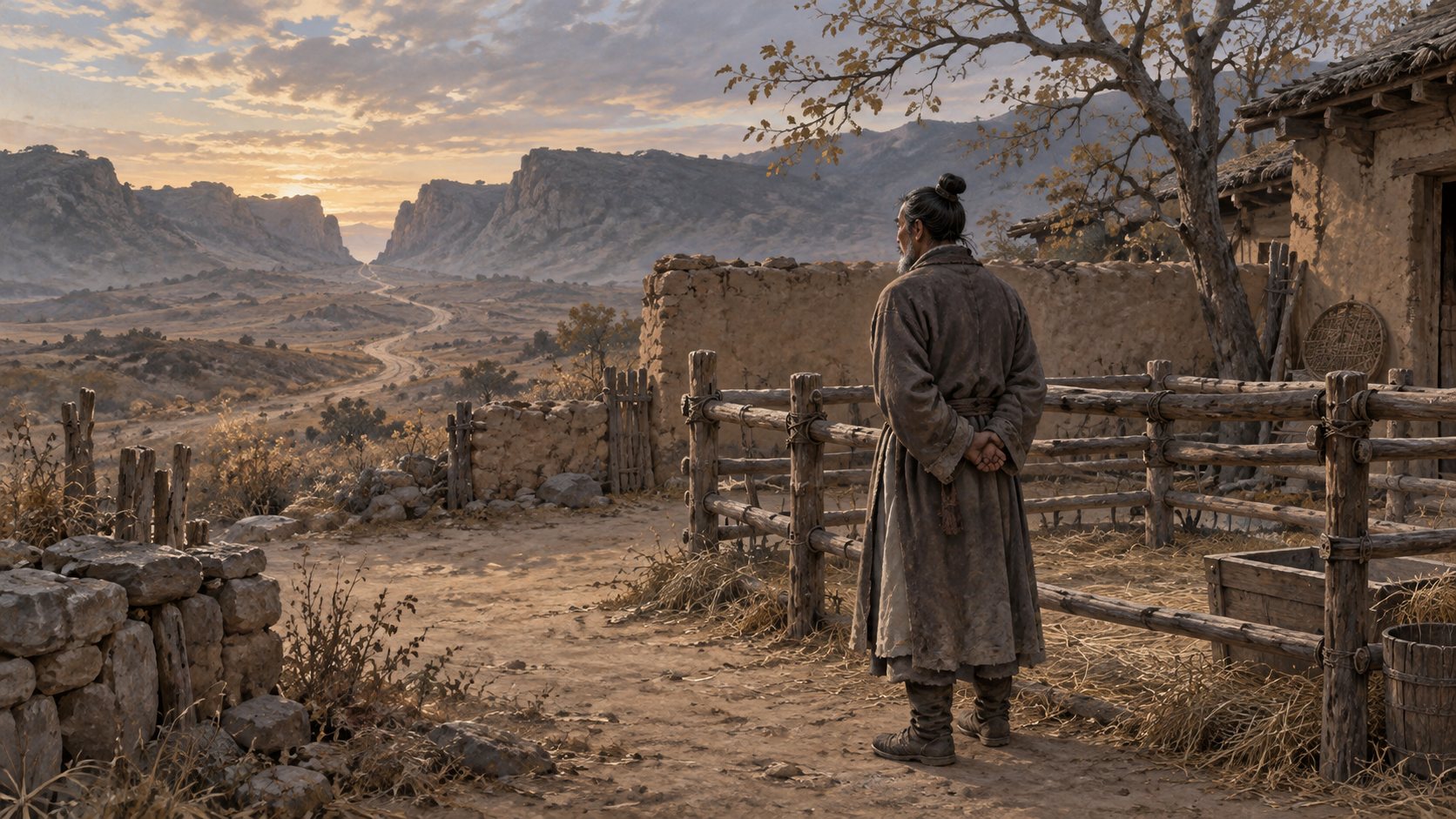
A horse beyond the border
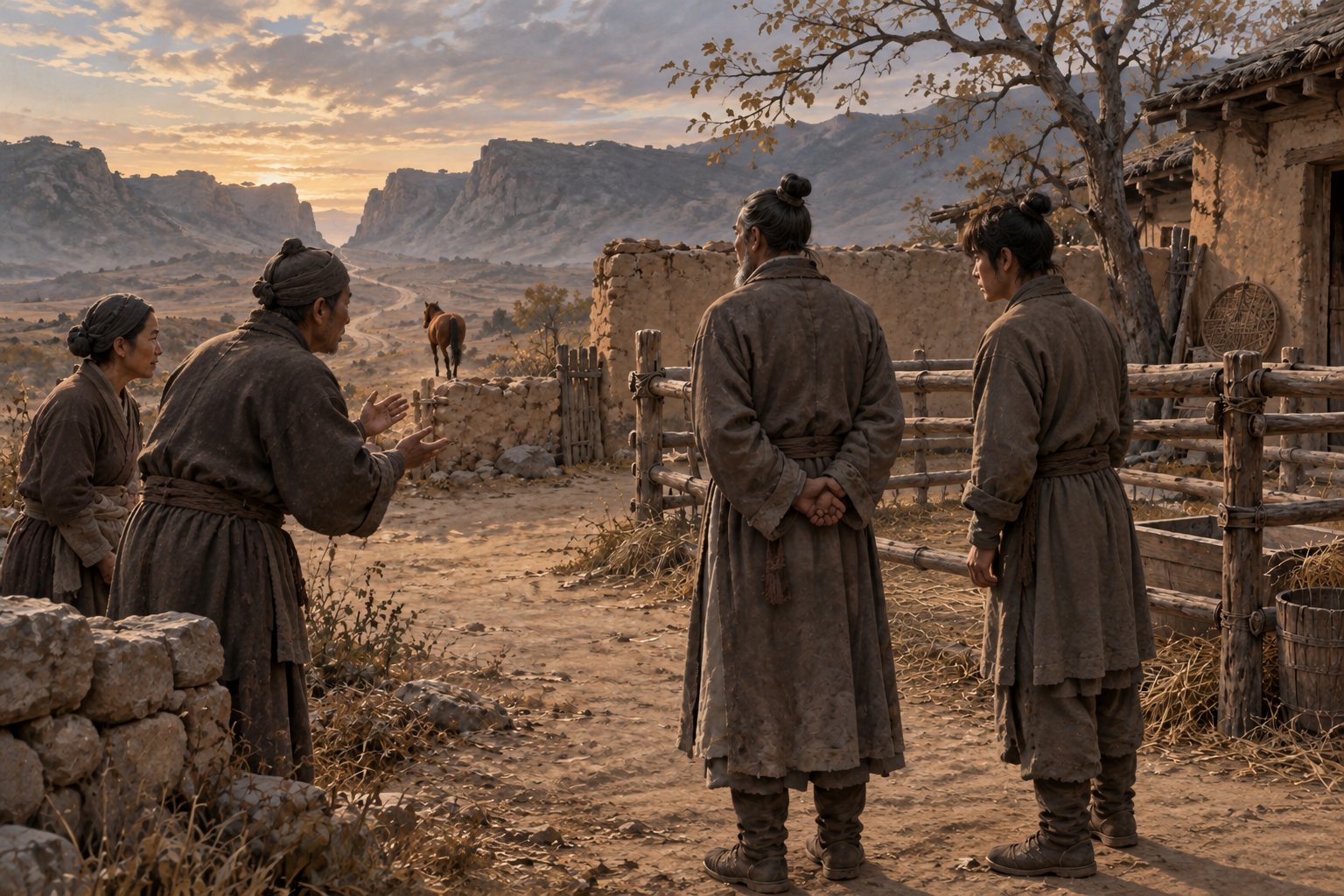
A man who lived near the frontier lost a horse. It strayed across the border into lands beyond the settled line. Neighbors came to console him. A horse was valuable; its loss seemed plain enough. The man asked how anyone could be certain the loss would not prove fortunate. [1]
The ancient passage gives us no stable, no color for the horse, and no map. We can imagine dust settling on an empty track, but that track is ours. The neighbors' concern is understandable. The man's reply is not a prediction that his horse will return. It is a refusal to turn one moment into a verdict on everything that may follow. [1]
02 / 04
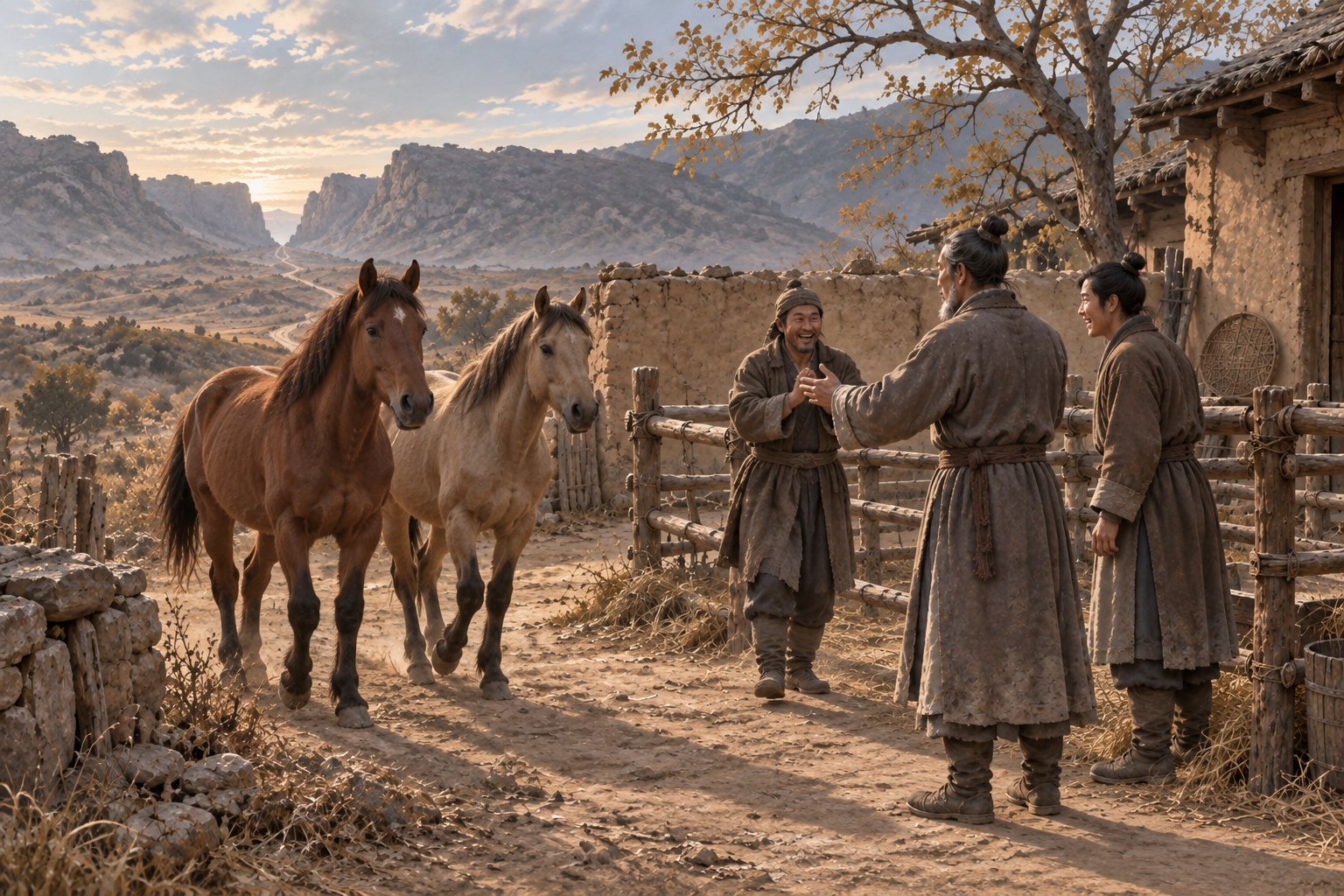
A second horse
Months passed. Then the missing horse returned, bringing a fine horse from beyond the border. The neighbors offered congratulations. Now the household had more horses than before. Once again the man asked how anyone could know that this apparent good fortune would not lead to harm. [1]
Nothing in his response cancels the pleasure of seeing a lost animal return. He can acknowledge what has happened without claiming to know where it leads. That distinction gives the story its rhythm: an event is real; the final meaning assigned to it remains uncertain. [1]
03 / 04
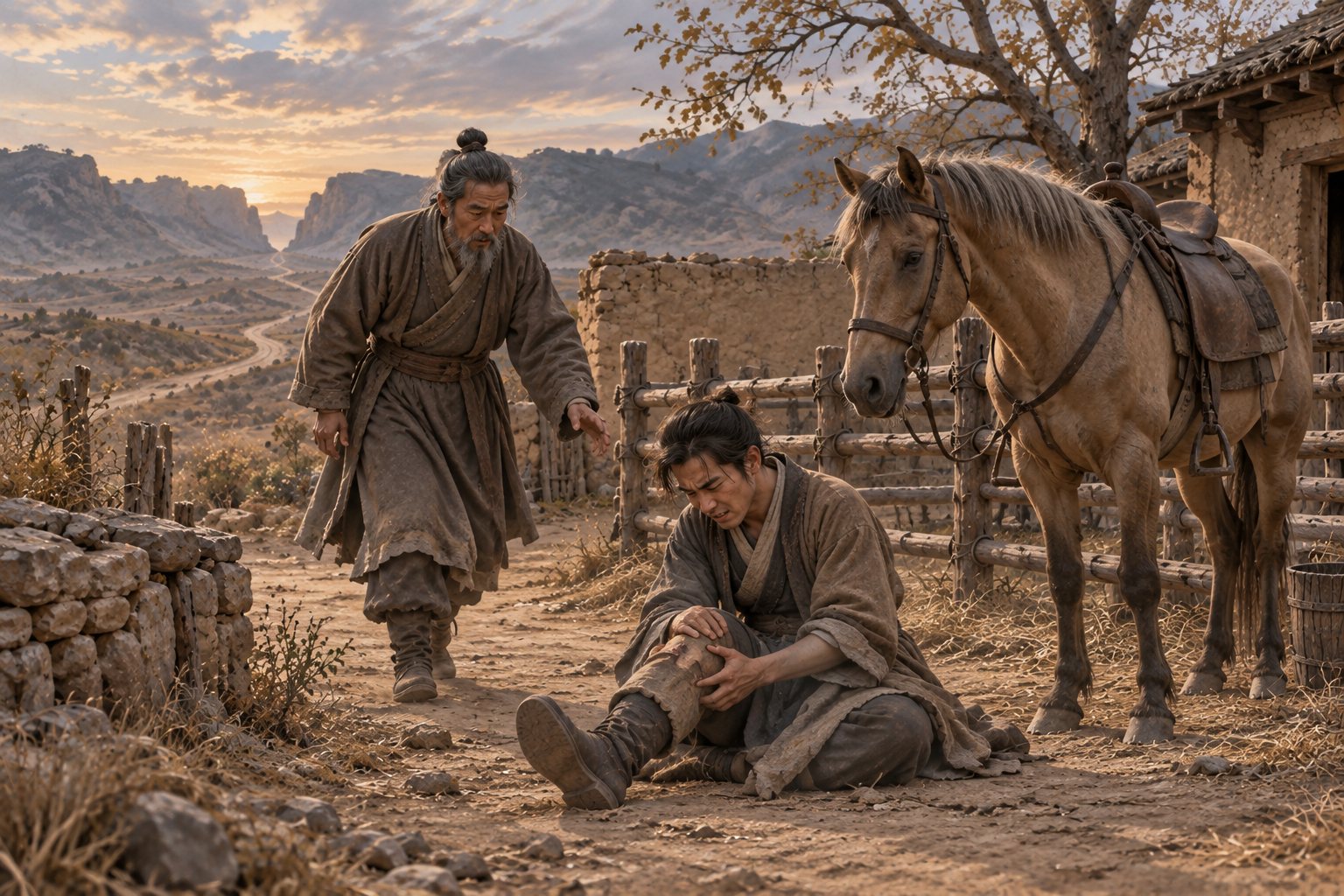
The fall
The family had good horses, and the man's son enjoyed riding. He fell and broke his thigh. The neighbors came back with sympathy. The father asked whether this misfortune, too, might be connected to something they could not yet see. The injury was not an abstract lesson for the son. He had a broken leg. The tale never asks us to call pain a prize. [1]
04 / 04
When the border changed
A year later, forces from beyond the border entered in strength. Able-bodied young men took up bows to fight. Many died. The son could not fight because of his injured leg. Father and son survived together. [1]
The source ends by reflecting on how fortune and misfortune can change into one another, beyond easy calculation. That ending is often flattened into a slogan: every bad thing is secretly good. But the tale is more cautious. The lost horse did not erase the broken bone. The son's survival did not undo the deaths of other families. At each turn, the neighbors reacted to what they could see, while the father resisted treating an unfinished chain as complete. [1]
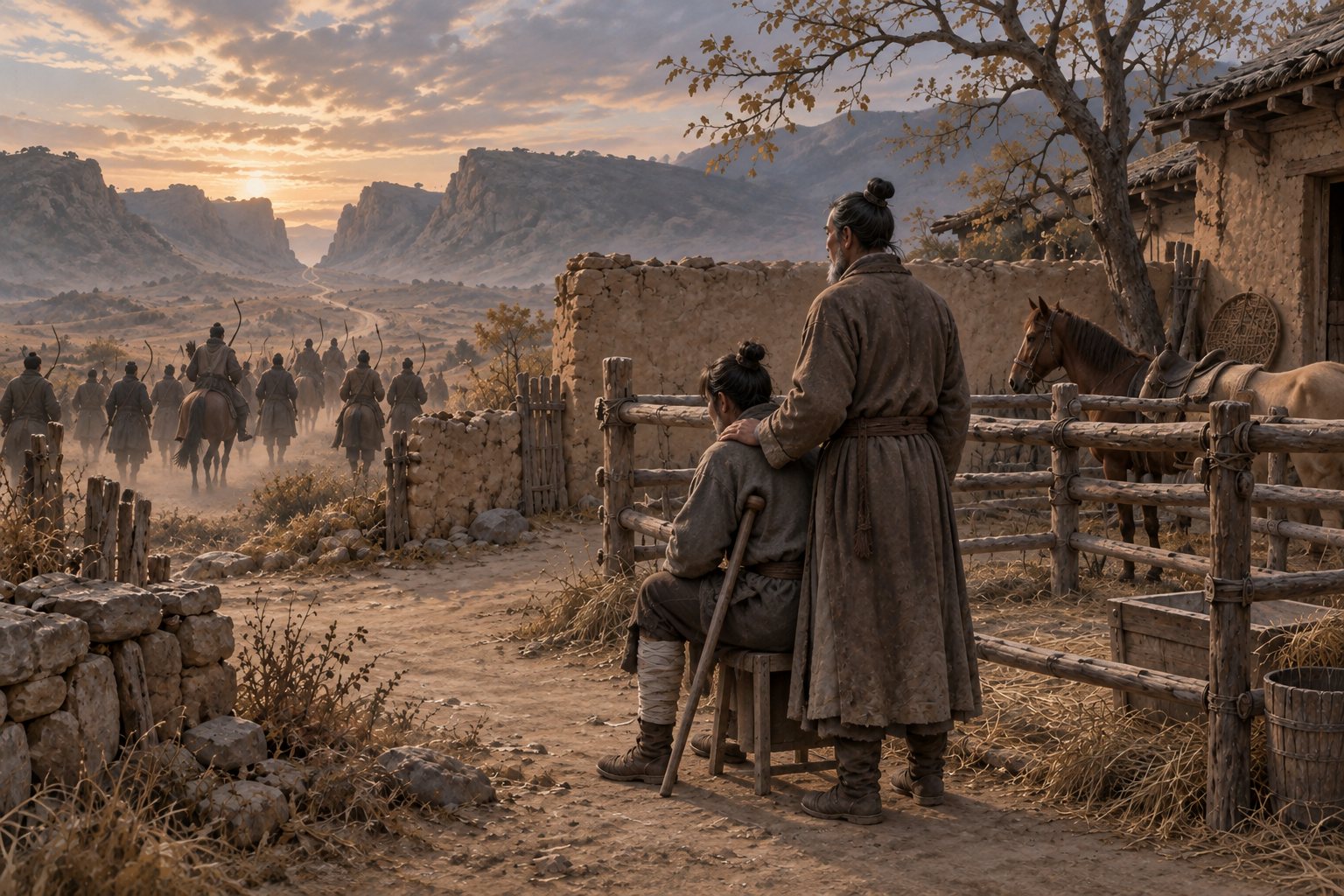
We do not know what happened to the family afterward. The text stops at their survival. In our imagined final view, the horses are still at home and the border is quiet for a moment. That picture does not promise lasting safety. It gives the story back its open edge: an event can be named without pretending we already know its last consequence. [1]
The spoken version
Podcast transcript
Read the full podcast transcript
Storyteller: Welcome to Eastward Stories. A horse disappears across a frontier. Neighbors call it a disaster. Months later it returns with another horse. They call it wonderful. An older man, standing in the middle of both judgments, asks how anyone can be so sure. Today we follow the whole chain, not just the proverb at its beginning.
Guide: I know this as “Sai Weng loses his horse.” Is Sai Weng the man's actual name?
Storyteller: No personal name appears in the passage. It describes someone living near the border who was skilled at understanding events. The compact phrase “Sai Weng loses his horse” became the familiar name of the tale. Our source is the “Renjianxun” chapter of the Huainanzi. It is an instructive story about how fortune and misfortune can turn into one another, not a report about an identified family and battle.
Guide: Why does the border matter? Could we tell the same story in any village?
Storyteller: The border is part of the chain. The horse strays into lands beyond it. Later a horse returns from there. Finally an invasion reaches the people living nearby. The text does not identify the crossing, tribe, or military campaign, and neither will we. In our illustrations we can show an imagined gate and a track, but we cannot label them as a real site.
Guide: Start with the loss. What do the neighbors do?
Storyteller: They come to console the man. That response is ordinary and kind. A horse meant mobility and value. The old man asks, in effect, “How do you know this will not become fortunate?” He does not announce that he has seen the future. He does not say the horse is already safe. He challenges the certainty of the verdict.
Guide: If I were the neighbor, I might think he was avoiding his feelings.
Storyteller: That is a possible human reaction, but the source does not describe his private feelings. We should not turn him into a cheerful prophet. The horse really is gone. The first event has a cost. What he resists is calling that cost the last word. Imagine an empty place in a small enclosure; that image is ours, not a detail in the text.
Guide: How long before anything changes?
Storyteller: Several months. The horse comes back and brings a fine horse from outside the frontier. Neighbors return, now to congratulate him. The household has more horses than before. The man asks the opposite question: how can they know this gain will not lead to harm?
Guide: That can sound as though he refuses to enjoy anything.
Storyteller: The passage never says he refuses joy. It shows him refusing to confuse a present benefit with a guaranteed future. You can welcome a returned horse and still know that tomorrow is unwritten. The neighbors are not villains; each time they respond to the piece of the story they can see. The father keeps the sentence open.
Guide: Then the second horse matters because the son likes riding?
Storyteller: The family has good horses, and the son enjoys riding. He falls and breaks his thigh. The text is plain about the injury. The neighbors come to comfort the family again. The father again asks whether this apparent misfortune might lead somewhere they do not yet see.
Guide: Let us pause there. I do not want a broken leg turned into a motivational poster.
Storyteller: Nor should it be. Pain is pain. An injured person needs care. The story does not tell us the son was glad, or that he was meant to fall, or that every fracture becomes a blessing. It stages a question about knowledge across time. That question becomes sharper precisely because the injury is real.
Guide: What happens a year later?
Storyteller: Forces from beyond the frontier invade. Able-bodied men take up bows to fight. Many of the young men near the border die. The son cannot fight because of his injured leg, so he and his father survive together. That is the fourth turn. The original passage then reflects that fortune can become misfortune and misfortune fortune, in ways hard to measure.
Guide: The son's survival is good. But the battle is devastating for everyone else.
Storyteller: Exactly. It would be cruel to say the earlier accident made the war “good.” Nor does the war make the lost horse a desirable plan. Our retelling should never promise that every bad event is secretly an advantage. The tale shows why immediate labels may not survive later events. It does not supply a formula for turning other people's suffering into a lesson.
Guide: There is also a difference between looking back and knowing in advance.
Storyteller: Yes. After the invasion, we can trace a chain: losing one horse, gaining another, a riding accident, a son unable to go to battle. But at the first moment the man could not see all of it. His repeated question is cautious precisely because he does not pretend to know. A viewer who knows the ending can become overconfident in a different way, imagining every earlier step had a fixed meaning all along.
Guide: How will the pictures handle that? Four turns could become four illustrations that tell the audience what to think.
Storyteller: We can give each turn its own frame while keeping the same home, father, son, and horses. The first picture leaves the enclosure empty. The second shows two horses arriving. The third shows the consequence of a fall without graphic injury. The last shows a distant mobilization and the son remaining behind. We will not invent a named army, recognizable uniform, exact date, or military victory. The visual continuity helps the audience follow the sequence without turning an imagined frontier into a false map.
Guide: Does the source actually call the man “old”?
Storyteller: The tale uses “father” in the responses, and the later shorthand suggests an elder, but it does not give an age. Our illustration can present a mature parent, not a precisely dated portrait. Likewise, we should not claim the fine horse was a particular modern breed. The story does not need those details to work.
Guide: What should someone take away at the final moment?
Storyteller: Perhaps a question rather than a rule. We can say the horse was lost. We can say the son was hurt. We can say the family survived. All are true within the tale. What we cannot know from the first event is the whole future. The source ends at survival; it gives no account of what happened the next year. Our story stops there too.
Guide: I want to go back to that second turn. Why does the arrival of a fine horse not count as a simple happy ending?
Storyteller: Because the passage lets it be good news only for a moment. The people congratulate the family, and the father again asks how anyone can know whether it will turn into trouble. The young man loves riding, falls, and breaks his leg. We should not pretend the father foresaw that exact fall. His question expresses uncertainty, not a secret ability to predict each event. If we make him a prophet, the tale becomes much easier and much less interesting than the source.
Guide: And the later war does not make the broken leg painless.
Storyteller: Right. The source says many able-bodied young men near the frontier went to fight and many died. The injured son survives because he cannot go. That result does not erase his injury or the grief of other households. When adapting this story, it would be careless to call the accident a blessing without acknowledging its immediate cost. The text holds the turns together without asking us to enjoy anyone's suffering.
Guide: People often quote the proverb as if every bad thing is guaranteed to become good. Does the old passage promise that?
Storyteller: No. It offers a sequence in which the judgment attached to an event keeps changing as later events arrive. We can observe this one sequence. We cannot infer that every loss in every life will pay off. At the end the source records the father and son surviving the crisis. It does not say that the whole frontier was made safe, that the horse returned the dead, or that their future contained no more harm.
Guide: The story seems very interested in the words people say to one another.
Storyteller: Yes. The neighbors offer consolation after the loss, congratulations after the return, consolation after the injury, and finally the story records a reversal in who lives. Each social response makes sense at its moment. The father refuses to turn that momentary response into final knowledge. Our dialogue gives the neighbors no invented speeches beyond the social pattern in the source. Their changing reactions matter more than their names, faces, or precise words.
Guide: What about the horses? The first leaves, then comes back with a fine horse from elsewhere. Is that enough to claim we know a historical trade route?
Storyteller: It is not. The passage places the family near the frontier and says the horse goes into the territory beyond it, then returns with another good horse. It gives no itinerary, no horse breed, and no date. For the images we can show a broad, unmarked landscape and a familiar enclosure. We cannot label the mountains or a border post from this text. That restraint lets the narrative stay vivid without lending our invention the authority of a map.
Guide: Could a child hearing the tale think the message is never to feel happy or sad?
Storyteller: I would resist that reading. The people in the story respond to real events. Losing an animal can cost a household; a broken leg hurts; survival matters. The tale asks us to be careful with the extra claim that an event's full meaning is settled right now. One can care deeply about what has happened and still admit that the story is unfinished. That is a demanding form of attention, not emotional indifference.
Guide: And if a listener wants to read the original?
Storyteller: The Eastward Stories page links the Chinese “Renjianxun” passage and marks our invented setting. There are independent English and Chinese story versions, plus this transcript. We leave the old man's question intact. It is less comforting than a guarantee that everything will work out, and more honest about an unfinished life. Thanks for listening.
Research notes
Sources & adaptation
- Huainanzi, Renjianxun, the border horse passage
See source and adaptation notes at the end of the story.
What was adapted
- This is a didactic parable; the man has no personal name in the source and no battle is identified.
- The loss, return, broken thigh and survival during an invasion follow the original order.
- The house, horse colors, gestures and border architecture are imagined. The tale does not promise that every loss becomes a gain.
Music credit
“At The End Of All Things” — Scott Buckley · CC BY 4.0。 Track details CC BY 4.0 license