
People · China / Western Han
Sima Qian: A History Written Through Adversity
司马迁
The historian who set out to write 130 chapters and kept working through the Li Ling disaster.
Historical account. Based on the cited historical text. The prose is an independent retelling; portraits, clothes and environments are interpretive illustrations rather than surviving likenesses.
Listen to the story
Take the audio path
The episode will try to begin when the page opens. Browser settings may require you to press Play.
The two voices are AI generated from an edited dialogue script. Music credit appears below.
The illustrated story
Read the story
Follow the full English narrative, with scenes placed alongside the passages they illustrate.
01 / 03
A historian in formation
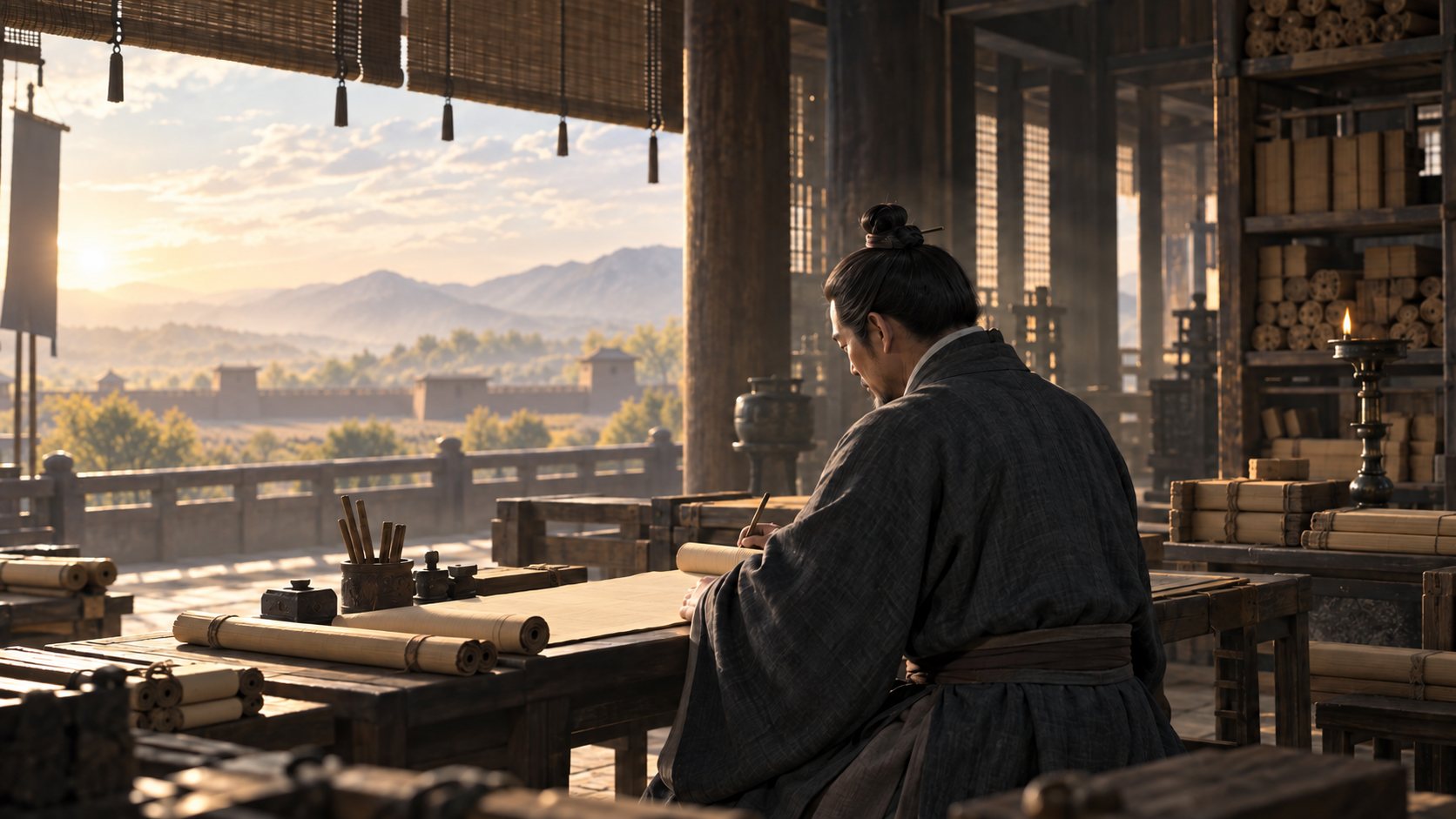
Sima Qian's own account begins at Longmen. As a young man he read old writings and traveled through the Jiang and Huai regions, the south, and the former heartlands of the eastern states. The itinerary in his postface tells us he sought places connected with earlier history. It does not give us an accurate map for every journey, a diary from every stop, or the thoughts that passed through his mind beside a particular river. [1]

His father, Sima Tan, held the office of Grand Historian. The sources say the elder man became ill after missing an imperial ceremony at Mount Tai. When Sima Qian returned from travel, his father charged him to continue collecting and organizing accounts of the past. The histories preserve an extended conversation. It conveys a professional and family obligation, but we cannot treat every reported sentence as an audio transcript. [1] [2]
Three years after his father's death, Sima Qian inherited the office. He could consult court archives. He also asked what history should do: record rulers, certainly, but also weigh decisions, preserve the actions of ministers, and keep individuals from vanishing from the record. His postface includes a discussion of Confucius's *Spring and Autumn Annals* and then lays out the structure of his own work. Compilation was never just a matter of copying dates onto a scroll. [1]
02 / 03
The Li Ling case
While the work was under way, the Han commander Li Ling surrendered to the Xiongnu after defeat. Sima Qian spoke in Li Ling's defense. Emperor Wu took offense, and Sima Qian was imprisoned and subjected to punitive castration. The *Shiji* postface calls this the “Li Ling disaster” with few details. The *Book of Han* gives a fuller account and preserves a letter Sima Qian later wrote to Ren An. [1] [2]
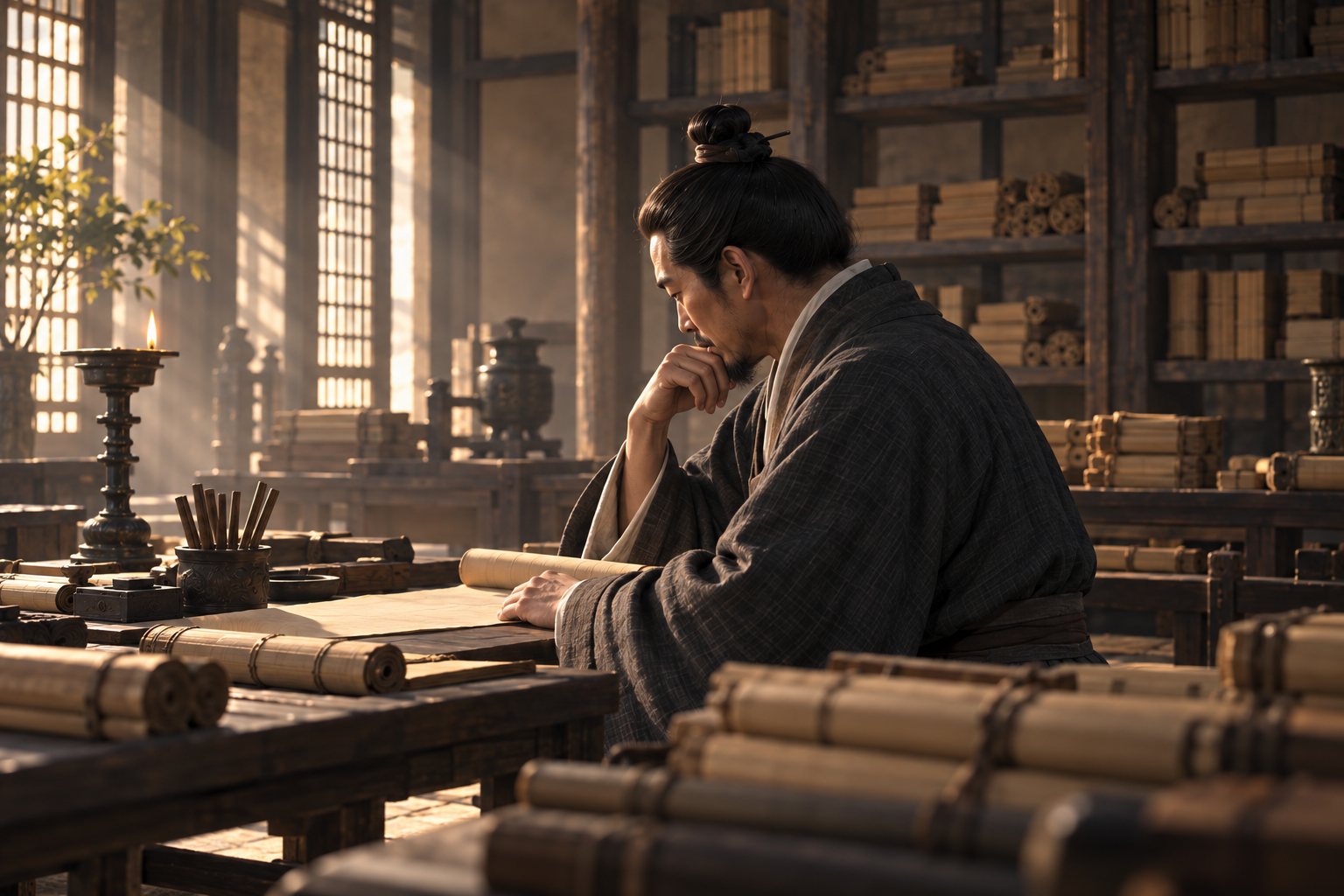
The letter is central because it lets us hear the argument Sima Qian wanted a correspondent to understand. It recounts humiliation without treating it as a brief trial before an inevitable triumph. He says his historical work was unfinished when the punishment came, and he explains why completing it mattered to him. The source does not show him writing this letter inside a prison cell. A scene of him composing it behind bars would be an invented image presented as if it were witnessed. [2]
One line is often quoted in isolation: a person's death may weigh more than Mount Tai or less than a feather. In context, this is no simple command to endure anything. It appears in a long attempt to account for survival, shame, and work whose value he hoped might outlast him. He described gathering scattered traditions and examining the patterns of success, failure, growth and decline. He wanted his 130 chapters to explore the meeting of Heaven and humanity and change across time. We can hear his ambition without claiming to know his private thoughts beyond what he wrote. [2]
03 / 03
The shape of a book
The postface provides a table of contents: twelve Basic Annals, ten Tables, eight Treatises, thirty Hereditary Houses and seventy Biographies. Together they make 130 chapters. These forms do different work. The annals organize rule and major transitions. The tables align events that happened at the same time in different lives and states. The treatises follow subjects such as ritual, calendars and economic administration. The houses and biographies bring many families and individuals into view. This architecture keeps the past from being reduced to a single line of emperors. [1]
That achievement does not make every report in the *Shiji* a modern verified fact. Sima Qian selected, arranged and judged. His work contains inherited tales, competing accounts and his own evaluations. Readers can value the extraordinary scope of what he preserved while asking where each account came from and how it was shaped. The same caution applies to writing his life: admiration should not become invented certainty. [1]
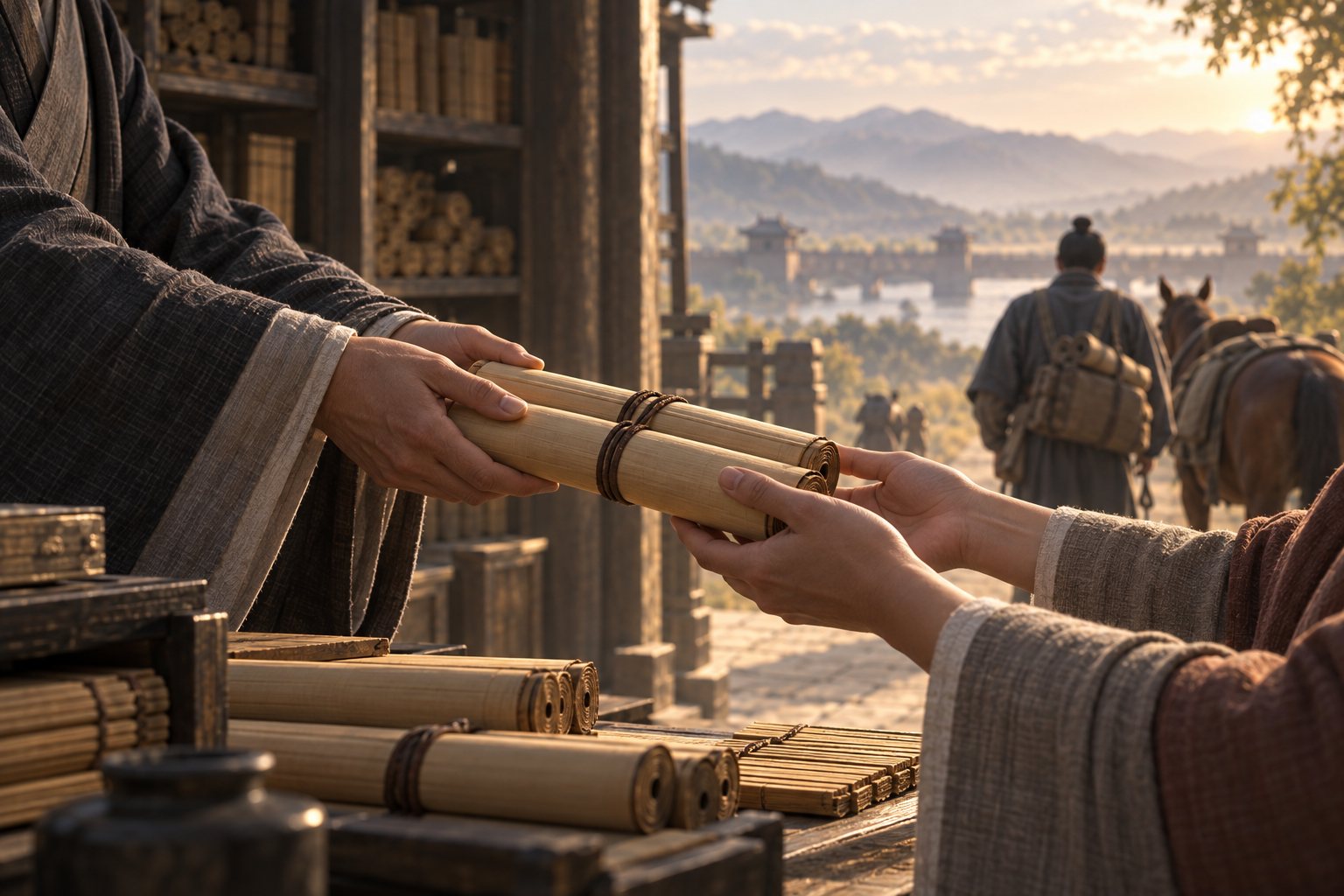
According to the *Book of Han*, the work circulated gradually after Sima Qian's death; his grandson Yang Yun helped make it public in a later reign. Writing a history, preserving copies of it, and placing it in readers' hands were separate stages. Sima Qian could not know the exact audience that would read him two millennia later. He left a text large enough for later readers to keep testing, questioning and learning from. [2]
The spoken version
Podcast transcript
Read the full podcast transcript
Storyteller: This is Eastward Stories. Imagine writing a history large enough to include emperors, families, wandering advisers, calendars, rivers and the price of grain. Now imagine trying to finish it after the court has taken away your freedom and your dignity. Sima Qian lived that second part. But we should begin before the punishment, with the questions that gave his book its shape.
Guide: The book is the Shiji, or Records of the Grand Historian. What do we know about the person behind it?
Storyteller: His own postface says he was born at Longmen, read old writings when young and traveled through several regions of the Han empire. He visited places associated with earlier traditions and later entered court service. The itinerary is valuable, but it is not a complete travel diary. We cannot recover the weather or the private revelation at each stop.
Guide: His father had a historical office too.
Storyteller: Sima Tan was Grand Historian. The sources say he became ill after missing Emperor Wu's ceremony at Mount Tai. When Qian returned, Tan charged him to carry forward a work of gathering and ordering accounts of the past. The histories preserve a long father-and-son exchange.
Guide: It sounds almost theatrical. Do we know the exact words?
Storyteller: No. The scene reaches us through a literary historical account. The important point is its transmitted claim: Qian understood his work as part of a family and professional obligation. Three years after his father's death he became Grand Historian, with access to court records.
Guide: When we hear “historian,” we might picture a man listing dates and names.
Storyteller: Qian had a much broader plan. The postface asks what historical writing can do. It discusses earlier classics and the moral power of seeing actions in their circumstances. He wanted to preserve rulers and prominent families, but also generals, persuaders, merchants, officials and people whose lives crossed the state's great changes.
Guide: Was the book already finished when the Li Ling case happened?
Storyteller: No. Sima Qian later said it was still unfinished. Li Ling, a Han commander, had surrendered to the Xiongnu after defeat. Qian spoke for him at court. Emperor Wu took offense. Qian was imprisoned and subjected to punitive castration. His postface calls the event the Li Ling disaster; the later Book of Han gives a fuller biography and preserves a letter Qian wrote to Ren An.
Guide: Many retellings reduce this to one righteous sentence and then jump to the completed book.
Storyteller: That compression erases the long distress in the letter. Qian describes shame, isolation and the difficulty of explaining himself. He was not announcing that suffering was good because a masterpiece would result. He was telling a correspondent why he endured a punishment that was devastating in his social world.
Guide: Was the letter written from a prison cell?
Storyteller: The sources we are using do not establish that. A painting of Qian composing the letter behind bars might feel dramatic, but it would claim a setting we cannot support. We can show a symbolic writing space and label it an artistic interpretation, or focus on the physical text rather than a fabricated occasion.
Guide: There is a famous line about death weighing more than Mount Tai or less than a feather.
Storyteller: Yes. In English it often sounds like an isolated moral proverb. In the letter it belongs to an argument about social disgrace, survival and what Qian had not yet finished. His own description of the book is more revealing than a slogan. He said he would gather scattered old accounts, examine success and failure, and make 130 chapters to explore the relation between Heaven and humanity and the changes of past and present.
Guide: Do we know that he considered every chapter complete before he died?
Storyteller: We need to be careful. The postface lists the planned or assembled contents, and the Book of Han says the work circulated gradually after his death. Neither detail gives us a photograph of a final bound volume on his desk. Ancient books were transmitted through copies and could change as they circulated.
Guide: Walk me through those 130 chapters. What made the structure useful?
Storyteller: Twelve Basic Annals track rulers and major transitions. Ten Tables let you see events unfolding at the same time across different states and lives. Eight Treatises consider institutions and subjects such as ritual, calendars and the economy. Thirty Hereditary Houses follow significant lineages and powers. Seventy Biographies bring people into focus in a different scale.
Guide: So a reader can move from the high-level chronology to one person's decisions.
Storyteller: Exactly. The forms correct one another's blind spots. A battle that appears in an emperor's reign can look different in the life of a commander; a reform that occupies one line of an annal can take a whole treatise to explain. Not every part fits our modern idea of a biography, and Sima Qian did not invent all narrative history from nothing. But the scope and organization were remarkable.
Guide: Was he a neutral recorder of facts?
Storyteller: No historian writes without selecting. Qian chose subjects, arranged episodes and gave judgments. His book preserves earlier tales alongside reports that later readers may question. Respect for the Shiji should mean reading it closely, asking which source a claim uses and noticing when accounts disagree. Treating every line as an automatically verified fact would make it harder to understand the work he actually made.
Guide: We also need to be careful describing his punishment. It can turn into a dramatic prop.
Storyteller: Right. It was bodily violence and social humiliation, not an aesthetic shortcut to a great book. We should not stage it graphically or pretend to know his unrecorded thoughts. The letter gives us enough in his own written voice to understand that finishing the work carried a cost.
Guide: What happened to the book after him?
Storyteller: The Book of Han says it appeared gradually after his death. During a later emperor's reign, his grandson Yang Yun helped make it known. Writing, preserving and distributing a book were separate tasks. Qian did not stand in a modern bookstore holding the complete edition that readers now call the Shiji.
Guide: That makes the ending quieter. He worked without knowing exactly who would read him.
Storyteller: Yes. He could state his purpose and organize the material. What happened to the work afterwards depended on family, scribes and later readers. His history survives as an invitation to test the past: to look beyond rulers, compare different kinds of evidence and notice how a writer's own experience shapes the questions he asks.
Guide: And our version should be tested the same way.
Storyteller: Yes. Before we close, I want to return to the structure of the book, because it answers a question raised by Qian's own life. How do you write about political power without letting emperors occupy every page? The Basic Annals give rulers a necessary place, but the Tables and Treatises interrupt a purely royal story. They make room for chronology and for systems. The Biographies then ask what a large event looked like from the scale of one person's decisions and consequences.
Guide: Could we take one example of that different scale?
Storyteller: Think of a campaign. An annal may identify when it happened and what the court announced. A table helps place it beside other events. A biography can follow a commander or another person whose fortunes changed through it. A treatise might help us understand institutions that made such action possible. This is a way of reading the book, not a claim that Qian wrote each entry according to a modern research plan. But his arrangement invites comparison, and comparison can disturb a single official version of events.
Guide: The old words “Heaven and humanity” can sound mystical to an English listener. How should we hear them?
Storyteller: In his surviving statement of purpose, Qian asks about the relation between Heaven and human affairs and about changes from the past to his present. We should leave room for the ancient terms instead of pretending they map neatly onto one modern discipline. They signal a broad historical question: how do events, choices, institutions and patterns connect? The answer is worked through many genres across the 130 chapters, not delivered in one easy motto.
Guide: He had access to records at court, but what about material from outside it?
Storyteller: His postface describes travel, inherited learning and written records. His project gathered different sorts of material, including traditions that readers must evaluate rather than simply accept. We should not make him an all-seeing investigator who personally witnessed the distant events he wrote about. His achievement included collecting, selecting and arranging what had reached him. For a modern reader, that makes the question “How does he know?” part of the pleasure of reading the Shiji.
Guide: And it means we have to be careful when we tell the story of his father. The scene is moving, but it has come to us through texts.
Storyteller: Right. We can say that the transmitted account presents Sima Tan giving his son a charge to continue historical writing. We cannot say the speech is a recording. The emotional force survives that caution. A son inherited an office, an unfinished intellectual task, and a problem larger than one life: how to preserve a usable account of the past when records are scattered and political power shapes what can be said.
Guide: The Li Ling case must have sharpened that problem, though we should not claim to know how every chapter changed afterwards.
Storyteller: Exactly. His letter connects the punishment to his decision to finish the book; that is an unusually direct statement of motive. But it does not tell us which sentence he wrote on which day, or allow us to say the punishment “created” the Shiji. His plan and training came before the case. To turn bodily violence into a source of literary greatness would erase both the work already begun and the injury he described.
Guide: Does the letter also complicate the familiar picture of a fearless public dissenter?
Storyteller: It does. Qian writes about obligations, humiliation, the danger of speaking, and what his correspondent might think of his choices. That is a complicated voice, not an uncomplicated modern slogan. We can admire his persistence while recognizing the constraints of an imperial court. We can also avoid inventing a dramatic scene in which he addresses the emperor with a polished line that our sources never record.
Guide: Then the circulation after his death matters for the meaning of “finished.”
Storyteller: Yes. The Book of Han says the work emerged gradually and that Yang Yun later helped bring it to wider notice. The physical history of copies is not the same thing as the intellectual plan of 130 chapters. We know the plan because the ancient texts tell us. We also know that readers met the work through later transmission. That gap should make us curious, not anxious to invent a final handoff scene.
Guide: What can someone do after hearing this, if they have never opened the book?
Storyteller: Start with one short biography and then look at the corresponding annal or table. Ask who is visible in each form. When a speech is especially perfect, remember it has been preserved by a writer. When a number looks exact, ask what kind of report carried it. And when Sima Qian speaks of his own disgrace, read the letter in context rather than extracting only the most quotable line. The bilingual story page links the Chinese originals and separates source-supported events from visual interpretation. That is the best way to honor a historian whose book still asks us to read carefully. This has been Eastward Stories.
Research notes
Sources & adaptation
- Shiji 130, Postface of the Grand Historian
Travel, family charge, office, Li Ling case and 130-chapter plan.
- Hanshu 62, Sima Qian biography and Letter to Ren An
Biography, letter and later circulation.
What was adapted
- [*Shiji* 130, “Postface of the Grand Historian”](https://zh.wikisource.org/zh-hant/%E5%8F%B2%E8%A8%98/%E5%8D%B7130); [*Hanshu* 62, “Biography of Sima Qian,” including the “Letter to Ren An”](https://zh.wikisource.org/zh-hant/%E6%BC%A2%E6%9B%B8/%E5%8D%B7062). No private speech, prison letter-writing scene, physical manuscript design or exact birth/death year is asserted as fact. Artwork is historical interpretation.
Music credit
“At The End Of All Things” — Scott Buckley · CC BY 4.0。 Track details CC BY 4.0 license
Original Chinese feature: Read on WeChat