
People · China / Western Han
Su Wu: The Envoy Who Came Home
苏武
An imperial envoy carried his staff through nineteen years of captivity and a changing diplomatic world.
Historical account. Independent account based on Hanshu 54. Concept illustrations are interpretive; the goose message is a diplomatic ruse in the source, not an observed bird carrying a letter.

Listen to the story
Take the audio path
The episode will try to begin when the page opens. Browser settings may require you to press Play.
The two voices are AI generated from an edited dialogue script. Music credit appears below.
The illustrated story
Read the story
Follow the full English narrative, with scenes placed alongside the passages they illustrate.
01 / 03
A mission that changed
In the first year of Tianhan, around 100 BCE, a Han envoy named Su Wu traveled north with a staff that marked his authority. His orders sounded straightforward: escort Xiongnu envoys home and carry gifts to their ruler, the Chanyu. The two powers had been exchanging both missions and captives. Returning these men was meant to answer a diplomatic gesture with one of Emperor Wu's own. Su Wu's party included his deputy Zhang Sheng, an officer named Chang Hui, and more than a hundred attendants. The staff in Su Wu's hand made him the emperor's representative, not a traveler on a private errand. [1]
The mission arrived, presented its gifts, and prepared to leave. Then a plot that Su Wu had not joined overtook it. A man named Yu Chang, who had connections with Zhang Sheng, was part of a scheme against the Xiongnu court. Zhang had privately promised him support. The scheme failed; Yu was captured, and Zhang feared that his part in it would be exposed. Only then did he tell Su Wu. The distinction matters. The surviving account describes a deputy's secret commitment and an envoy suddenly facing its consequences. [1]
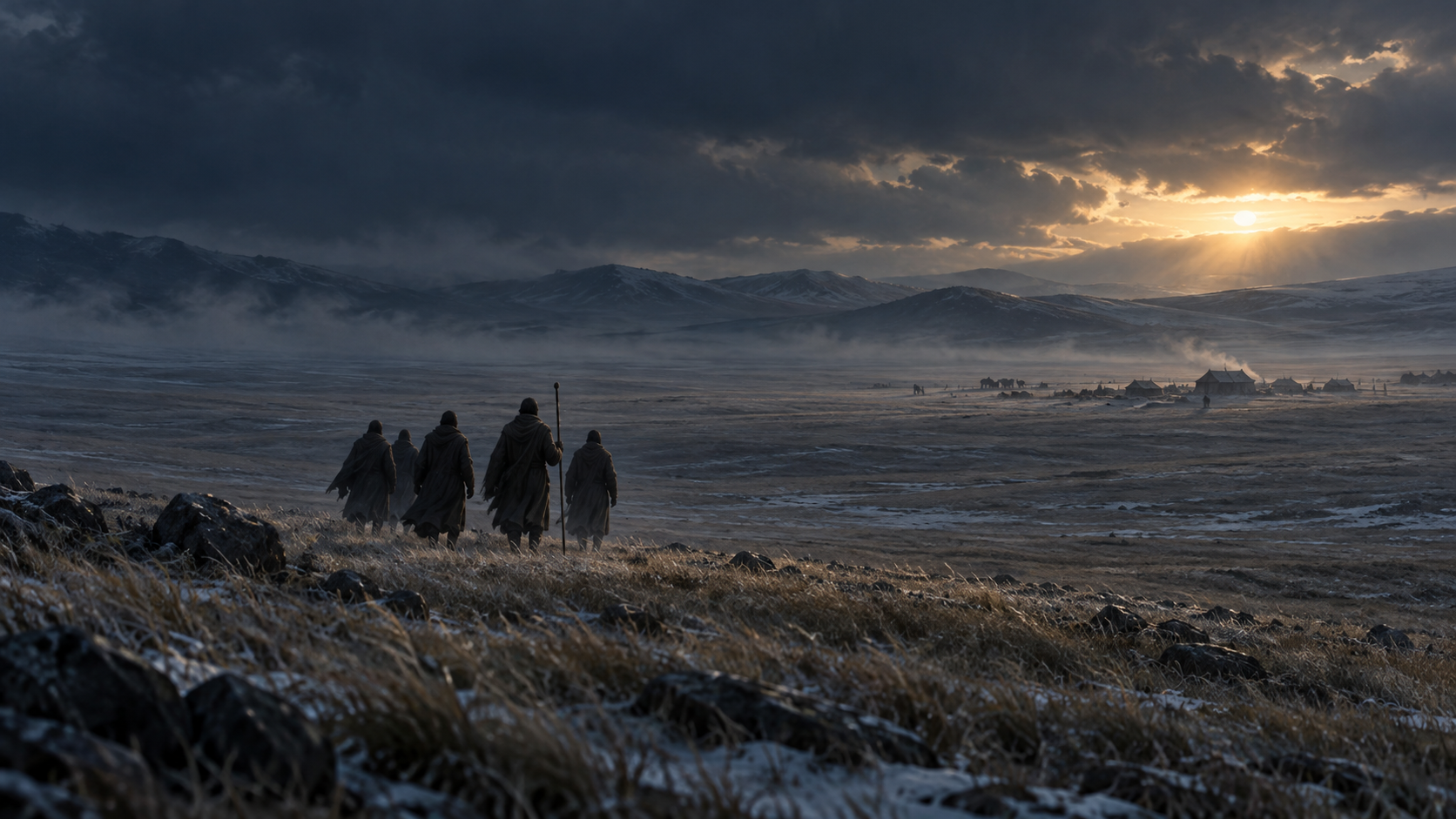
Su Wu expected the accusation to reach him as head of the delegation. He tried to kill himself before he could be made to answer for it under coercion, but Zhang and Chang stopped him. Later, when the Xiongnu official Wei Lü summoned him, Su Wu stabbed himself with his own knife. He was badly wounded, then revived. The Chanyu, impressed by his resolve, sent people to ask after him while Zhang was held. This is a harsh episode. It is also the moment at which the mission changed from diplomacy to captivity. [1]
Wei Lü brought Su Wu another choice. Zhang Sheng had submitted, and Wei Lü held out the rewards of doing the same: status, followers, wealth. Su Wu refused. When threats and inducements failed, he was shut in a deep pit without food or drink. The Book of Han says snow fell and he swallowed snow mixed with felt to live. The account then moves him to a place it calls the North Sea. There he was ordered to tend male sheep. He would be allowed home when the rams produced milk: a condition designed never to be met. [1]
02 / 03
The years at the North Sea
This was a sentence with no stated end. The Book of Han says his provisions stopped arriving. He searched the burrows of wild mice for stored seeds. He carried the Han staff while tending the flock, until the tufts attached to it had fallen away. The image has lasted because it is plain: an envoy still holding the sign of a mission after the court that sent him had lost sight of him. Yet the record is more complex than a picture of one man, untouched by anyone, on an empty shore for nineteen years. [1]

Several years into the exile, a younger brother of the Chanyu came to the North Sea to hunt. Su Wu could make and maintain hunting equipment, and the prince valued those skills. For a time he supplied Su Wu with food and clothing. After the prince fell ill, he gave him animals and shelter; after the prince died, the people around him moved away. Later Su Wu lost livestock to raiders and again fell into hardship. The help was real in the source, and so was its limit. His refusal to surrender did not mean every Xiongnu person he met behaved the same way. [1]
Another visitor knew him from the Han court. Li Ling, once a Han commander, had surrendered after a military defeat. The Chanyu sent him to persuade Su Wu. The Book of Han preserves a long exchange: Li Ling described the distance from home, Su Wu's family losses, and the uncertainty of the emperor's favor. Su Wu answered in terms of the obligations he believed he owed. Li Ling could speak from experience about defeat and disgrace; Su Wu would not take the path Li Ling proposed. The history presents both men under pressure, with different answers. Its polished speeches are a historian's record, not a sound recording of what either said word for word. [1]
News from home did reach Su Wu. On a later visit, Li Ling told him Emperor Wu had died. The account says Su Wu turned south and mourned for months. That detail makes the timeline especially striking: the man who appointed him was gone, but the appointment still shaped his conduct. We do not know every thought that passed through his mind. What we can see is the action the source chose to record. [1]
03 / 03
The road home
After a new Han emperor came to the throne, the two states moved toward peace. Han envoys asked for Su Wu and his party. The Xiongnu court initially replied that he was dead. Chang Hui, still alive in captivity, found a way to meet a Han envoy and told him otherwise. He also supplied a story for the envoy to tell: the emperor had shot a goose in his park and found a silk message tied to its foot saying Su Wu was alive. It was a diplomatic bluff. The source does not say that any such bird carried a letter. Confronted with the claim, the Chanyu admitted that Su Wu lived. [1]
The return did not restore the original mission as it had been. Some attendants had died; others had submitted. Nine people returned with Su Wu. In spring of Shiyuan year six, around 81 BCE, he reached the Han capital. The source says he had left strong and returned with white hair and beard, nineteen years after his departure. The court gave him an office concerned with foreign peoples and rewards that recognized his service. [1]
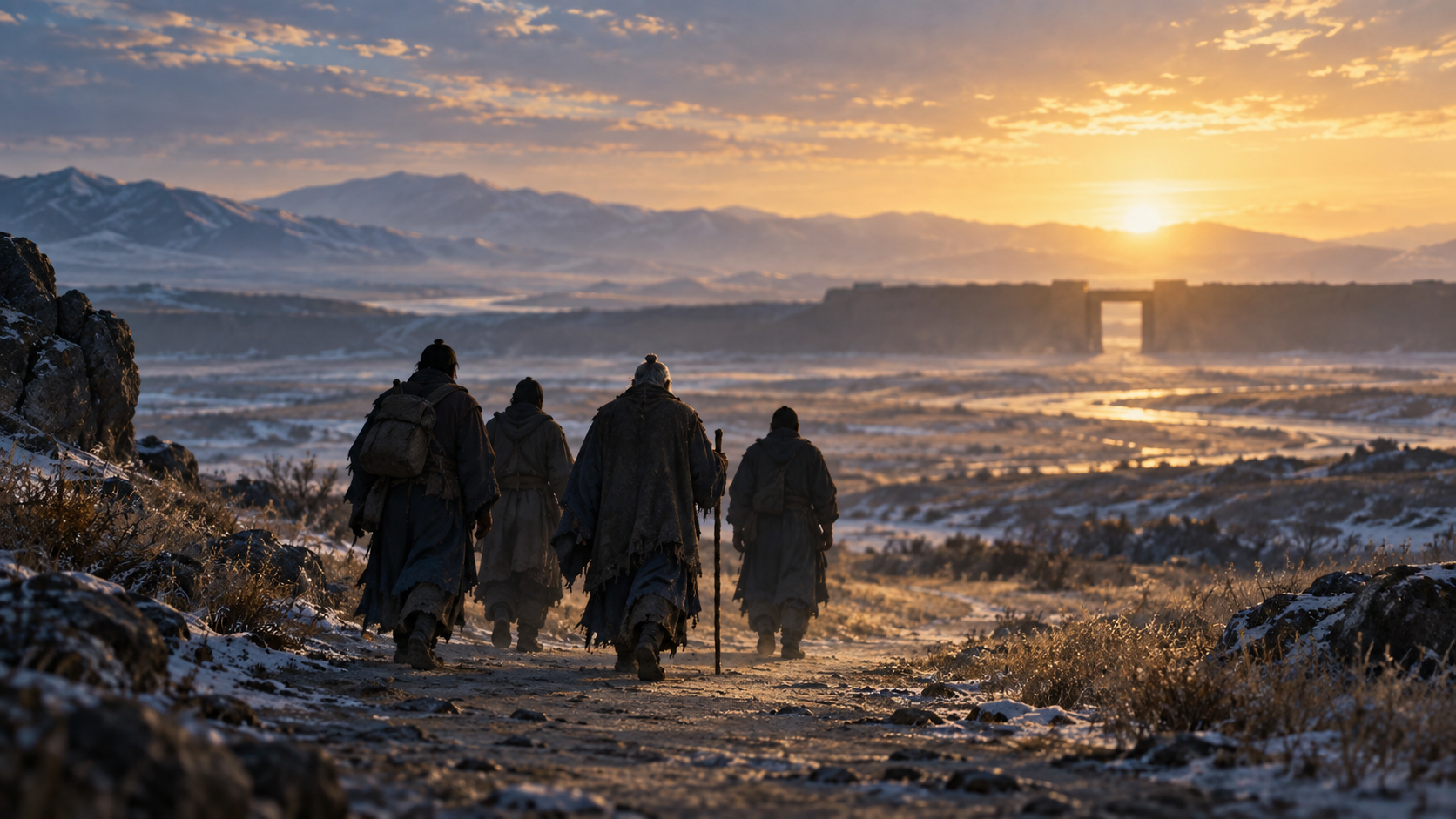
The familiar picture is a man and a staff beside sheep. The fuller story holds more: a failed conspiracy Su Wu did not join, a deputy who surrendered, a prince who helped him, a former colleague who tried to change his mind, and Chang Hui's clever false story about a goose. Su Wu was neither alone in every moment nor rescued by a miracle. He survived long enough for diplomacy to change around him. He came home carrying the staff of a mission that had become most of his adult life. [1]
The spoken version
Podcast transcript
Read the full podcast transcript
Storyteller: You're listening to Eastward Stories. Today, a Han envoy sets out with an imperial staff and comes back nineteen years later still carrying it. His name is Su Wu.
Guide: Nineteen years is almost too big a number to picture. What was the trip supposed to be?
Storyteller: A diplomatic exchange. Around 100 BCE, the Han emperor sent Su Wu to the Xiongnu court to return envoys who had been held in Han territory. He was also carrying gifts. The Han and Xiongnu courts had fought, negotiated, detained each other's envoys, and sent people back. So the mission mattered politically, but it wasn't meant to be a nineteen-year stay.
Guide: And the staff?
Storyteller: A visible sign that he represented the emperor. Su Wu traveled with a deputy named Zhang Sheng, an officer named Chang Hui, and a much larger party. The Book of Han says more than a hundred people went with him. When Su Wu held that staff, he was carrying an office as well as an object.
Guide: What went wrong? I know the picture of him tending sheep, but there must be a whole story before that.
Storyteller: There is. After the delegation arrived, a plot against the Xiongnu court failed. One of the plotters, Yu Chang, knew Su Wu's deputy. Zhang Sheng had privately agreed to support him. Su Wu wasn't described as a participant. When the plot collapsed and Yu Chang was captured, Zhang knew his own role could come out. He told Su Wu what he had done.
Guide: So Su Wu could be held responsible for something his deputy arranged without him.
Storyteller: Exactly. He believed the accusation would reach him as the envoy in charge. The account says he first tried to take his own life and was stopped. Later, when he was summoned to answer questions, he stabbed himself. People rushed to treat him, and he survived. I don't want to turn that into a heroic action scene. It was a desperate moment in a failed diplomatic mission.
Guide: And after he recovered, he was offered a way out?
Storyteller: He was pressed to surrender. A Xiongnu official named Wei Lü had once served the Han and now held rank at the Chanyu's court. He pointed to the wealth and position Su Wu could have if he switched allegiance. Zhang Sheng submitted. Su Wu refused. The account gives us a long speech at this point, but we should hear it as a later historian's presentation, not as a recording made in the room. The decision itself is clear in the narrative.
Guide: What did the Chanyu do when pressure didn't work?
Storyteller: Su Wu was confined in a deep pit without food or drink. The history says snow fell, and that he swallowed snow with felt to stay alive. Then he was taken to a place called the North Sea and ordered to tend male sheep. He could return, he was told, when those rams produced milk.
Guide: In other words, never.
Storyteller: That was the point. The text doesn't give us a precise modern map coordinate for that shoreline, so we keep the historical name. But it does give us some sharp details. Food stopped reaching him. He dug seeds out of wild-mouse burrows. He took the Han staff with him as he watched the flock, and eventually its decorative tufts fell away.
Guide: That sounds completely solitary. Was it?
Storyteller: Not the entire time. This is where the usual image is incomplete. Several years in, the Chanyu's younger brother came there to hunt. Su Wu had useful skills with hunting gear, and the prince supplied food and clothing. Later he gave Su Wu animals and shelter. The prince died, the people around him moved on, and Su Wu faced hardship again. So the same source that tells us about his captivity also tells us about someone at the Xiongnu court who helped him.
Guide: That's an important distinction. A court made a coercive decision; that doesn't tell us how every person in that society acted.
Storyteller: There is another reason to keep the people separate. The Book of Han begins the episode with diplomacy going in both directions. The Han had detained Xiongnu envoys, and the Xiongnu had detained Han envoys. The Chanyu then released one group as relations shifted, and Emperor Wu sent Su Wu to return the other group. None of that makes the later detention just. It does tell us these were two courts managing a tense relationship, not an empty frontier populated only by Su Wu and his jailers.
Guide: And the prince's help happened inside that same Xiongnu political world.
Storyteller: Yes. He could not reverse the Chanyu's decision, but he could feed and clothe a man who had been left with an impossible condition for release. The source says Su Wu was useful at making hunting gear. That practical skill matters. It gives us a way to talk about his survival without turning it into a miracle or claiming he lived on snow for nineteen uninterrupted years. The snow and felt belong to an earlier period of confinement. The stored seeds, the flock, the prince's help and the losses after the prince died belong to a much longer, changing sequence.
Guide: That also changes the image of the staff. It was with him through different circumstances.
Storyteller: Right. The source says he held the Han staff when tending sheep and that its decorative tufts wore away. We cannot identify every surviving physical detail of the object from that sentence. We can say that the history returns to it as a visible thread connecting the original embassy with his later years. If a picture makes the staff look perfectly new throughout the exile, it misses the passage of time. If it turns the staff into a magic weapon, it adds a story the source never told.
Storyteller: Right. There's another complicated relationship in the record. Li Ling, a former Han commander, had surrendered after a military defeat. He knew Su Wu from earlier service. The Chanyu sent Li Ling to talk to him. Li Ling brought a painfully practical argument: you might never go home, your family life has changed, and the ruler you served might not reward you even if you could return.
Guide: He wasn't just saying, “Take the money.” He was asking what Su Wu's loyalty was costing him.
Storyteller: Yes. The Book of Han gives Li Ling and Su Wu extended speeches. We don't need to pretend we know their exact phrasing. What matters for this account is that Li Ling tried to persuade him, and Su Wu did not submit. Later, Li Ling also brought news that Emperor Wu had died. According to the history, Su Wu turned south and mourned for months. The emperor who had sent him was gone, but Su Wu's duty, as he understood it, was not.
Guide: Did anyone at home know he was still alive?
Storyteller: Eventually. Under the next emperor, Han and Xiongnu relations improved, and Han envoys asked for Su Wu. The Chanyu's court said he had died. But Chang Hui, one of the men who had gone with Su Wu, was alive and found a way to reach a Han envoy at night. He told the envoy the truth and gave him a way to challenge the denial.
Guide: This is the goose, isn't it?
Storyteller: It is, but the distinction is crucial. Chang Hui told the Han envoy to claim that the emperor had shot a goose in his park and discovered a silk note on its foot. According to that invented message, Su Wu was still alive. The envoy repeated the story; the Chanyu admitted that Su Wu was alive. In the Book of Han, the goose is a bluff, not a miraculous postal service.
Guide: I like that the person who breaks the impasse is another captive with a smart diplomatic move.
Storyteller: Chang Hui's role deserves more than one sentence. He had traveled with Su Wu at the start. After the Xiongnu court told the Han that Su Wu was dead, Chang Hui found a way to speak privately to a Han envoy and supplied the argument the envoy could use. The story of a goose with a note was not there to convince a listener that birds deliver official mail. It was a way to make the court face a claim about knowledge it had denied. When the envoy repeated it, the Chanyu admitted Su Wu was alive.
Guide: Why choose a tale about an emperor shooting a goose in a park? It sounds almost fantastical now.
Storyteller: We do not know every calculation Chang Hui made. The Book of Han records the proposed claim and the response, not an explanation of his mental process. But in narrative terms it lets the Han envoy say, “We have learned something you told us was impossible.” That is an inference from the episode, not a quotation from Chang Hui. We should keep the historical action and our interpretation distinct.
Guide: And the result still depended on peace talks, not only on a clever line.
Storyteller: Exactly. The next Han emperor was in power and the two states were moving toward accommodation. Chang Hui's stratagem opened a specific dispute within those negotiations. It did not single-handedly reverse nineteen years of politics. That is why the ending matters as diplomacy as well as personal endurance. Su Wu kept the sign of his mission, but he needed other people and a changed political setting to cross the frontier again.
Storyteller: And it reminds us this isn't a story of one man acting alone for nineteen years. Some of the original party had died, some had surrendered, and nine people returned with Su Wu. The history says he reached the Han capital in spring, around 81 BCE. He had left as a strong man; he returned with white hair and beard. The court appointed him to an office dealing with foreign peoples and gave him rewards.
Guide: What stays with me is that the staff didn't solve anything. It couldn't feed him or tell the emperor where he was.
Storyteller: No. And we shouldn't make it a magical object. It was an ordinary symbol of an extraordinary length of duty. He kept it while the mission, the emperor, and the diplomatic situation all changed. The people around him made different choices: Zhang surrendered; a Xiongnu prince helped; Li Ling argued with him; Chang Hui made a bluff that opened the road home. Those choices make the story human.
Guide: And they keep the ending from being too neat. Coming back didn't return the nineteen years.
Storyteller: Nor did it bring the entire embassy back. The account says the original party was large, but nine people returned with him. Some had died and some had submitted. We should not treat those different outcomes as a simple scoreboard of virtue. The source does not give equal space to every attendant or explain every individual choice. By naming the losses, we resist making the return look like a parade in which the whole company marches home unchanged.
Guide: Does the record tell us what Su Wu felt when he reached the capital?
Storyteller: It describes his white hair and beard and the honors given to him, but it does not give us a private diary of the homecoming. We can imagine relief, grief, uncertainty, or all three; we cannot publish one of those feelings as a documented fact. The image of the older envoy crossing toward an anonymous city wall is therefore a visual interpretation, and its visible companions are not a claim about the exact nine who returned.
Storyteller: Exactly. The account lets us say that Su Wu came home. It does not let us say that exile became worthwhile, or that every part of his life was restored. His staff survives in the story as a sign of what he chose to carry through it. This has been Eastward Stories. You can read the full account and source notes with this episode.
Research notes
Sources & adaptation
- Book of Han, scroll 54, section on Su Wu, Chinese original
The two online transcriptions of this ancient source are not independent corroboration. The goose message is an envoy's bluff in the account.
What was adapted
- Independent retelling of Hanshu 54. Ancient reported speeches are treated as a transmitted historical account. The goose message is a diplomatic ruse, not evidence of a real bird carrying a letter. Visual settings and faces are interpretation rather than documented likenesses.
Music credit
“At The End Of All Things” — Scott Buckley · CC BY 4.0。 Track details CC BY 4.0 license
Original Chinese feature: Read on WeChat