
Myths & Ideas · China / Ming-era novel
The Monkey King Who Challenged Heaven
孙悟空大闹天宫
An uninvited banquet draws the Monkey King into a quarrel with Heaven.
Traditional retelling. Original retelling of an ancient text; source events and invented visualization are labeled in the story and captions.
Listen to the story
Take the audio path
The episode will try to begin when the page opens. Browser settings may require you to press Play.
The two voices are AI generated from an edited dialogue script. Music credit appears below.
The illustrated story
Read the story
Follow the full English narrative, with scenes placed alongside the passages they illustrate.
01 / 05
A title without a seat
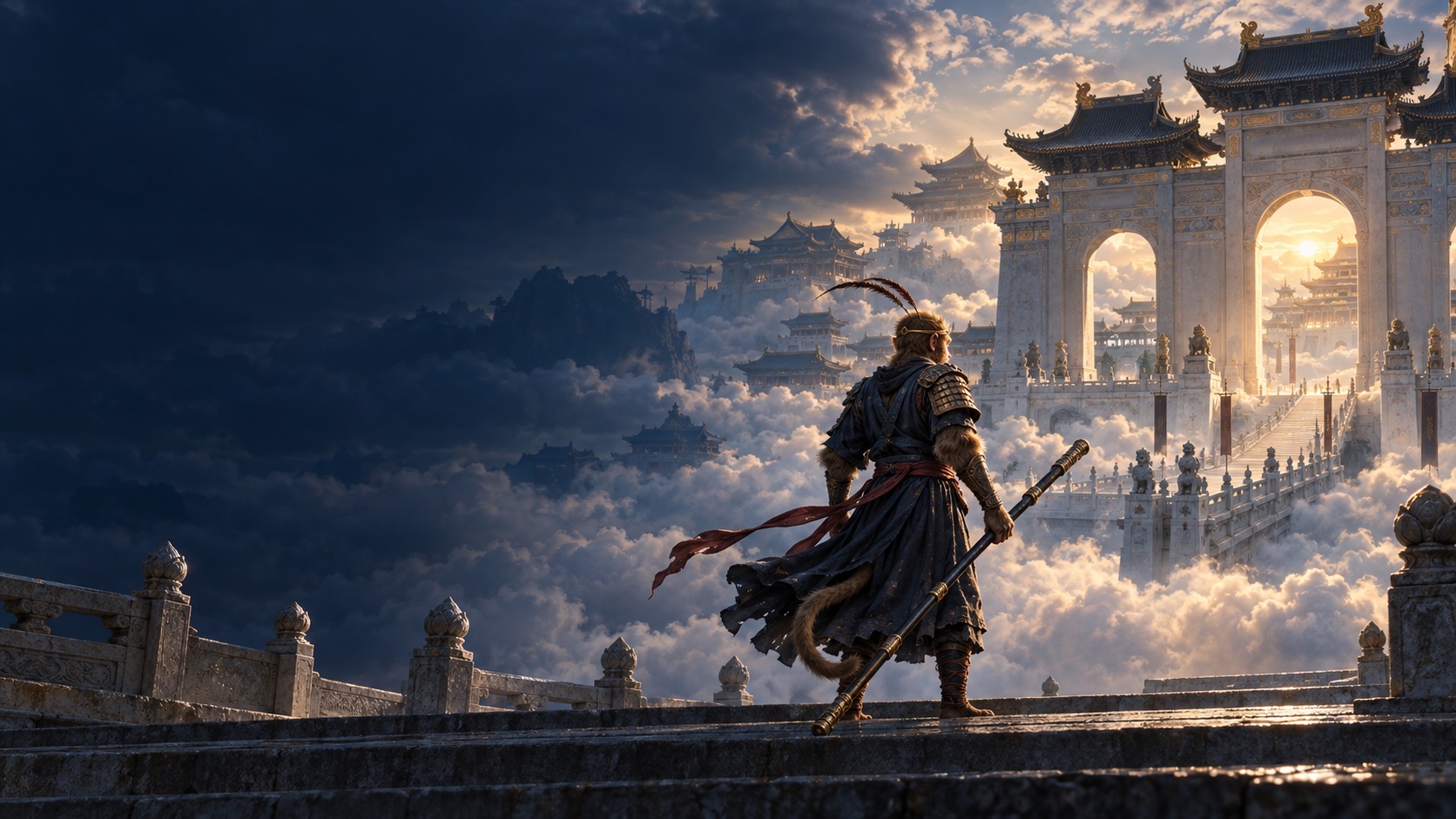
The Heavenly Court first gave Sun Wukong a job among its horses. He had crossed the clouds expecting an honor equal to his powers. When he learned how low the post of Keeper of the Heavenly Horses stood, he went home to Flower Fruit Mountain, raised a banner and called himself the Great Sage Equal to Heaven. Heaven tried force; then it tried a title. He returned with magnificent words attached to his name, but no real duty to match them. [1]
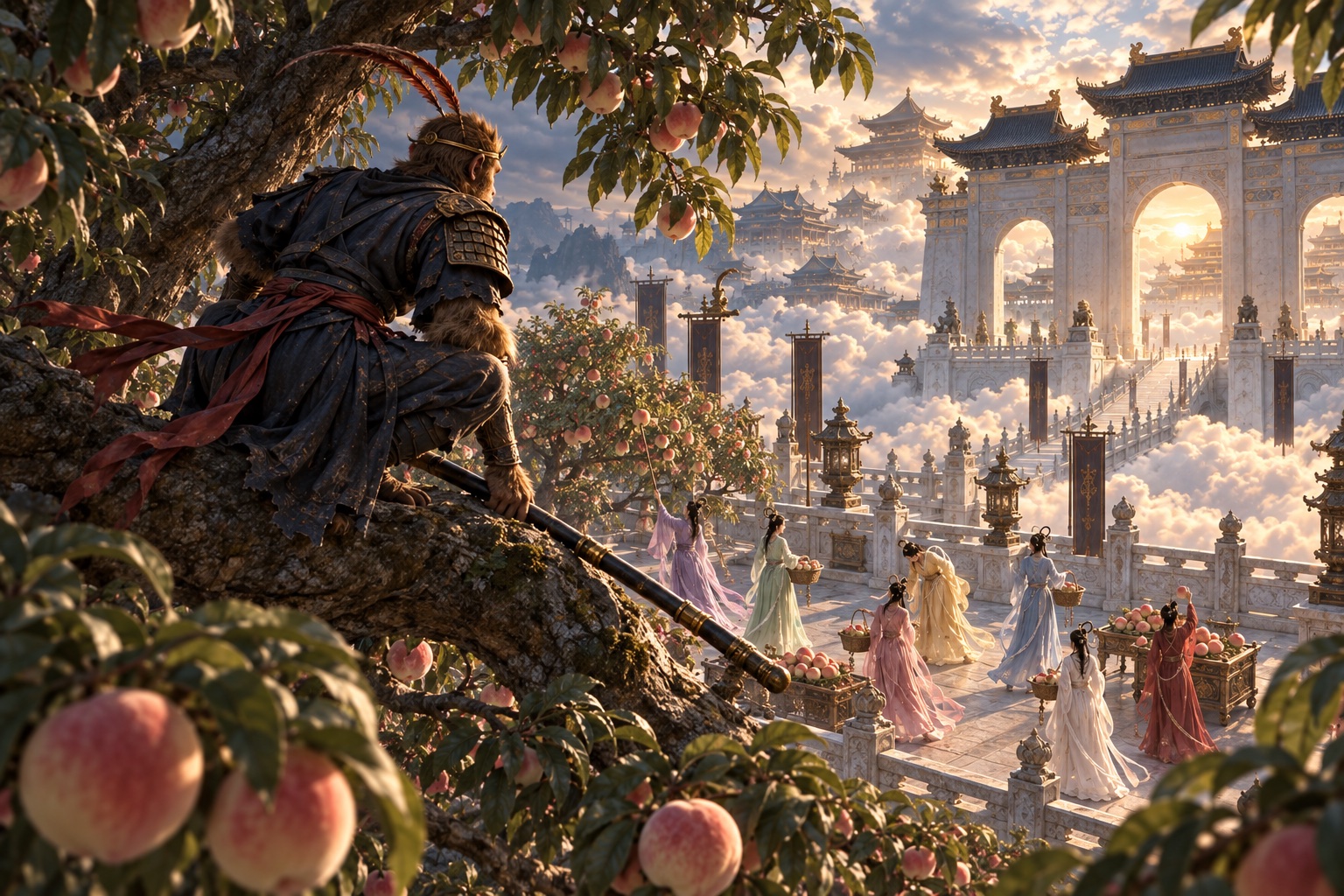
At last the court put him in charge of the Queen Mother's peach orchard. Imagine him there, high in a tree, with the stone paths and palace roofs beyond the branches. The garden held trees whose fruit ripened across immense spans of time. Wukong ate the peaches he was meant to guard. The scene's view and his private thoughts are ours; the appointment, the orchard and the eating are in the novel. [2]
Seven attendants arrived to pick fruit for the Queen Mother's banquet. Wukong asked who had been invited. Their list was long, and his name was missing. For a moment the grand title seemed to weigh less than an empty place at a table. That last feeling is our interpretation. In the text he stops the attendants with magic and goes to find out about the feast himself. [2]
02 / 05
The feast with no guest
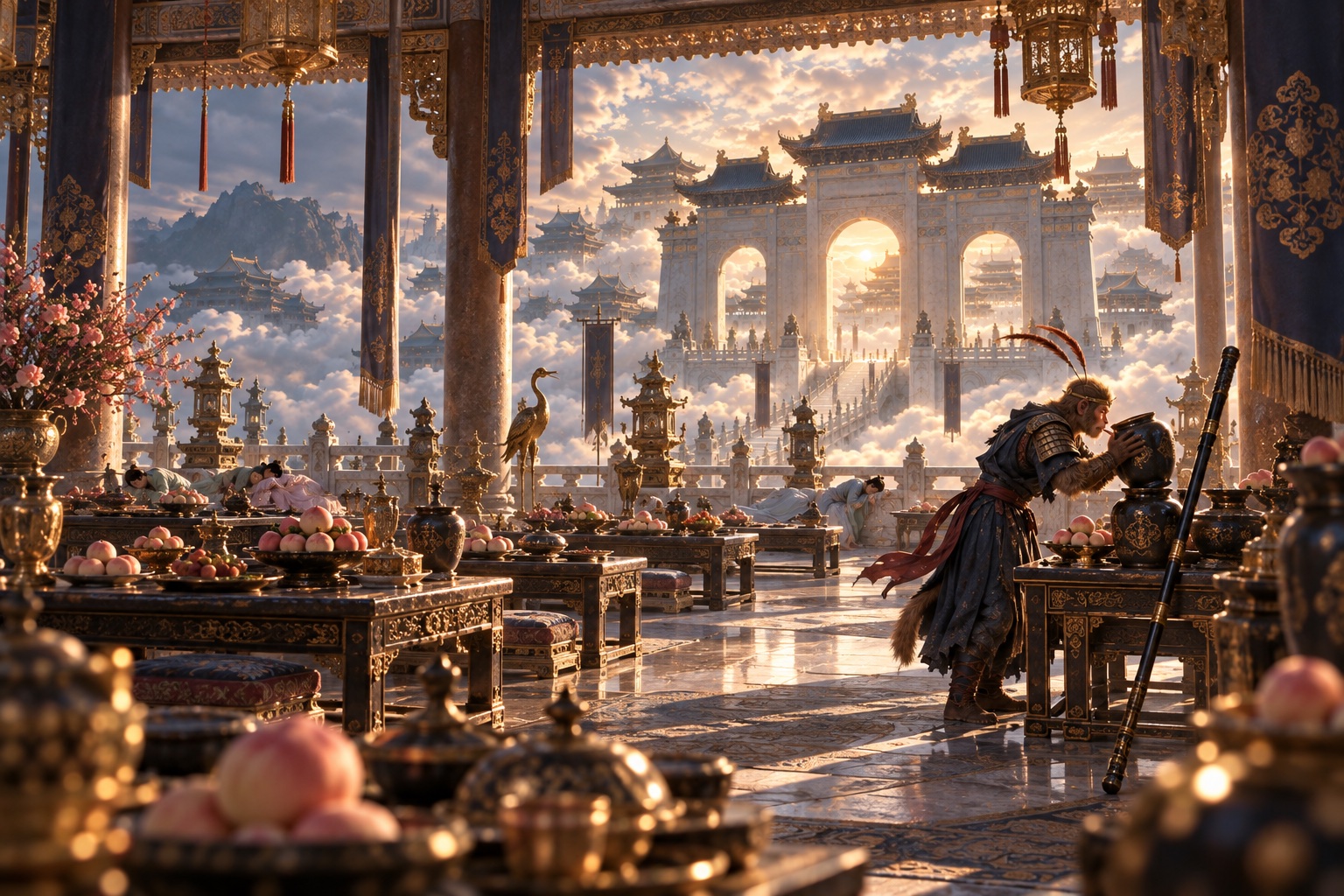
On the road Wukong met a guest bound for the banquet, the Barefoot Immortal. He sent the guest elsewhere with a false message, borrowed his appearance by transformation and entered the pavilion at Yaochi. The feast was ready, but the other guests had not yet arrived. Tables carried food; jars held fragrant wine. Wukong used a spell to put the workers to sleep, then ate and drank until he was unsteady. [2]
Our picture shows Wukong openly in the empty hall so that this series keeps one visible character design. In the novel, his disguise is part of how he enters. He did not storm a room full of gods. The quiet before the guests came gave him the opportunity. That difference matters: the rebellion began here with stealth, appetite and wounded pride, then grew into open battle. [2]
Trying to find his way home while drunk, he reached the palace of the alchemist Taishang Laojun. There he found five gourds of elixir pills and ate them. When he understood what he had done, he fled Heaven for Flower Fruit Mountain. The court's reply was an army. [2]
03 / 05
Smoke behind the furnace door
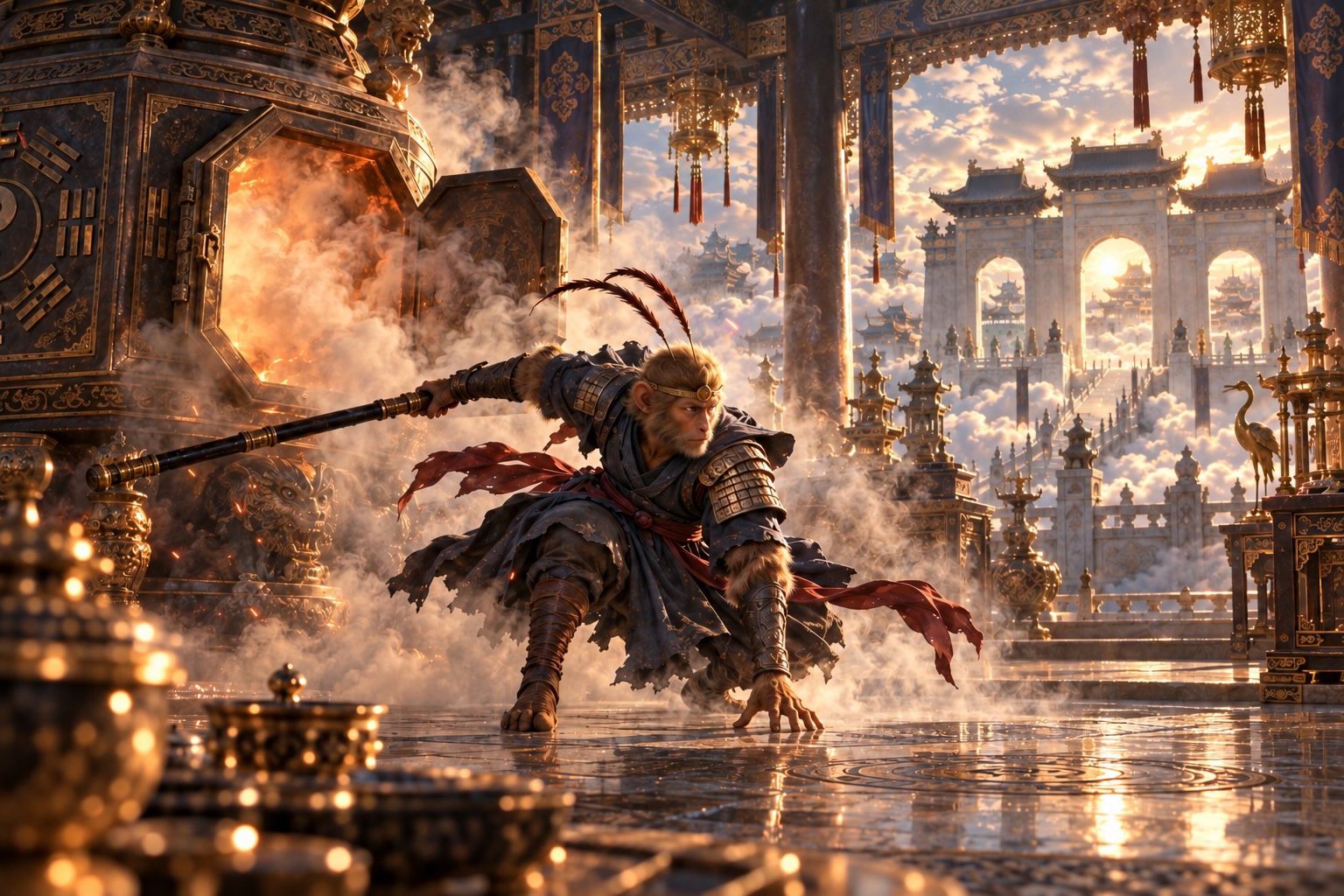
Heaven's forces could not easily take Wukong. In the fighting that followed, Erlang Shen met him in a contest of transformations. Taishang Laojun's metal ring struck Wukong, and Erlang's hound helped bring him down. The captured Monkey King was brought before the court. Blades, fire and thunder failed to finish him. Laojun then shut him inside the Eight Trigrams furnace. [3] [4]
Forty-nine days passed in the story. Wukong kept to the furnace's wind position, away from the worst of the fire; the smoke stung his eyes. When the door opened, he burst out and fought through the guards. The old novel calls his altered sight "fire eyes and golden pupils." It does not say that flames gave him eye-beams. Our image shows the smoky escape, with the same palace gate visible beyond the chamber. [4]
Wukong drove toward the Lingxiao Hall but did not take the Jade Emperor's throne. Wang Lingguan stopped him outside the hall; thunder generals joined the fight. Heaven called on the Buddha to face a challenger its soldiers could not settle. [4]
04 / 05
The edge of the sky
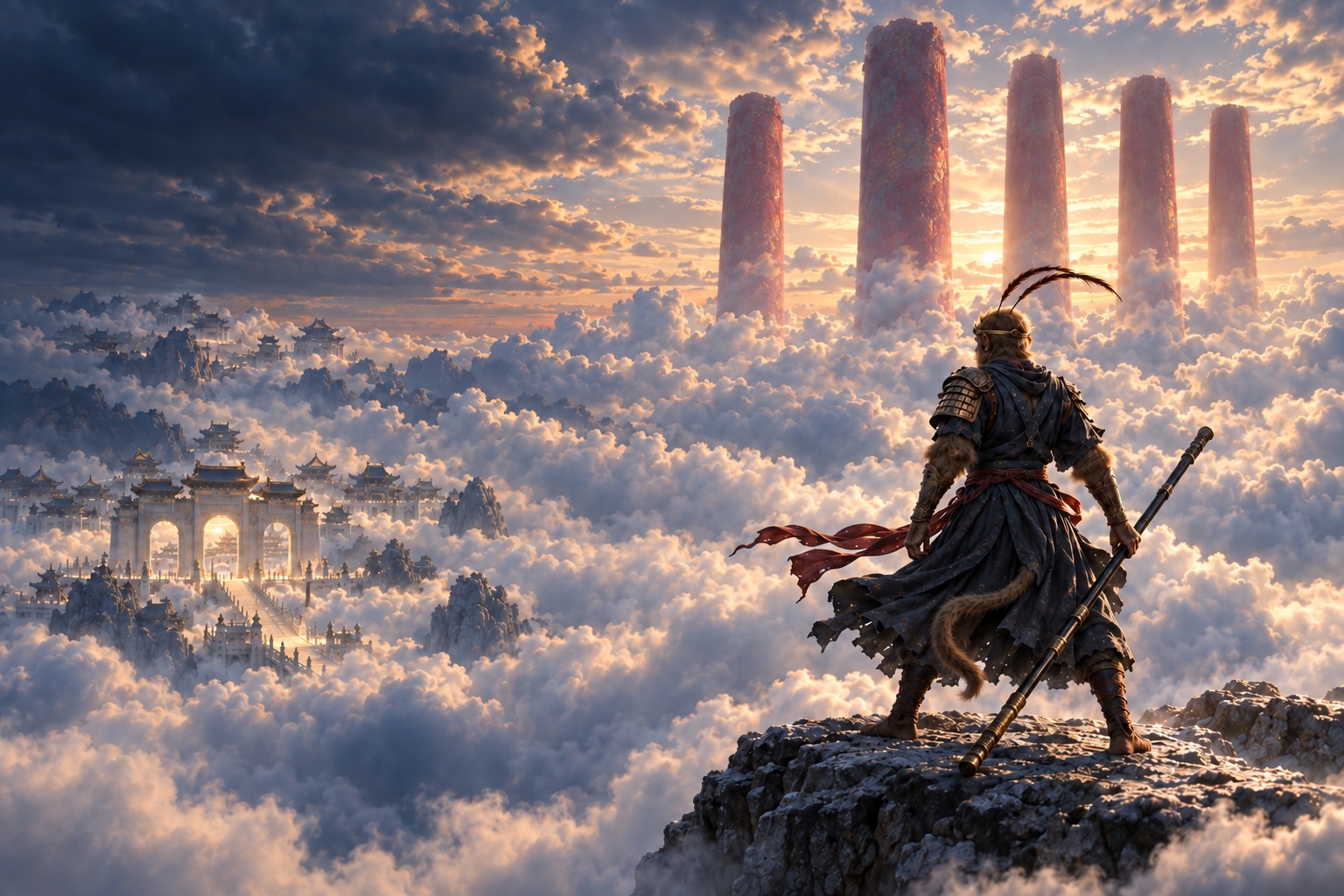
The Buddha proposed a wager: if Wukong could leap out of his palm, the palace would be his. Wukong trusted the reach of his somersault cloud. He sprang away, flying until five tall red pillars appeared at what he took to be the world's far edge. He marked one of them to prove how far he had gone, then flew back. [4]
Our last scene gives that moment a vast horizon and leaves the pillars unexplained. The novel supplies the reversal: Wukong had never left the Buddha's hand. The mark was on a finger. The Monkey King tried to leap again, but the hand turned over. Its five fingers became Five Elements Mountain and held him beneath it. [4]
05 / 05
What remains
The palace still stood. The peaches were gone, the banquet ruined, and the title Great Sage Equal to Heaven had not won Wukong the seat he wanted. Yet the novel does not leave him as a simple joke or a defeated monster. His energy, pride and ingenuity will have another story when a traveler eventually reaches the mountain. That later journey lies beyond this episode. [4]
This retelling follows the novel's order while choosing its own camera positions and language. The heavenly gate, orchard layout, costumes and colors in the illustrations are one imagined visual world, held consistent from frame to frame. They are not surviving images of a historical place.
The spoken version
Podcast transcript
Read the full podcast transcript
Storyteller: You’re listening to Eastward Stories. Today, Sun Wukong walks into Heaven with a title large enough to fill the sky—and discovers there is no place for him at the banquet.
Guide: Is this the famous rebellion before he joins the journey west?
Storyteller: Yes. We are following chapters four to seven of Journey to the West. The novel's events are our backbone; the views, feelings and details of the imagined palace in our pictures are our own.
Guide: Where does the quarrel begin?
Storyteller: With a job among the heavenly horses. Wukong thinks he has been honored. When he learns the rank is low, he leaves, raises a banner at Flower Fruit Mountain and names himself the Great Sage Equal to Heaven. Heaven fights him, then grants the title, but it is mostly a way to keep him close.
Guide: A splendid name, with little behind it. Why would Heaven offer the title if it did not want to give him power?
Storyteller: The novel presents a court trying to manage a figure it cannot easily control. The honor sounds enormous, but an impressive name can also be a way to keep someone inside an institution's walls. That is our reading of the situation; the events themselves come from chapter four. Wukong's anger is not a speech we invented for him here. You can see the gap between the title and the actual office in what he does next.
Guide: Does the audience need to know the horse office before we get to the peaches?
Storyteller: I think so. Wukong arrives believing Heaven has recognized him. He learns what the job is worth only after taking it. That first disappointment makes the later guest list more than an isolated slight. A court title and a seat at the feast are both signs of belonging. Twice he finds the ceremony impressive and the substance thin. We should not make him a modern employee filing a complaint; the joke and the anger belong to the novel's heavenly court. But listeners can still feel how a label can hide a hierarchy.
Guide: It makes the banquet invitation feel more consequential.
Storyteller: Exactly. Later, the court gives him the Queen Mother's peach orchard to manage. He eats the fruit he was told to guard. Then seven attendants arrive to pick peaches for a great banquet. He asks for the guest list. His name is not on it.
Guide: I picture him watching them from a branch. Is that precise view in the novel?
Storyteller: No. The tree, the view of the gate and his private feeling are our staging. The novel does say he eats the peaches, questions the attendants, stops them with magic and sets off toward the feast.
Guide: Seven attendants is a wonderfully specific detail.
Storyteller: It is, and we keep all seven in the scene. The palace itself has no surviving floor plan; this is a fictional Heaven. But the count belongs to the text. We also leave out later features of the Monkey King, like the tightening headband he wears during the pilgrimage.
Guide: He could have stayed in the orchard after that conversation. Why does he go to the banquet himself?
Storyteller: Because the list confirms what the splendid title did not: he is not among the honored guests. The novel lets him act in an instant, freezing the attendants and setting off to investigate. Our written story adds the hush under the peach trees, a moment in which he studies the path toward the hall. That pause is an invented dramatic bridge. We never present it as a quoted line from the novel.
Guide: The story suddenly moves between two scales. The court looks impossibly grand, and he is alone in a tree with a very personal question.
Storyteller: Yes. We stay in the orchard for a moment before we enter the hall. It gives us a place to stand with him before the action speeds up.
Guide: What does he find there?
Storyteller: First he meets the Barefoot Immortal on the road and sends him away with a trick. Wukong takes that guest's appearance to enter Yaochi. The tables are ready, but the guests have not arrived. He puts the workers to sleep, eats, drinks and gets drunk.
Guide: So he is wearing the Barefoot Immortal's appearance when he reaches the hall?
Storyteller: Yes. The disguise gets him past the entrance. The feast is prepared but the guests have not yet arrived. If we made him burst into a room full of immortals, we would miss the timing that makes the episode funny. He enters by deception, and his appetite does the work before the army ever comes.
Guide: Then it is quiet: prepared dishes, unused seats, nobody to stop him.
Storyteller: Exactly. No cheers, no clash of weapons yet. By the time Heaven hears about the disturbance, the feast has already been upset. The comedy rests on that delay.
Guide: He is mischievous, but he also chooses a pretty strange way to answer an insult.
Storyteller: He does. We need not make every act admirable. The novel enjoys his wit and energy while showing how his choices widen the conflict. The banquet is funny until one thinks about the attendants left asleep and the court mobilizing its army. That blend of comedy and danger is part of the story's momentum.
Guide: Does the trouble stop at the banquet?
Storyteller: No. Drunk and trying to get home, he wanders into Taishang Laojun's palace and eats five gourds of elixir pills. He then flees to Flower Fruit Mountain. Heaven sends its army. In the fighting, Erlang Shen matches his transformations; Laojun's metal ring and Erlang's hound help capture him.
Guide: That is quite a journey from an empty table to a military campaign.
Storyteller: It is. And the source matters here, because many quick summaries compress it to “he fought Heaven.” Chapter five first gives us the unattended banquet and the pills. Chapter six gives us a detailed capture after a contest with Erlang. Their abilities meet in shifting forms, and the final capture depends on help from Laojun's ring and Erlang's hound. He is not simply beaten by one opponent's strength.
Guide: What happens between the hall and the furnace? That battle sounds enormous.
Storyteller: It is. The heavenly forces pursue him, and the contest with Erlang is full of changing shapes and counter moves. We cannot tell every exchange today, but we should not jump straight from a stolen banquet to a locked furnace. He has to be captured first, and that takes more than one opponent.
Guide: So the furnace comes after the capture, not as the first response.
Storyteller: Yes. Blades, fire and thunder fail to kill him. Laojun places him in the Eight Trigrams furnace for forty-nine days. Wukong keeps to its wind position, away from the worst fire, but the smoke hurts his eyes. When the furnace opens, he comes out fighting.
Guide: People describe his eyes as firing flames.
Storyteller: That is a later visual habit. The novel's phrase is often rendered as “fire eyes and golden pupils,” connected here to smoke in the furnace. He does not shoot beams from his eyes. The important sequence is smoke, heat, the opening of the furnace and his escape. The precise shape of the furnace is left to our imagination.
Guide: Forty-nine days is a long time to hold inside one image. Does the text tell us what he thinks during that wait?
Storyteller: It does not give us a private diary from inside the furnace. It tells us where he shelters, what the smoke does to his eyes and what happens when the lid opens. We can imagine the ash and heat, but cannot know every thought he had. The number of days matters because the attempted punishment is thorough, yet it fails to end the disturbance.
Guide: People sometimes picture him taking the Jade Emperor's throne.
Storyteller: The novel does not do that. He reaches the area outside Lingxiao Hall. Wang Lingguan and thunder generals hold him there, and Heaven asks the Buddha to intervene.
Guide: Does that mean the rebellion failed before the wager even began?
Storyteller: He has not seized the throne, and the fighting has not solved the conflict. The Buddha's arrival changes the form of the contest. Instead of another weapon against Wukong's weapon, there is a test of his own certainty about how far he can travel. That turn gives the end of the episode its shape.
Guide: That leads to the wager in the palm?
Storyteller: The Buddha says Wukong can have the palace if he can leap out of his hand. Wukong trusts his somersault cloud. He flies until he sees five tall red pillars at what he thinks is the end of the sky. He leaves a mark to prove the journey and returns, certain he has won.
Guide: Five pillars exactly? It sounds simple, but a wide image might easily add a sixth.
Storyteller: Exactly five. The number is essential to the reversal. Our final picture keeps them apart and countable. It shows the horizon as Wukong believes it to be, before the explanation. The cloud platform and distant palace are imaginative scenery; the five red pillars and the mark come from chapter seven.
Guide: But the pillars were fingers.
Storyteller: Yes. He never left the hand. When he tries to leap away again, the Buddha turns it over; five fingers become Five Elements Mountain. That is where this episode ends, with Wukong under the mountain and the longer journey still ahead.
Guide: The reversal is so visual. He sees a horizon, makes his mark, comes back triumphantly, and then learns the horizon was inside a hand all along.
Storyteller: And the novel makes his confidence essential to the trick. Wukong can travel an astonishing distance; the wager does not deny that skill. It asks whether speed and distance were enough to understand the space he entered. For a moment, we stay with what Wukong thinks he sees: five separate red pillars against an immense sky. If we gave away the giant hand immediately, the reversal would vanish.
Guide: That makes the reader participate in his mistake for a moment.
Storyteller: Exactly. Then the turn of the hand changes the meaning of the whole journey. This is an interpretation of the scene's storytelling, not a claim that the novel offers one fixed philosophical lesson.
Guide: Is this a moral lesson about pride, or is that too narrow?
Storyteller: Pride is certainly one way to read it, especially after the banquet. But the Monkey King is more than a lesson illustrated by a mistake. He is inventive, restless and powerful. The novel lets his story continue after this defeat. We stop here because these chapters make one arc: an empty honor, an excluded guest, a rising disturbance and finally a limit he did not know he had reached.
Guide: I can picture the same gate and bridge as we move through the orchard and hall. Did the novel map this place for us?
Storyteller: It offers vivid descriptions of Heaven, but our route from gate to orchard to hall is a way of connecting the scenes, not a surviving map. The plot points come from the novel; the route is an imaginative guide for the listener. On Eastward Stories, you can read our independent version and follow the chapter links to the Chinese original.
Research notes
Sources & adaptation
- Journey to the West, chapter 4, Chinese original
The horse office, Great Sage title and second court appointment.
- Journey to the West, chapter 5, Chinese original
Peach orchard, banquet, disguised entry, wine, pills and return.
- Journey to the West, chapter 6, Chinese original
Contest with Erlang Shen and capture.
- Journey to the West, chapter 7, Chinese original
Furnace, fight outside Lingxiao Hall, palm wager and Five Elements Mountain.
What was adapted
- Plot sequence follows Journey to the West, chapters 4–7; thoughts, costume and palace geography are original.
- The banquet image shows Wukong openly, although the novel says he enters disguised as the Barefoot Immortal.
- The headband and tiger-skin skirt belong to later pilgrimage chapters and are excluded.
Music credit
“At The End Of All Things” — Scott Buckley · CC BY 4.0。 Track details CC BY 4.0 license