
Classics & Literature · China / Classical text
Who Woke from the Butterfly’s Dream?
庄周梦蝶
A butterfly, a dreamer, and a question about what it means to wake.
Traditional retelling. Original retelling of a philosophical story. The room, garden, dialogue and sensory details are invented; the dream, waking question, distinction and transformation come from the Zhuangzi. Editorial sample awaiting review.
Listen to the story
Take the audio path
The episode will try to begin when the page opens. Browser settings may require you to press Play.
The two voices are AI generated from an edited dialogue script. Music credit appears below.
The illustrated story
Read the story
Follow the full English narrative, with scenes placed alongside the passages they illustrate.
01 / 03
The room
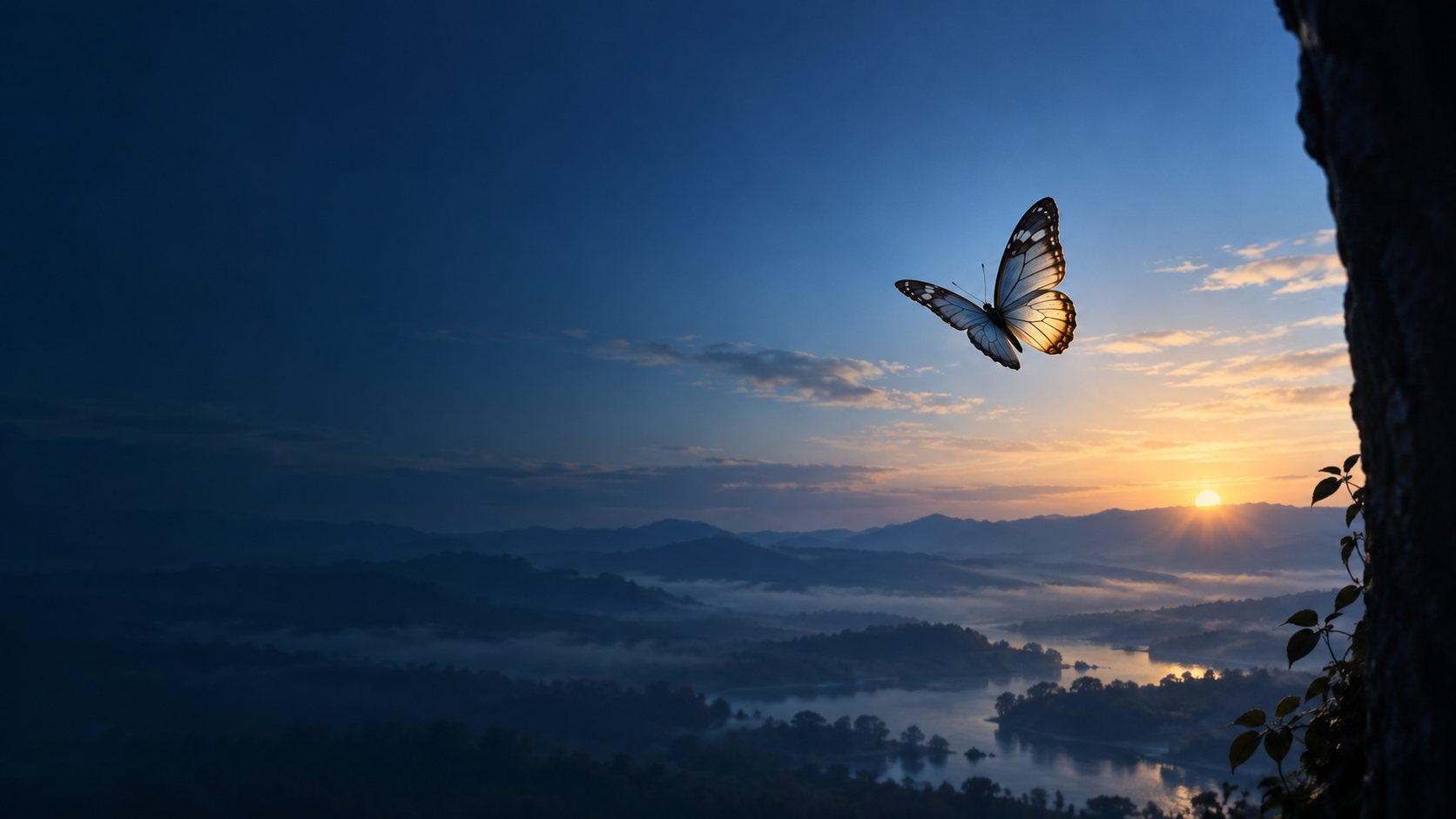
The last thing Zhou noticed before sleep was a narrow bar of light crossing the floor. It moved so slowly that he could not tell whether it was moving at all. A moth had found the open window. Somewhere outside, leaves scraped together in a breeze. He closed his eyes before the light reached his hand.
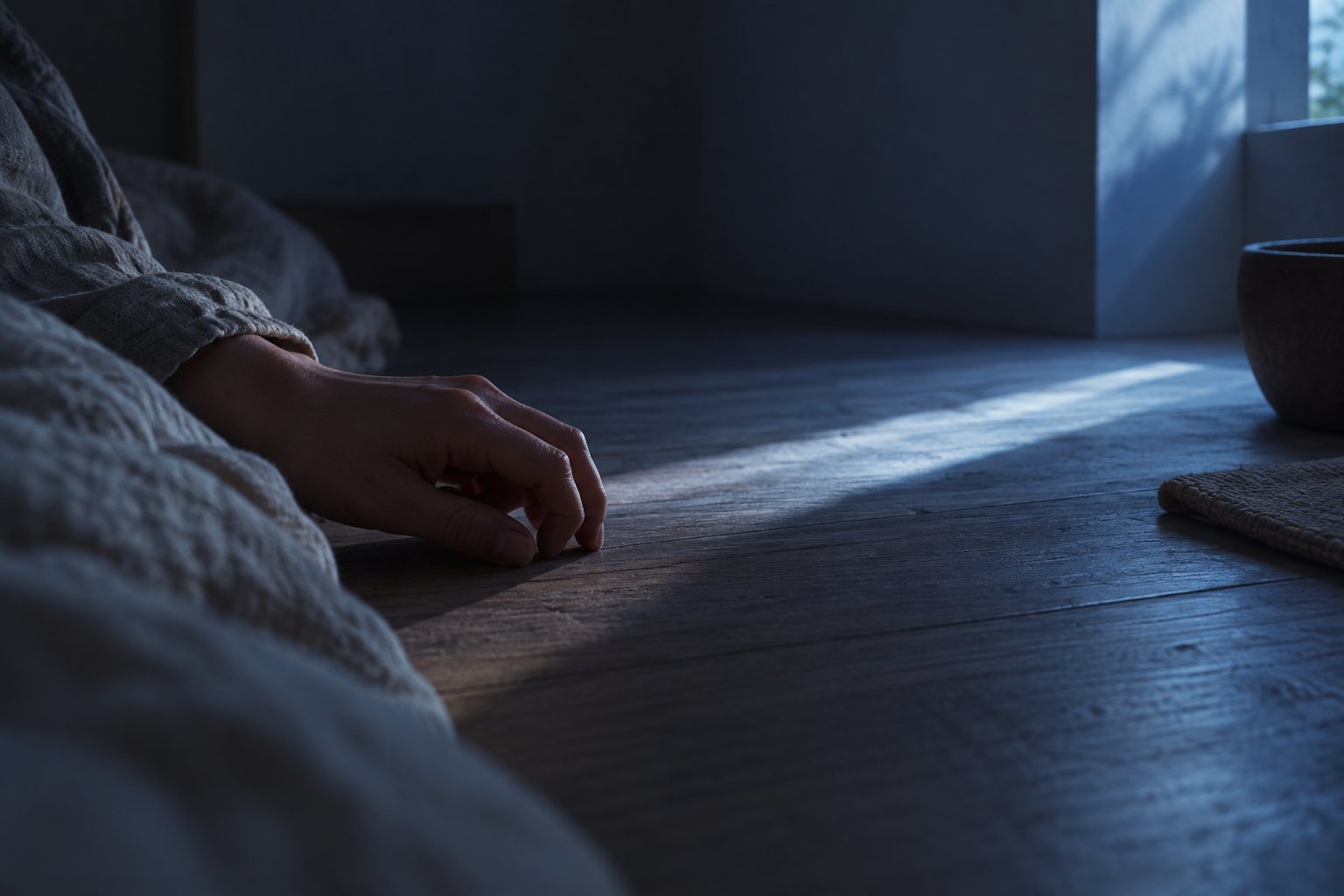
He had spent the day putting names to things. A shadow was a shadow because he could point to the light that made it. A doorway was a doorway because there was a room on either side. Such names were useful; they let him walk home, set down a cup, and recognize the place where he would sleep. He did not imagine that they would follow him everywhere. The cup, the doorway, and even this thought belong to our invented scene, not to a recorded episode in Zhou's life.
Then there was no room.
02 / 03
The flight
There was warmth on a pair of wings. There was a current of air beneath them and the effortless correction of a body that knew how to ride it. The world arrived as brightness, shadow, scent. A yellow flower stood near enough to land on, but a patch of sun just beyond it seemed more inviting. The butterfly went there instead.
It did not remember choosing to be a butterfly. It did not remember once being anything else. There was no Zhou waiting inside it, secretly taking notes on the dream. In the old passage, the butterfly moves with easy pleasure, unaware of the man named Zhou. That absence matters. For as long as this moment lasts, its life is not a disguise. [1]
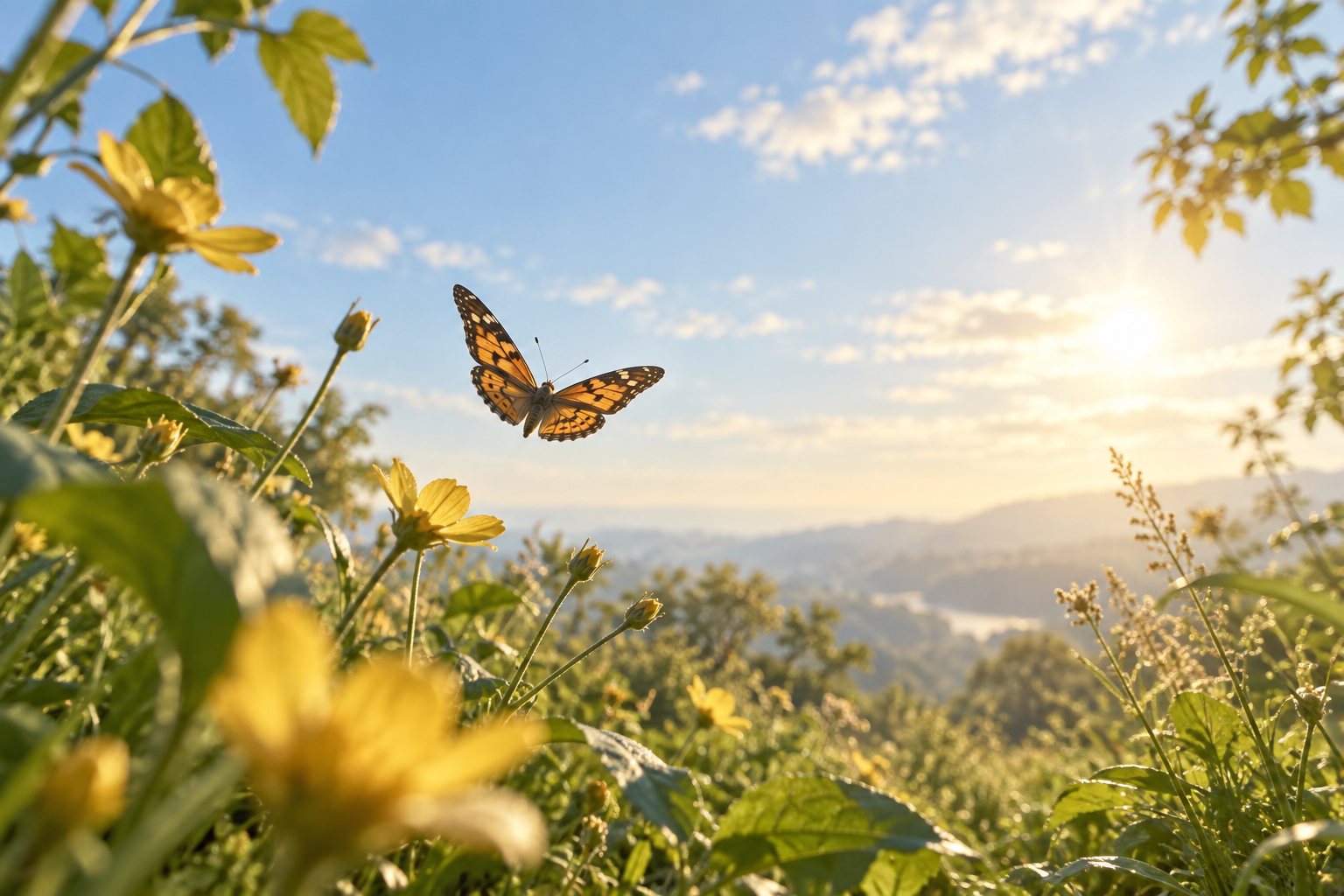
A draft lifted it above the flowers. Their heads bent at different angles, each holding its own share of the morning. The butterfly moved from one bright space to another. At the edge of its sight, the garden's wall became a pale line, then vanished behind a cluster of leaves. There was no need to turn back and measure the distance.
From above, the paths might have formed a pattern. From within the flight, there was only the next place to go. A petal tilted under its weight. The butterfly steadied itself. Sunlight touched one wing, and the wing opened to receive it.
There was no lost human past to recover and no human future to prepare for. The insect did not need to prove that the sun was real before it could warm itself. It did not pause above the wall to wonder whether a wall in some other life might be more solid. A gust came; its body answered. In this invented flight, that simple fit between movement and air is the butterfly's whole horizon.
Nothing announced the end.
03 / 03
The waking
The current failed. The flower, the wall, and the open sky drew away at once, as though a hand had folded the whole morning shut. Zhou woke. His arm lay where it had been; a stripe of light had reached the back of his fingers. The room returned with its corners and its familiar sounds. He could feel the grain of the floor beneath his other hand.
He knew his name. He knew the shape of his hands. Yet the knowledge arrived after the flight, not during it. A moment ago, there had been no man in that bright air who could be called Zhou. Now there was a man who could remember the butterfly.
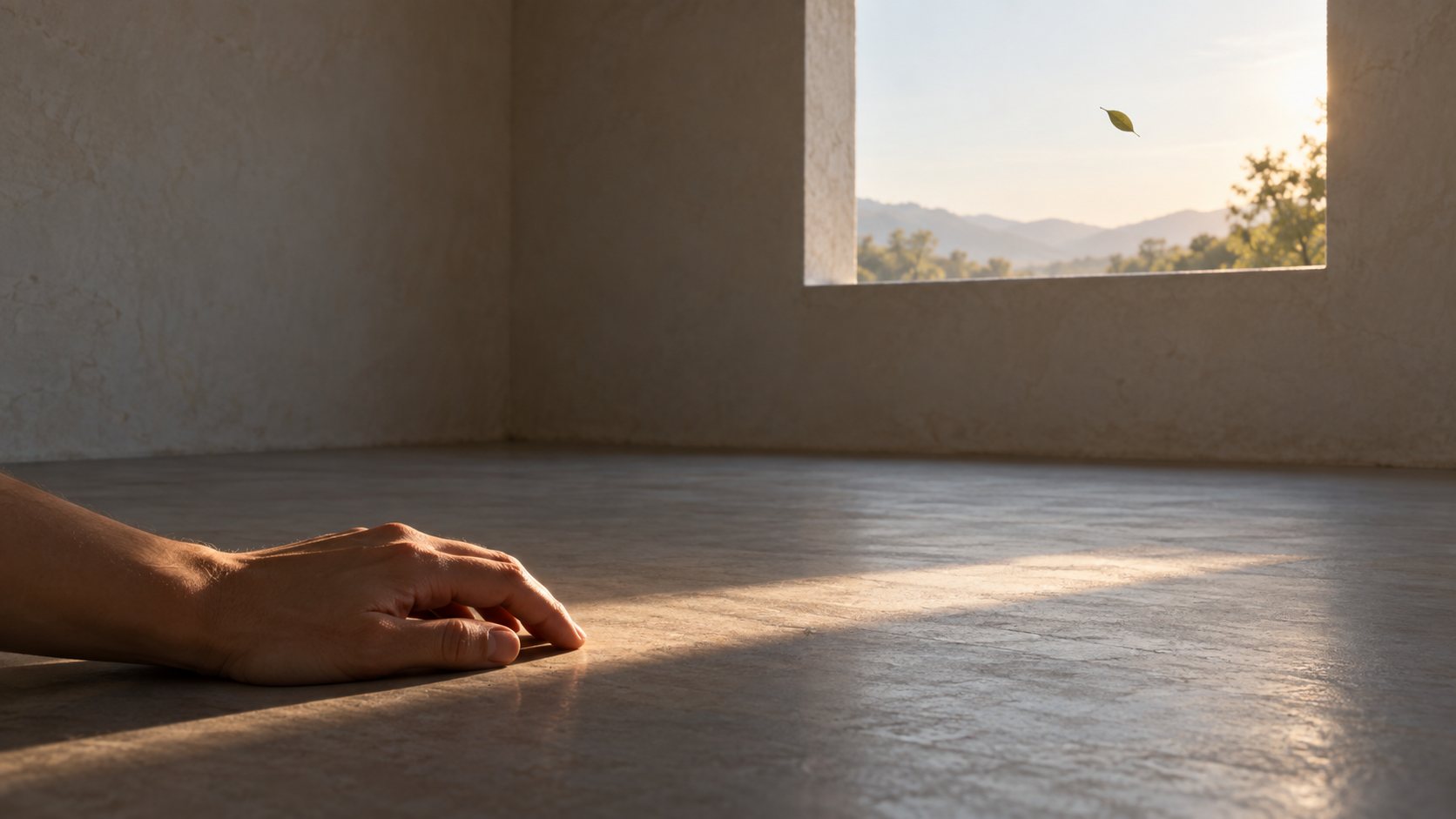
He sat up. The moth had gone. At the window, a leaf briefly crossed the strip of light and left it whole again. Zhou watched the empty space behind it. He could say, with ordinary confidence, that he had been asleep and was awake. The passage itself says he awoke as Zhou. But the certainty of this room did not erase how complete the other life had felt. [1]
He might have turned toward the cup and named it again. He might have listened for the same leaves he had heard before sleep. Either action would have located him in a familiar world. Neither could make the flight into a mere mistake. It had been a complete experience while it happened, just as waking was complete now. The two did not line up as neatly as the objects in his room.
“Which one was the dream?” he asked into the quiet. This line is our invented speech, not a quotation from the text. The older story asks whether Zhou dreamed he was a butterfly or a butterfly dreamed it was Zhou. It leaves the question open. [1]
He imagined explaining the difference to another person: here was a man, with a name, a body, and a room; there was an insect, with wings and a flower. Those were not interchangeable facts. The original passage insists that Zhou and the butterfly have a distinction. If he denied it, he would lose the force of the question. A wing could not hold this floor, and a hand could not ride that small current of air. [1]
Still, which point of view had the right to call the other unreal? In the flight, he had not felt like a man pretending. On the floor, he did not feel like a butterfly pretending. Each life, while it was lived, had its own center. Each had made its own world feel immediate.
Zhou let his hand rest in the stripe of light. It was warm now. He did not need to claim that the hand was a wing, or that the room was a flower. Something had changed between the two conditions, and his mind could not stand outside both at once to inspect the change from a safe distance.
The final words of the old passage name this wuhua: the transformation of things. They do not hand the reader a key that unlocks the dream. They leave Zhou awake, the butterfly gone from sight, and the boundary between them at once unmistakable and strangely mobile. [1]
The light traveled past his fingers. Zhou rose to open the window wider. The air came in with no explanation of where it had been.
The spoken version
Podcast transcript
Read the full podcast transcript
Storyteller: You’re listening to Eastward Stories. Today, a man goes to sleep, a butterfly flies through a garden, and one of them wakes up. The question is: which one?
Guide: That sounds like a riddle with a trick answer.
Storyteller: It may be more interesting without one. The scene comes from the closing lines of “Qiwulun,” the second Inner Chapter of the Zhuangzi. It is very short. Zhuang Zhou dreams he is a butterfly. In the dream, he is completely at ease. He does not know Zhou. Then he wakes as Zhou and asks whether Zhou dreamed the butterfly or the butterfly dreamed Zhou. The text ends by saying the two are distinct, and by naming the transformation of things.
Guide: So the original gives us the dream and the question. Does it describe a garden?
Storyteller: No. The garden we are about to walk through is our invention. So are the light, the room, and anything Zhou says aloud. We are giving the little passage room to breathe, while keeping its turning points visible.
Guide: All right. Take me to the beginning.
Storyteller: Imagine a quiet room at the end of a day. There is a bright strip on the floor, a little air at the window, and the rustle of leaves outside. Zhou closes his eyes. Then the room disappears. There is no announcement that a dream has started, no curtain rising. There is simply a butterfly in motion.
Guide: And we are seeing from the butterfly’s side?
Storyteller: Yes. Wings open into warm air. A flower comes near, then falls behind. The butterfly rises, dips, and finds another current. It doesn’t think, “I used to be a man.” In the source, it has no awareness of Zhou while it is a butterfly.
Guide: That is the first surprise. We know it is Zhou’s dream, but the butterfly doesn’t.
Storyteller: Exactly. If it secretly remembered its human name, the dream would be a costume. The story gives the butterfly a complete moment of its own. The breeze matters, the next landing place matters. Zhou’s concerns do not appear inside that moment.
Guide: I can picture the wings, but I’m tempted to say this proves that the butterfly is the real one.
Storyteller: Hold that temptation. The passage does not settle it. The butterfly’s ease is vivid; then there is a sudden waking. Zhou is Zhou again. He recognizes his own human form. The change is abrupt enough that we can imagine him sitting still for a second, waiting for the other world to finish leaving.
Guide: That pause is yours, though, not in the old text.
Storyteller: Right. In our retelling, the butterfly’s garden folds away. Zhou feels the floor under his hand, sees daylight cross his fingers, and listens to a leaf at the window. The source says he wakes, but it does not tell us what his room looked like. Those details are stage scenery, not historical evidence.
Guide: Then why spend time on them?
Storyteller: Because the story turns on two strong experiences. The butterfly was not a vague thought. Waking is not vague either. We want the listener to feel how easy it is, while standing in one condition, to call it the only solid one. The invented scene makes that tension audible; it does not answer the philosophical question for us.
Guide: Zhou could say, “I was asleep. Now I’m awake.” That seems ordinary enough.
Storyteller: It is ordinary. And the text does say he woke as Zhou. But its question follows immediately: was Zhou dreaming the butterfly, or is the butterfly dreaming Zhou? From inside the butterfly’s moment, there had been no Zhou to consult. From inside Zhou’s moment, the butterfly is something he remembers. Each standpoint has a claim to presence.
Guide: Are we meant to believe that everything is a dream?
Storyteller: I would be careful with that shortcut. The closing lines do not simply flatten the two into one. They explicitly say Zhou and butterfly have a difference. A man has hands; a butterfly has wings. The waking scene and the flying scene are not interchangeable. What the passage unsettles is the confidence with which one moment can stand outside another and declare what it ultimately was.
Guide: So the difference stays, but the boundary moves.
Storyteller: That is one way to read it. The old text names the ending wuhua, often discussed as the transformation of things. We are not claiming that Zhou physically turned into an insect in a documented event. We are following a philosophical story that uses a change of standpoint to make identity feel less fixed than it did a minute ago.
Guide: Is that your reading, or something a later commentator noticed?
Storyteller: Both kinds of material are worth separating. Our reading starts with the words of the passage. Later notes collected by Guo Qingfan discuss the butterfly’s ease, the force of waking, and the distinction between the two states. Those notes can sharpen a question. They do not add a real garden, a date, or a conversation to the original.
Guide: I like that the butterfly is not asked to explain itself. It just flies.
Storyteller: And Zhou, when he wakes, is not handed an explanation either. Imagine him trying to turn the experience into a neat sentence. “I dreamed a butterfly.” That is true from the room. “I was a butterfly.” That is what the flight felt like. Then he asks what the butterfly might say, if it were the one doing the dreaming.
Guide: But a butterfly cannot give us a report.
Storyteller: No, and the story is not an experiment in insect memory. It is a way to loosen the grip of our preferred angle of view. For one brief passage, the human narrator no longer gets the final word simply because he has a human name. The question stays alive after waking.
Guide: Does that mean Zhou is supposed to feel afraid?
Storyteller: The original does not tell us his emotional verdict. We might feel wonder, unease, delight, or all three. In the butterfly’s state, the text gives us ease and pleasure. In the waking, it gives us an unmistakable return to Zhou. Our version lets him pause in uncertainty, because that is the dramatic space between those moments. We should not sell his hesitation as a recorded confession.
Guide: Let’s return to that room, then. What happens after the question?
Storyteller: In our imagined ending, Zhou puts his hand into a stripe of sunlight. It is a hand, not a wing. The room is a room, not a flower. He opens the window, and air moves in. We stop there. The ancient passage also stops without telling us what he did next. Its final word is transformation, not a solution printed in the margin.
Guide: That feels strangely generous. I’m allowed to keep asking.
Storyteller: Exactly. The story is small enough to remember, but it keeps changing shape when you return to it. One day you may think about the butterfly’s ease. Another day you may think about the shock of waking. Or about that stubborn line: Zhou and the butterfly are different. None of those details is disposable if we want to hear the whole question.
Guide: There is a small detail I keep coming back to. The butterfly does not know Zhou. Why include that?
Storyteller: The source makes the dream feel complete from inside. The butterfly is not a person in costume, privately aware that it is really Zhou. The dream contains its own ordinary certainty. Then waking brings a second ordinary certainty: now Zhou is Zhou. The force of the ending comes from setting those two standpoints beside each other. If we describe the butterfly as knowingly pretending, the question collapses before it begins.
Guide: But the passage still says Zhou and the butterfly are different.
Storyteller: It does. That line keeps us from treating the story as a cheap claim that there is no distinction anywhere. A waking person and a butterfly are not interchangeable in the text. The problem is how confidently a person can describe the change of standpoint that links them in this account. The final phrase, often rendered as the transformation of things, gives the passage a name for change rather than a technical proof of what physically happened.
Guide: Could we read it as a story about dreams in the modern scientific sense?
Storyteller: We can bring our own questions to it, but the old lines do not report an experiment in sleep science. They offer a philosophical image. We would mislead listeners if we used the image as evidence for a particular theory of the brain. The adaptation stays close to what the passage actually says: a dream, a butterfly at ease, a waking Zhou, a question, a distinction, and transformation. The rest is our way of letting a listener dwell with those steps.
Guide: In our illustrations there is a room, a window, a wash of daylight. None of that appears in the brief original, does it?
Storyteller: No. The passage does not specify the room, season, weather, or Zhou's appearance. We use the window and changing light to make a continuous visual sequence, and mark them as imagined. Even the picture of a butterfly is an artistic choice about color and movement. The old text gives us its ease, not a species identification. When a reader reaches the source note, we want the boundary between original passage and created scene to be obvious.
Guide: Does the story need a final answer from us?
Storyteller: I do not think so. A listener can say that a dream is a dream and waking is waking, while still noticing how each state feels authoritative from within. The old paragraph invites that unease and then stops. We can put the question in clear English, but we should not resolve it with a sentence the ancient text never wrote. The ending earns its quiet because the distinction remains, and so does the puzzle.
Guide: And for someone meeting the story for the first time, where should they go next?
Storyteller: On the Eastward Stories page for this episode, you can read the independent story and see the Chinese title, Qiwulun, plus the original passage and our adaptation notes. The illustrations are imagined scenes; the source note shows what belongs to the old text. Thanks for listening. We’ll leave the window open, and leave the question with you.
Research notes
Sources & adaptation
- Zhuangzi, Qiwulun (chapter 2), final passage, Chinese original
The dream, waking question, distinction and wuhua come from this brief passage. Punctuation varies by edition.
- Guo Qingfan, Zhuangzi jishi, later collected commentary
Later interpretation, not evidence for the invented room or dialogue.
What was adapted
- The room, garden, dialogue and sensory details are original dramatic additions.
- The primary text does not date the scene or describe a literal metamorphosis.
- Zhou and the butterfly remain distinct in the primary passage; the question is left open.
Music credit
“Meanwhile” — Scott Buckley · CC BY 4.0。 Track details CC BY 4.0 license