
Classics & Literature · China / Warring States account
Tian Ji's Three Races
田忌赛马
Sun Bin sees the matchups that make one loss and two wins.
Historical account. Newly written from the cited Chinese source. The image sequence is AI-generated illustration; all unsupported locations, appearances and gestures are artistic interpretation.
Listen to the story
Take the audio path
The episode will try to begin when the page opens. Browser settings may require you to press Play.
The two voices are AI generated from an edited dialogue script. Music credit appears below.
The illustrated story
Read the story
Follow the full English narrative, with scenes placed alongside the passages they illustrate.
01 / 04
What Sun Bin noticed
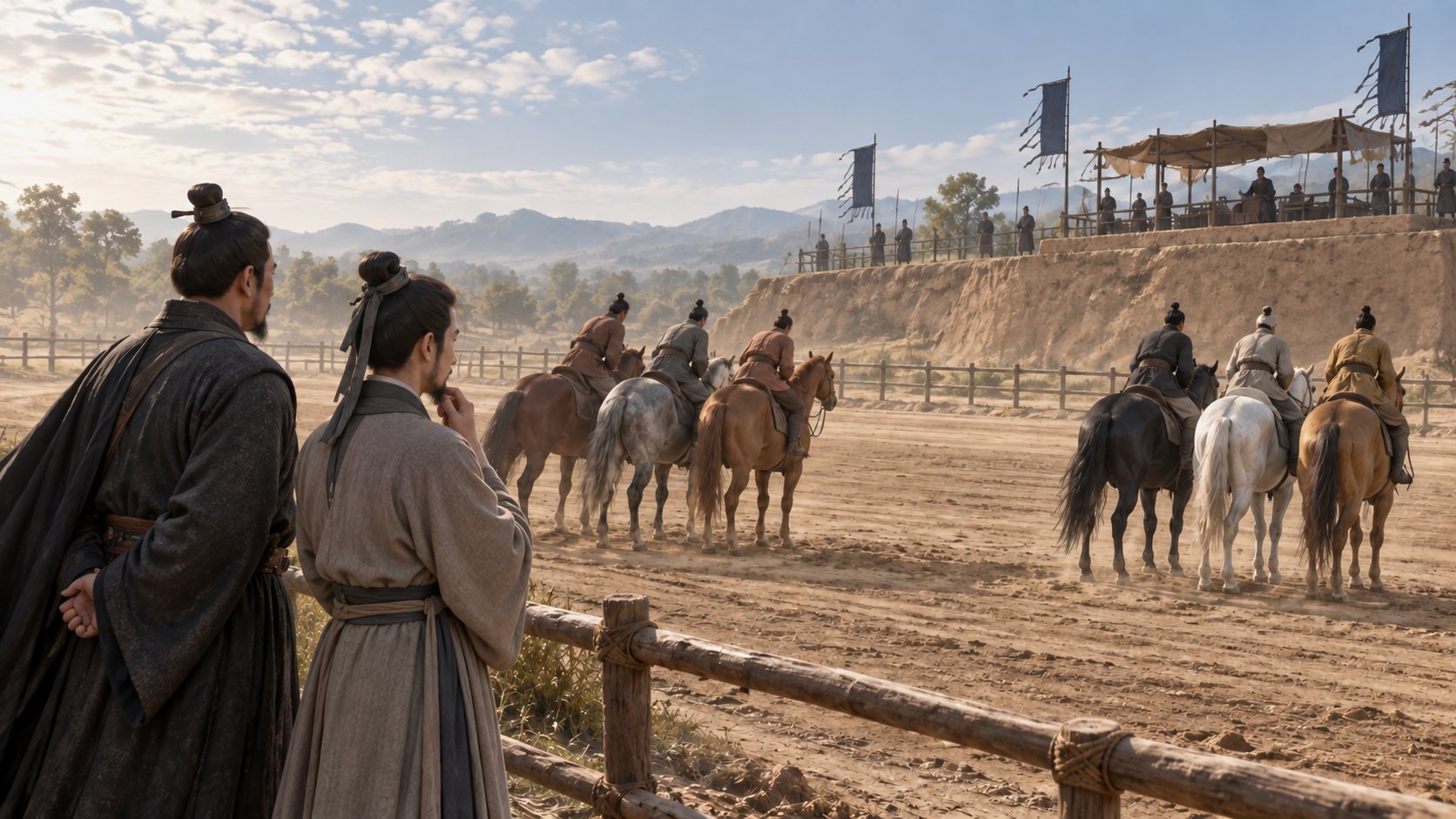
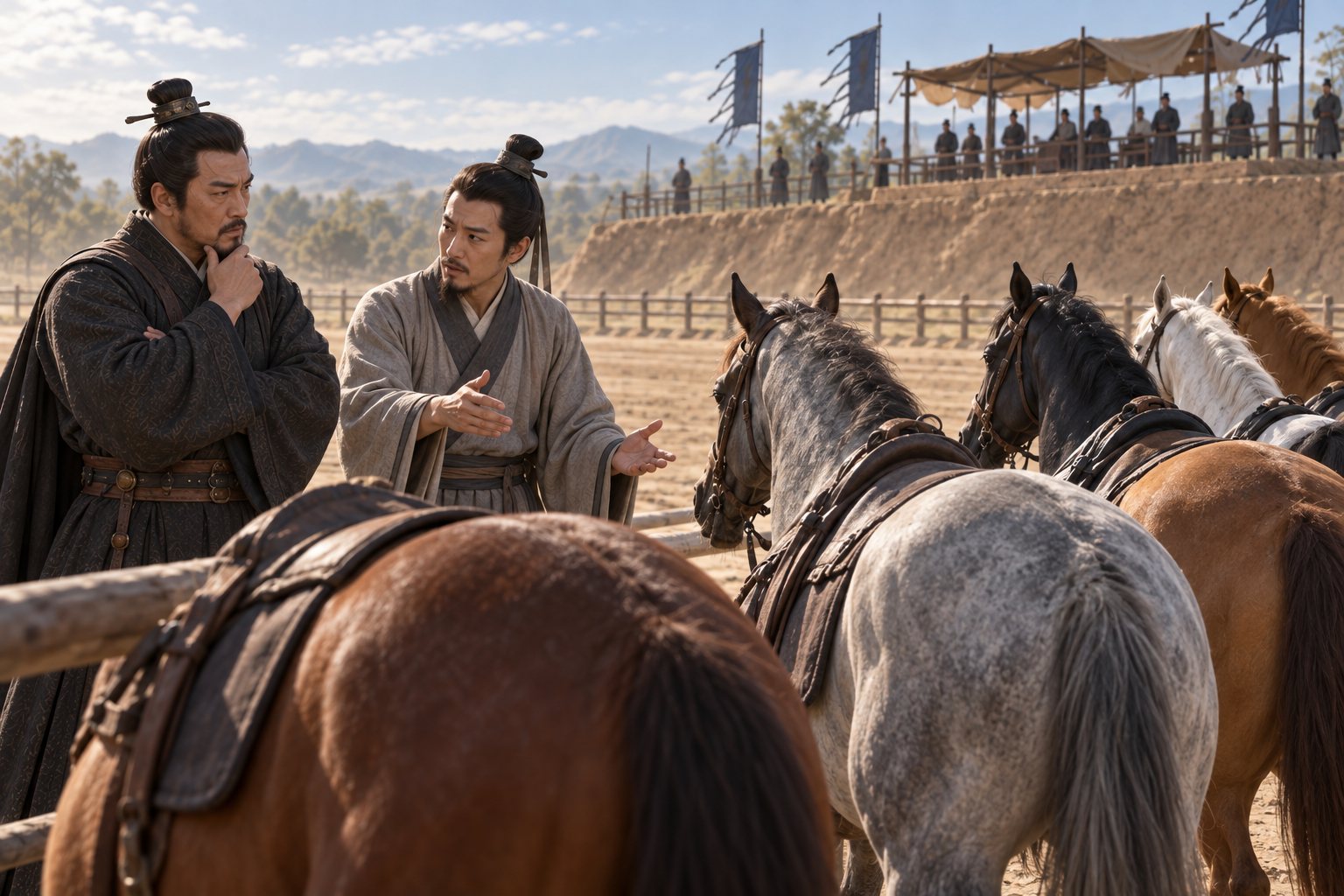
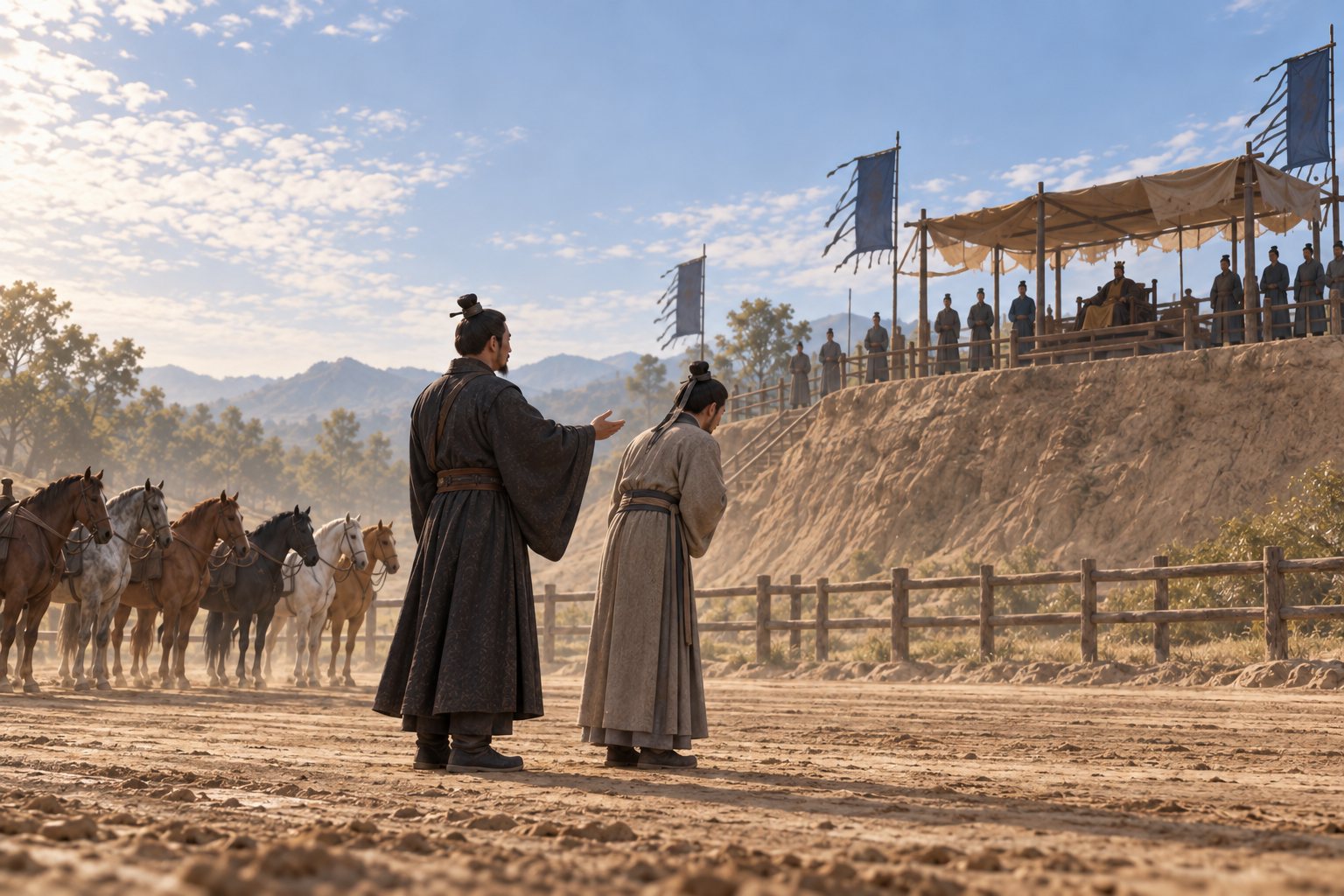
Tian Ji, a general in the state of Qi, often raced horses against the young nobles of the court for high stakes. Sun Bin, whom Tian Ji treated as a guest, watched the animals. Both sides had horses ranked in three classes: fast, middle, and slow. The differences between corresponding groups, the text says, were not enormous. Sun Bin told Tian Ji to wager again. He could arrange a win. [1]
The Shiji does not give us a track plan or a conversation over a wooden board. We can imagine the moment before the races, when someone decides the order in which each horse will run, but the only plan the source actually preserves is the pairing itself. [1]
02 / 04
One loss, then two wins
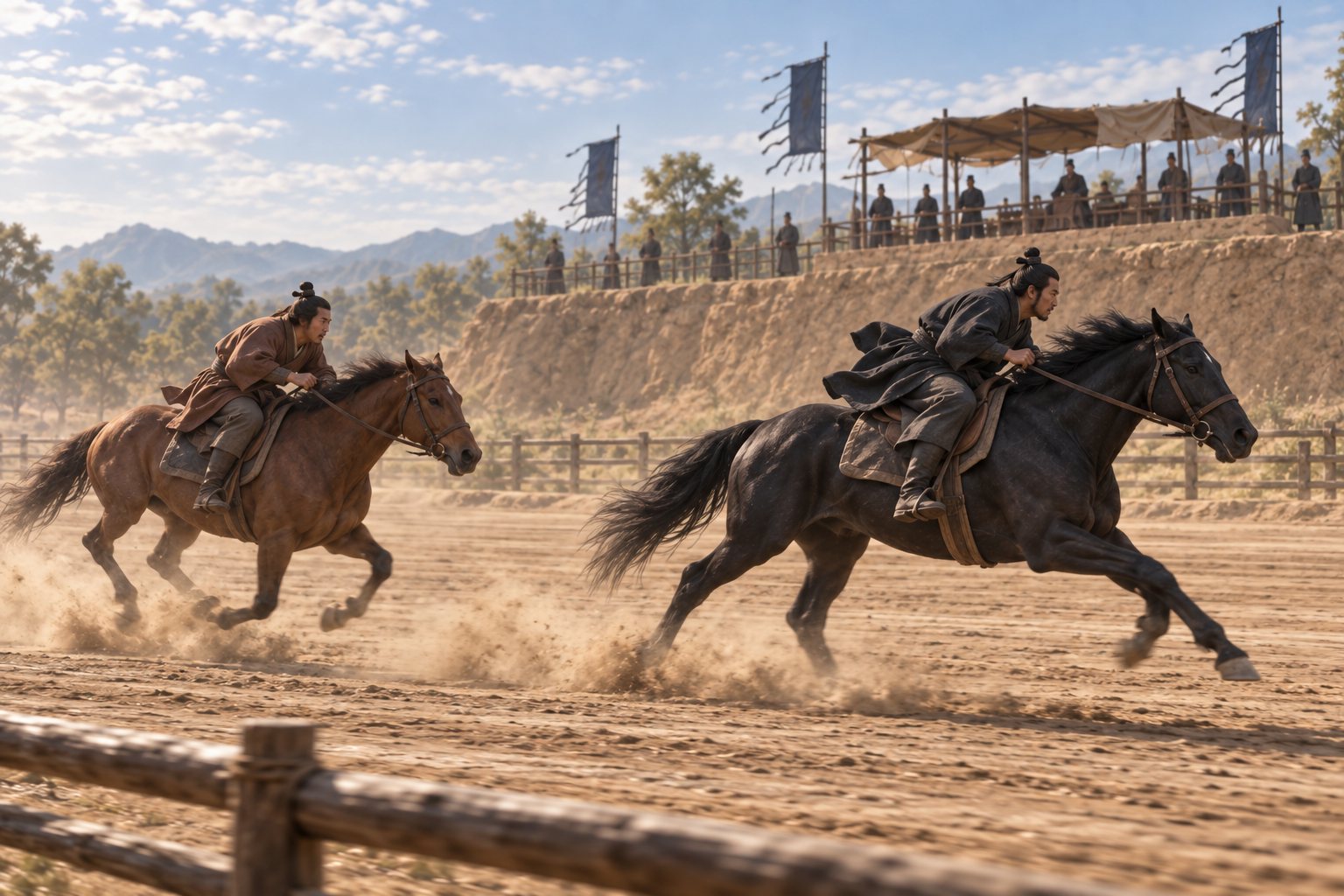
Tian Ji sent his slow horse against his opponent's fastest. That first contest was lost. [1]
03 / 04
Two wins from the next pairings
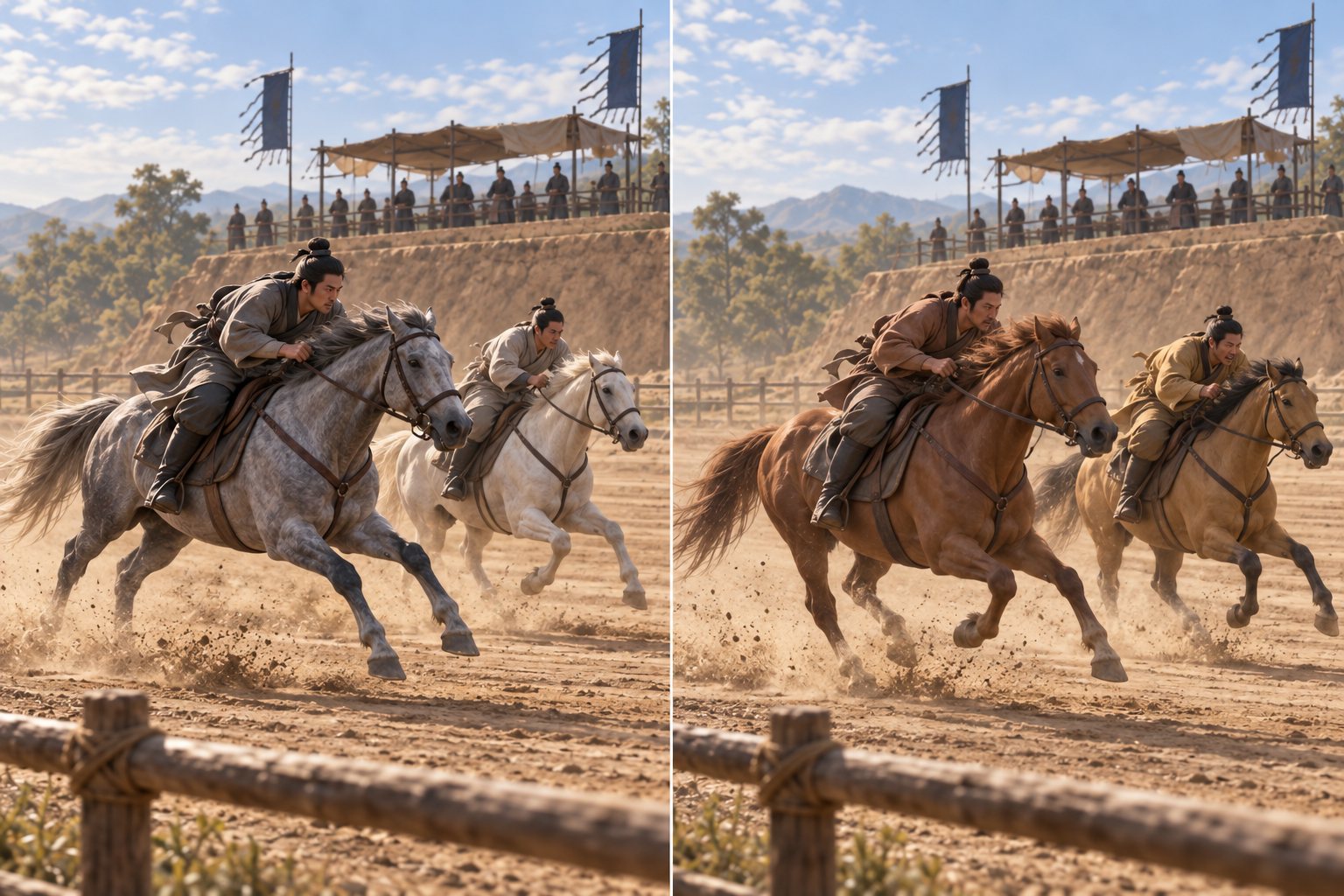
Next came Tian Ji's fastest horse against the other side's middle horse: a win. Finally, Tian Ji's middle horse raced the other side's slow horse: another win. He lost one of three and won the match. [1]
The point is easy to misremember as a trick that somehow made weak horses fast. It did not. Sun Bin changed the matchups, accepting a loss he was unlikely to avoid and using the other two horses where they could win. His observation about the relatively small gaps between the groups matters. Without it, the same order would not necessarily produce the same result. [1]
The text says the races took place in a wager involving the king and nobles, and that Tian Ji won the king's stake. It does not tell us who shouted at the first finish, how close the second race was, or whether Sun Bin smiled. Those are the familiar ornaments of later retellings. The preserved account gives us the order, the outcome, and what happened next. [1]
04 / 04
A guest becomes a teacher
After the races, Tian Ji presented Sun Bin to King Wei. The king asked him about military methods and made him a teacher. Later episodes in the Shiji place Tian Ji and Sun Bin together in campaigns. We stop before those campaigns. The race is a compact scene about choosing a better frame for a problem. The horses remain what they were; the structure of the contest changes. [1]
That does not mean every contest can be won by sacrificing the first round. It means Sun Bin looked closely enough at the actual conditions to know which round could be given up and which two could be won. In our imagined final image, the track is empty after the third race. The source records no such view. The useful thing left behind is a sequence: slow against fast, fast against middle, middle against slow. [1]
The spoken version
Podcast transcript
Read the full podcast transcript
Storyteller: Welcome to Eastward Stories. Three races. One deliberate loss. Two wins. A military thinker notices that the horses are not separated by a huge gap, and a general changes his order of play. Today we tell Tian Ji's horse race, then ask what the old account actually says.
Guide: Before we begin, is this one of your myths or one of the accounts attached to named historical figures?
Storyteller: It appears in Sima Qian's Shiji, in the biography that discusses Sun Bin and Wu Qi. Tian Ji is a Qi general. Sun Bin is a guest he treats well. The passage records their connection, the race strategy, and an introduction to King Wei of Qi. A textual account is not a camera recording. We can follow it while making clear that the course and faces in our art are invented.
Guide: I have heard Sun Tzu mentioned in versions of this story. Which Sun are we talking about?
Storyteller: Sun Bin. The chapter first tells of the earlier strategist Sun Wu, then moves to Sun Bin. The text calls Sun Bin “Sunzi” in this scene, which can confuse modern readers. We will use his personal name so the two are not merged. Sun Bin had endured a severe punishment in Wei and reached Qi, where Tian Ji welcomed him. That context appears immediately before the horse-racing paragraph.
Guide: So why did he think Tian Ji could win?
Storyteller: Tian Ji often raced against the princes of Qi for heavy stakes. Sun Bin watched the horses. They fell into three ranks, upper, middle, and lower. He saw that the differences in performance were not extremely wide. He told Tian Ji to keep wagering; he could make him win. The observation matters as much as the rearrangement. Without some overlap in capability, a neat diagram would not change the outcome.
Guide: Was there a chart, a row of painted tiles, something he used to show the plan?
Storyteller: The Shiji does not say. A chart could be a useful modern way to explain the logic, but we would not draw it as an authentic object in Sun Bin's hands. The text does give his instruction: match Tian Ji's lower horse against the opponent's upper, his upper against their middle, and his middle against their lower. Let us walk through the races in that order.
Guide: The first race sounds painful. Why send the weakest horse against the strongest?
Storyteller: Because that is the matchup most likely to be lost anyway. The lower horse runs against the other side's upper and loses. We can imagine the noise of a track, but not the exact margin or the crowd's reaction. What matters is that one loss uses up the opponent's strongest entry. The general has not made his weakest horse faster; he has made a strategic sacrifice.
Guide: Then Tian Ji's best horse still has to run.
Storyteller: Yes, against the other side's middle-ranked horse. It wins. And Tian Ji's middle horse races their lower-ranked horse. It wins too. The source says he was defeated once and victorious twice. He won the wager with the king. That is the arithmetic: one lost round plus two won rounds equals the overall result.
Guide: It sounds obvious once you say it. Why would the normal order have been different?
Storyteller: The familiar expectation is to compare like with like: upper against upper, middle against middle, lower against lower. Sun Bin asks a different question. The rules require three matches, but do they require identical rank pairings? The passage does not lay out a formal rulebook. It simply presents a permitted order that turns a weak position into two stronger ones. We should not invent officials approving a trick or opponents failing to notice a visible change.
Guide: Did Tian Ji know he would lose the first one?
Storyteller: The pairing makes that expectation plausible, and the account records the loss. It does not record his private thoughts. A dramatic retelling might show him gripping a rail, but that would be our staging. The source is remarkably spare. It spends more words on Sun Bin's assessment and instruction than on the speed of the horses. That tells us where its interest lies.
Guide: What if the other side had swapped its order in response?
Storyteller: A fair question for game theory, but not one this source answers. Its account gives one contest, not a universal formula. We should not promise this sequence beats any opponent in any circumstance. Sun Bin had noticed these particular horse groups. Another set of animals or a different rule might defeat the plan. Strategy here is attention to actual conditions, not a magic incantation.
Guide: The large wager also makes the stakes feel more than symbolic.
Storyteller: The text says the race was for a thousand gold pieces involving the king and princes. We need not stage piles of modern coins or claim a precise conversion into today's money. What matters is that it was consequential enough for Tian Ji to trust Sun Bin in a public setting. After the three rounds, Tian Ji presented him to King Wei. The king asked about military methods and made Sun Bin a teacher.
Guide: Does the race prove he could command an army?
Storyteller: Not by itself. The Shiji goes on to tell military episodes, but a horse race is a story about allocation under a rule, not a complete test of leadership. The later campaigns deserve their own account. Here the sequence serves as a compact introduction to Sun Bin's way of seeing relative advantage. Tian Ji matters too: he listened to a guest and then gave that guest access to the king.
Guide: I think a lot of modern versions make Tian Ji a passive person who just obeys a genius.
Storyteller: That loses the relationship in the source. Tian Ji had welcomed Sun Bin and believed him enough to wager. He could have ignored the advice. The text does not tell us about hesitation, but it does record trust. The result depended on the general accepting a plan that begins with a loss, something leaders can find difficult even when the arithmetic is clear.
Guide: What will the illustration sequence show?
Storyteller: An imagined pre-race lineup with three horse classes; the three pairings; then a quiet moment after the third finish. We will keep each horse's coat and tack consistent so viewers can follow which animal ran where. No modern grandstand, number saddlecloth, stopwatch, or painted finish line. We will label all visual particulars as artistic reconstruction, not evidence about this race.
Guide: Can the site make the pairing understandable without putting text inside an AI-generated image?
Storyteller: Yes. The page can place a small accessible table beside the illustration: Tian Ji lower versus opponent upper, loss; Tian Ji upper versus opponent middle, win; Tian Ji middle versus opponent lower, win. That is editorial typography, grounded in the source. The image model should never be asked to draw readable labels. Those usually fail and they can make an invented scene look falsely archival.
Guide: After all three, what should we remember?
Storyteller: That Sun Bin looked at the size of the differences, not only at the labels on the horses. He selected one loss he could afford and two contests he could win. Tian Ji accepted the order and later introduced him to the king. The old passage gives us that much. For the rest—the dust, the crowd, the faces—we can imagine, but we should say we are imagining.
Guide: I want to be certain about the arithmetic. Can we walk through the three races without the images?
Storyteller: Of course. Imagine each side has a faster group, a middle group, and a slower group. Tian Ji's groups are a little weaker than the opposing groups at the same level. If he pairs faster with faster, middle with middle, and slower with slower, he is likely to lose all three. Sun Bin uses the order instead. Tian Ji sends his slower horses against the opponent's faster horses and accepts that loss. He then sends his faster horses against the opponent's middle horses, and his middle horses against the opponent's slower horses. The old account says he wins those two. The match ends two to one.
Guide: So the move is not making any horse faster.
Storyteller: Exactly. Nothing in the source says Sun Bin improves the animals or changes the rules midway. He changes the pairings before the races. This is why the story remains understandable without a modern chart, but the chart helps. It makes visible that the single deliberate sacrifice creates two favorable comparisons. The strategy depends on the particular differences among these groups. It would not be a universal trick if the horses' relative speeds were different.
Guide: Does the Shiji tell us exactly how wide the margins were?
Storyteller: No measured times appear in the passage. It says the parties had upper, middle, and lower classes and that their strengths were close enough for Sun Bin to see an opportunity. We should not turn that into numbers, stopwatch readings, or a photographically precise finish. The visual version shows an order of arrival, not a recorded margin. Even the colors of the horses are our continuity device, not a detail taken from the chronicle.
Guide: The king appears in this episode. Is the king the same as Sun Bin's opponent in every race?
Storyteller: The account says Tian Ji often raced and wagered with the Qi princes or nobles, and it describes a wager involving the king. Our episode focuses on the three-race scheme and the meeting that follows. We avoid inventing a private conversation with the king or a named judge. After Tian Ji wins, he introduces Sun Bin to the king, and the king asks him about warfare. That continuation is in the Shiji; what any person felt while the horses ran is not.
Guide: Why would a racing story be in a biography about military thinkers?
Storyteller: The chronicle uses the race to show how Sun Bin attends to relative strength and sequence. Soon afterward the narrative moves to military counsel. We can notice that connection without claiming the horse race proves the outcome of a later battle. The useful thought is local and precise: a choice that loses one contest can still improve the result of a series. Our ending keeps the meeting with the king because it is part of the old narrative, while refusing to turn a clever afternoon into a complete theory of leadership.
Guide: Where can I check the old account?
Storyteller: The Eastward Stories page links the Chinese text of the Shiji, volume sixty-five, with the Sun Bin paragraph identified. Our English and Chinese stories include adaptation notes, and this transcript sits below them. Thank you for listening. Next time someone presents three equal-looking choices, ask whether the labels or the matchups are doing the real work.
Research notes
Sources & adaptation
- Shiji, volume 65, Biographies of Sunzi and Wu Qi, Sun Bin passage
See source and adaptation notes at the end of the story.
What was adapted
- The race strategy is a transmitted historical account in the Shiji, not a filmed or independently reconstructed event.
- Sunzi in this passage is Sun Bin, not the earlier Sun Wu.
- The documented pairings are lower vs upper (loss), upper vs middle (win), middle vs lower (win); clothing, course and horse colors are imagined.
Music credit
“Meanwhile” — Scott Buckley · CC BY 4.0。 Track details CC BY 4.0 license