
Myths & Ideas · China / Han-era classical text
Yi Shoots at the Suns
羿射日
Ten suns scorch the fields, and an archer faces the sky.
Traditional retelling. Original retelling of an ancient text; source events and invented visualization are labeled in the story and captions.
Listen to the story
Take the audio path
The episode will try to begin when the page opens. Browser settings may require you to press Play.
The two voices are AI generated from an edited dialogue script. Music credit appears below.
The illustrated story
Read the story
Follow the full English narrative, with scenes placed alongside the passages they illustrate.
01 / 04
A sky too crowded with light
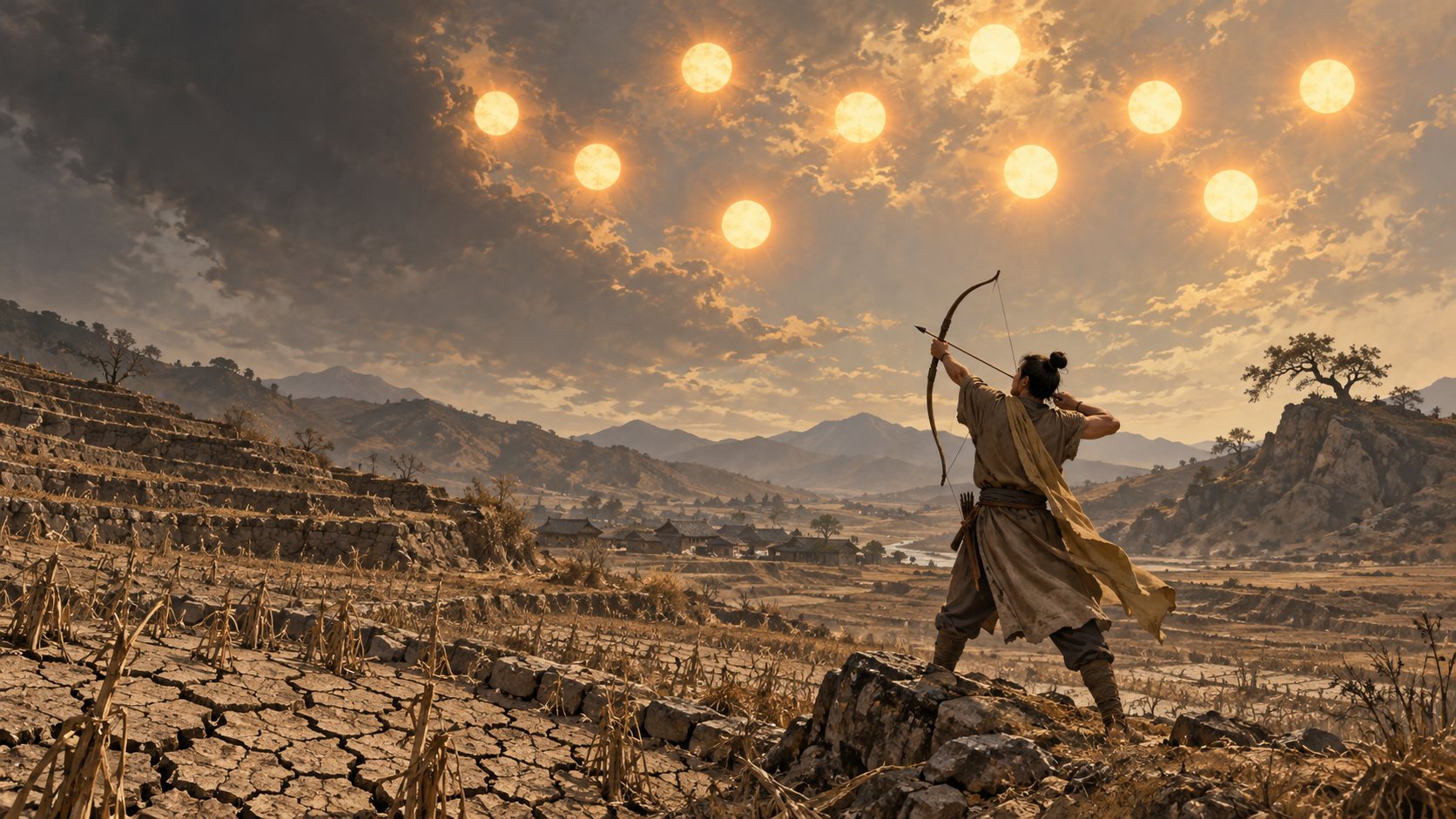
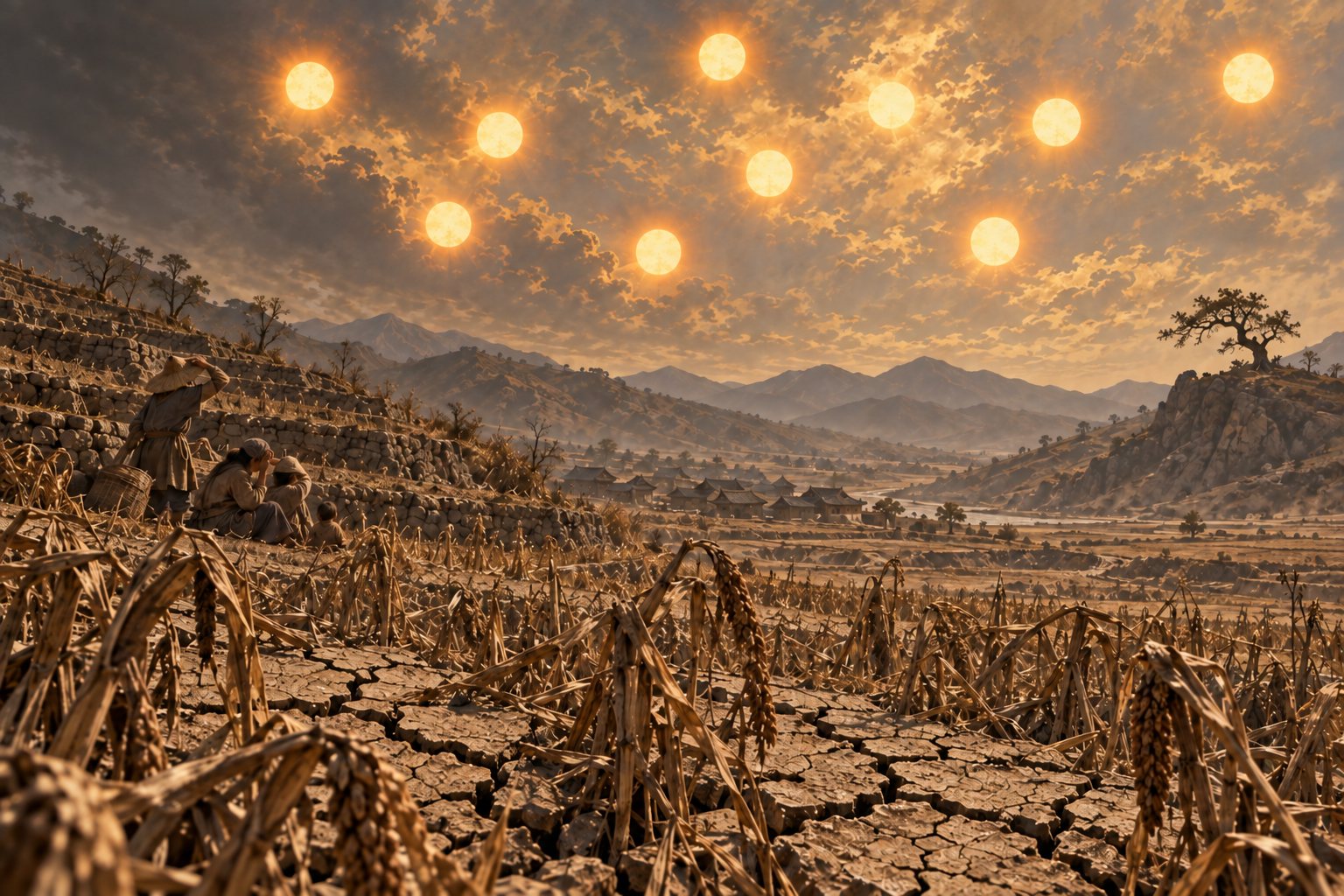
The old text places the story in the time of Yao. Ten suns rise together. Crops scorch; trees and grasses die; people have nothing to eat. Other dangers trouble the land as well. The heat above and the creatures below make the world difficult to inhabit. Huainanzi does not name a single farming household or draw a diagram of the ten suns. It gives us a crisis large enough to reach every field. [1]
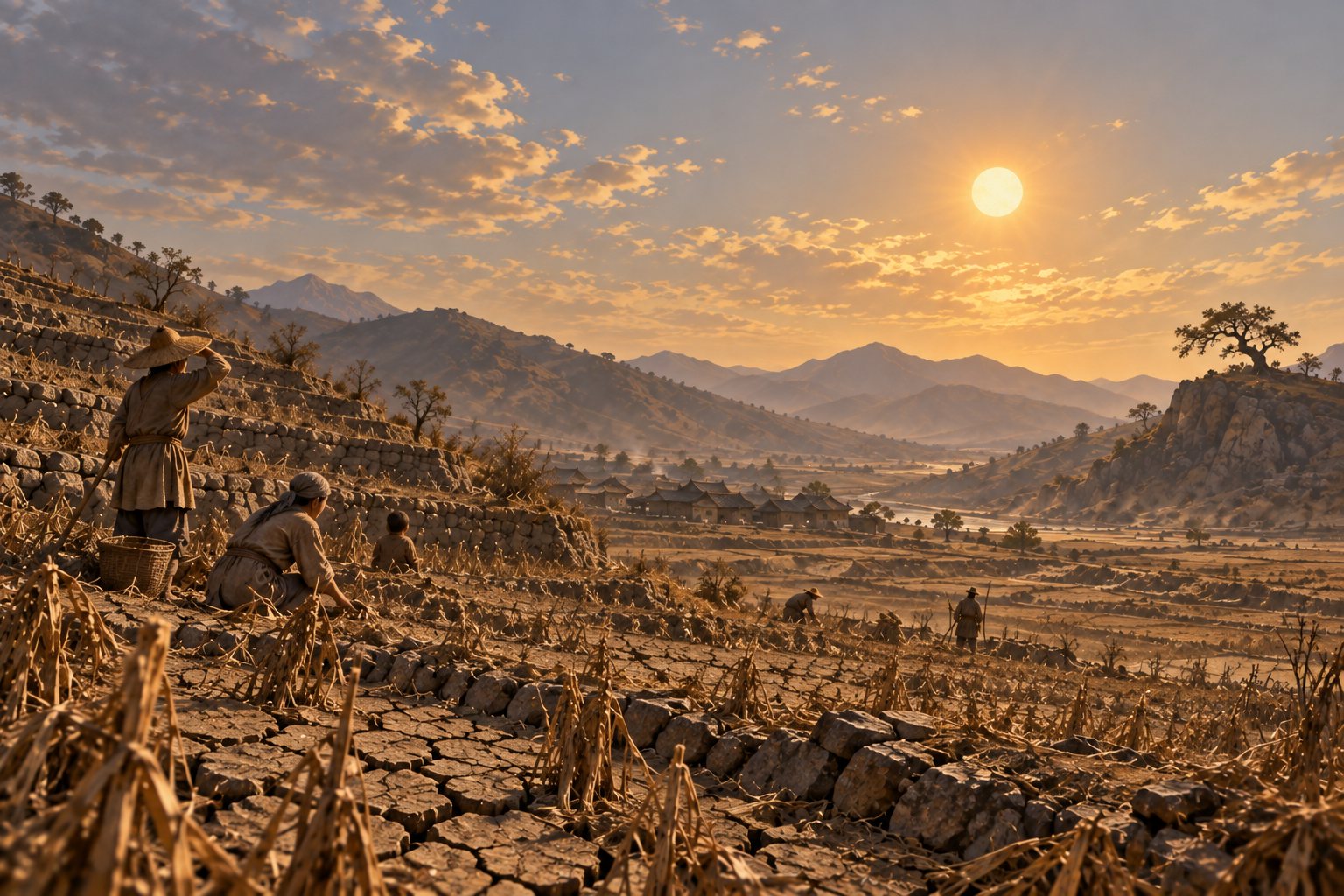
Our illustration puts a dry plot of farmland in the foreground. People shelter at its edge and look toward ten distinct lights overhead. The field and the people are invented viewpoints. The number of suns and the damage to crops come from the source. We make the lights countable for a reader, without presenting the arrangement as an ancient astronomical record. [1]
02 / 04
A charge from Yao
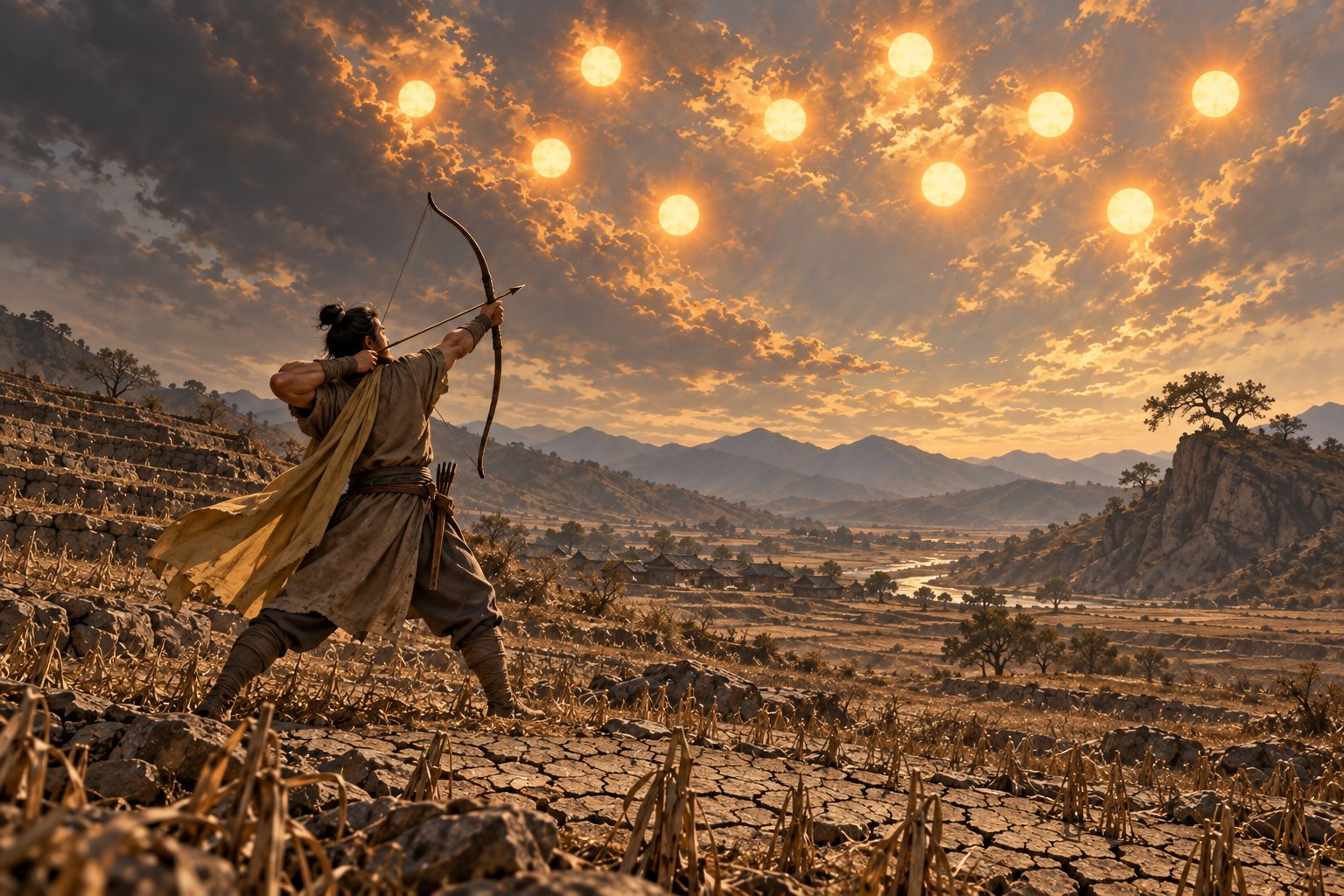
Yao sends Yi to deal with the harm. The passage names a sequence of threats and places Yi's act of shooting upward at the suns among his other actions. He faces beings called Zaochi, Jiuying, Dafeng, Yayu, the long snake and Fengxi in different places. These names describe a mythic field of dangers; they are not a list of animals that modern readers can identify by species. [1]
In our scene Yi pauses before drawing the bow. The pause, the wood of the bow and the expression on his face are our choices. The surviving passage does not give him a speech. It does not describe the exact shape of his arrows or the clothes he wore. Keeping those details in the realm of art lets the historical source remain clear. [1]
03 / 04
What the line says
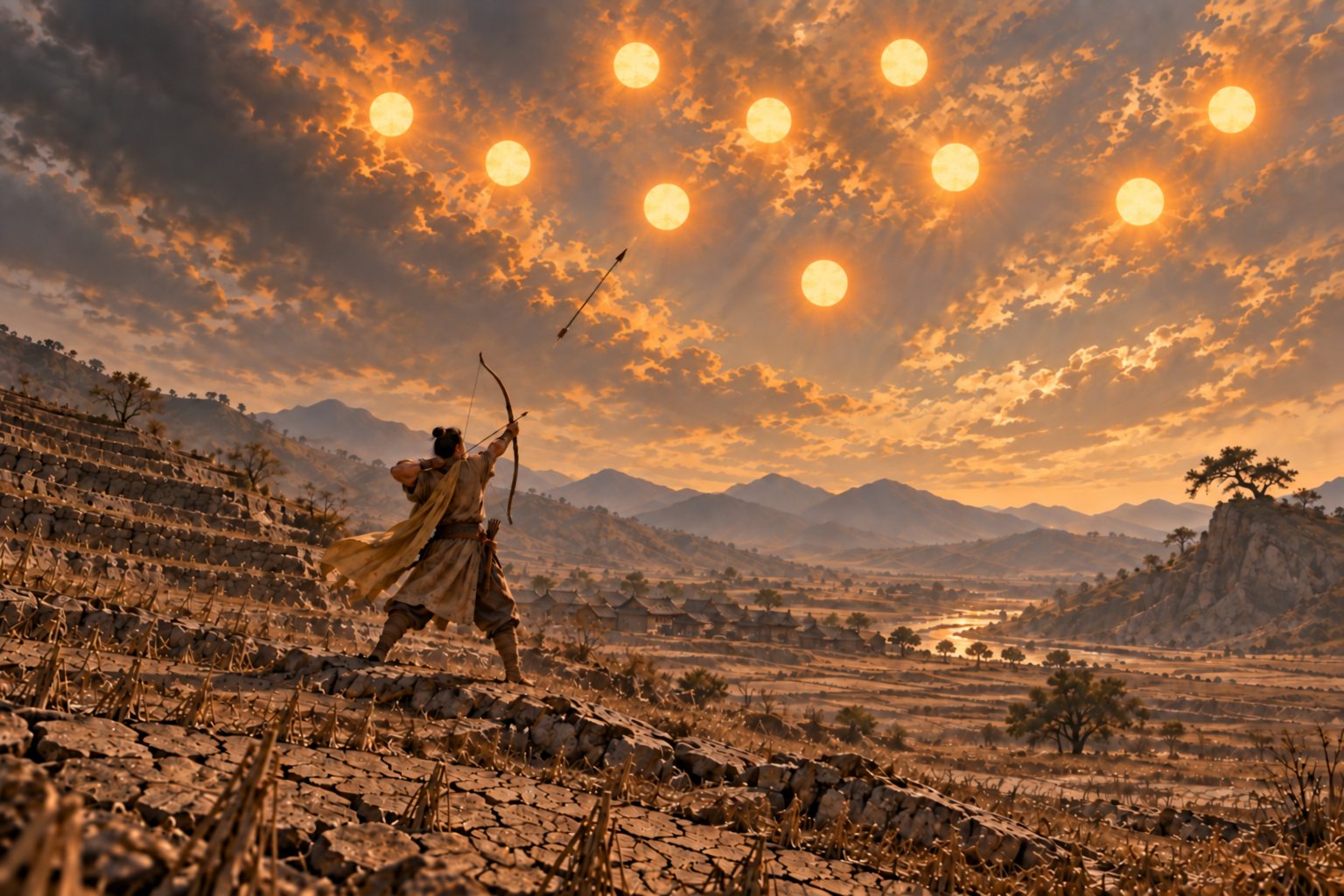
Yi shoots upward at the suns. The source is spare. It does not count each arrow or describe each sun falling. A later and very familiar telling says that nine were brought down and one remained to warm the earth. That is a useful way to picture the restoration of balance, but it should not be silently inserted into the wording of this Huainanzi passage. Our final image lets a single gentle sun light the ground as an interpretive ending, with that difference stated here. [1] [2]
The passage closes with the people rejoicing and honoring Yao as ruler. It connects Yi's action to an account of good government and relief from danger. We can read that political frame alongside the dramatic image of the archer; we do not need to claim that Yao's reign has a verifiable calendar date or that ten suns were an observed astronomical event. [1]
04 / 04
The day after the arrow
The dried field does not instantly turn green. Our version ends before any miraculous harvest, because the text does not describe one. The change is simpler: people can imagine tending the ground again without a sky that destroys the next season's food. The arrow is the most memorable picture; the life that becomes possible afterward is why the picture matters.
The spoken version
Podcast transcript
Read the full podcast transcript
Storyteller: Welcome to Eastward Stories. Imagine looking up from a dry field and seeing ten suns instead of one. In the passage we are reading today, the crops are scorched, trees die and people have no food. A figure named Yi is sent to face the danger.
Guide: Is this the story people often call Hou Yi shooting down nine suns?
Storyteller: It is related, but we need to be precise. Our anchor is a passage in Huainanzi, in the chapter “Basic Warp,” or Benjing xun. It says ten suns came out together and that Yi shot upward at the suns. It does not, in that passage, narrate nine separate suns falling and one being left behind. That familiar count appears in later commentary and popular retellings.
Guide: So we can tell a dramatic story while staying honest about what the source says?
Storyteller: Exactly. The number ten, the ruined crops and Yao's order to Yi are in the text. The shape of Yi's bow, his face, the particular field and the second-by-second action of an arrow are not. We can imagine them, but we should not smuggle them into the ancient line.
Guide: What happens before Yi draws his bow?
Storyteller: The source presents a world in distress. Ten suns shine together. Grain plants are burned; grasses and trees die; people cannot eat. It also names several harmful beings on the land. The sky and the ground both need relief. Our image of people sheltering at the edge of a cracked field is a way to feel the crisis on a human scale. The text does not name those people.
Guide: Does it say where the ten suns are arranged?
Storyteller: No. We imagine ten distinct lights spread across the sky, but the old text does not preserve a diagram. In a myth, “ten suns together” makes excess visible. The point is to feel that excess, not to treat the tale as a record of an astronomical event.
Guide: I keep thinking about the farmers. They cannot negotiate with the sky. What do they do in our telling while they wait?
Storyteller: They look for shade that keeps shrinking. Someone lifts an empty water jar and hears a grain of dust strike its base. Another person walks along an irrigation channel that has become a line in the earth. Those are scenes we invent to make hunger and heat felt. The source gives us the far starker statement that grain and plants have burned and people have nothing to eat. It does not give us a named farmer, a village or a jar.
Guide: A single jar makes “the people had no food” feel much less distant.
Storyteller: Yes. A short line from the text can contain a whole landscape of hardship without describing every life within it.
Guide: Where does Yao enter the account?
Storyteller: The passage says Yao sends Yi to remove the threats. It lists actions against beings called Zaochi, Jiuying, Dafeng, Yayu, a great snake and Fengxi, each in a different named place. Shooting upward at the suns appears among these deeds. Yi is not introduced as a lone archer who solves one isolated problem; he belongs to a larger sequence of relief from harm.
Guide: Those creature names sound unfamiliar. Do they all appear around Yi at once?
Storyteller: The passage lists his deeds one after another, each in a different place. It does not stage one enormous meeting of all the threats. We stay with the sun crisis today, but that wider list helps us understand why Yi's action matters in this account.
Guide: The name “Hou Yi” can also cause confusion, can't it?
Storyteller: Yes. English summaries often use “Hou Yi” for the archer, but the passage we are reading says “Yi.” Different traditions have figures with overlapping names. Our page uses “Yi” when discussing this line of Huainanzi, and it mentions the familiar “Hou Yi” name only to help readers recognize the tale.
Guide: Does that also mean we should resist giving him a tidy life story in the opening?
Storyteller: It does. A listener may know versions in which the archer has a wife, a magical medicine or a tragic ending. Those are powerful stories, but this passage does not ask us to follow them. Its Yi is the figure Yao sends when several harms threaten the world. If I gave him a complete family scene here, it would suggest the old paragraph supplied an inner life that it does not record.
Guide: Then the bow almost becomes a question mark. We see a person act, but we do not pretend to know everything inside him.
Storyteller: Exactly. His motion is vivid; his private thoughts remain unknown. I imagine a breath before the shot. The ancient paragraph does not mention that breath, yet pausing there lets us feel the distance between a person on the ground and ten lights above him.
Guide: What happens in that imagined pause?
Storyteller: Yi stands on a dusty ridge, small against the sky. He reaches for the bowstring. The old passage says nothing about a pause, a speech to Yao, or a promise to the farmers. Its force comes partly from how little it needs to say: an action stated in a few words against a sky full of danger.
Guide: And after he shoots, do nine lights drop?
Storyteller: In a later explanation preserved with commentary on Tianwen, nine suns are struck and one remains. A familiar modern telling follows that line. But the Huainanzi paragraph we began with does not count the fallen suns. We let the sky grow gentle again, while naming which tradition supplies the one-sun ending.
Guide: Why make that distinction if almost everyone knows the nine-sun ending?
Storyteller: Because it teaches the reader how traditions grow. One ancient sentence can be brief; commentary may add a concrete count; a later storyteller adds a character's thoughts and a family waiting below. None of those layers has to be thrown away. But it is fair to tell people which layer they are hearing.
Guide: Why bring that difference into the episode at all?
Storyteller: Because the versions show how a story travels. The earlier paragraph describes Yi shooting upward at the suns and then reports relief. Later explanation makes the outcome countable. We can carry both in one telling without pretending they are the same sentence. You can follow the arrow and still know that the ancient line is shorter than the story most of us remember.
Guide: Does the original at least say the danger ended?
Storyteller: Its closing report says that the people rejoice and honor Yao as ruler. That is how the text connects Yi's work to a broader account of good government. We are not going to turn that into a dated news report. Yao belongs to a legendary ancient setting here, and the story's political meaning is part of what the text is doing.
Guide: I had thought the point was only that one strong person saved the world.
Storyteller: Strength matters in the image, but the source's frame is larger. A ruler sees that people cannot live, sends someone to remove dangers, and the people respond. You can question that frame or admire it, but leaving it out would change the shape of the passage.
Guide: So an ancient listener might hear something about rule and responsibility as well as archery?
Storyteller: That is a fair reading of the text's arrangement. It begins with conditions that ordinary people cannot endure, places Yao's command before Yi's deeds and ends with the people's joy. Those clauses give the action a public setting. We should not claim every early reader heard one moral lesson. But we can notice that the narrative does not end by praising a beautiful shot. It ends with people able to imagine life after the danger.
Guide: And we can ask whether a ruler gets too much credit for work done by someone else.
Storyteller: We can. The text's ending honors Yao, while the list of dangerous tasks names Yi as the person carrying them out. Holding both facts together makes the tale more interesting than a simple hero poster. There is a world of people below the sky, an archer in the middle, and a ruler in the narrative frame. The old paragraph leaves us to consider how those roles connect.
Guide: What about the field? Does it immediately recover once the sky calms?
Storyteller: The passage does not tell us that. Our story stops before the next harvest. The soil has been damaged. A single pleasant sun in a picture cannot make the plants spring back overnight. A quiet ending may be more honest: people can finally begin the work of living and planting again.
Guide: Can we end with one of those invented people returning to the field?
Storyteller: We can, if we keep the gesture modest. Someone kneels, breaks apart a hard clod of earth and tests whether the ground will take water again. No instant green shoots, no miracle harvest. The ancient account says the people rejoiced; our small movement gives that joy a practical future. Relief is not the same thing as recovery, and the source does not promise a date for the crops to return.
Guide: I like that better than a victory parade. It lets the air change slowly.
Storyteller: It also keeps the focus on the people who could not eat. When the final image holds one sun over the damaged land, the land still matters. The later account of one remaining sun supplies a visual ending, but the human ending belongs to those who must live beneath it.
Guide: Do we know what Yi looked like?
Storyteller: No. We have no recoverable portrait of this mythic archer. The figure we describe, with a plain bow and a weathered cloak, is an imaginative character. The old text gives him an action, not a face or a period costume.
Guide: Let me see if I can summarize the evidence. Ten suns together and burned crops: in Huainanzi. Yao sends Yi, and Yi shoots upward at the suns: also there. Exactly nine fall: that comes through later explanation. The field, face and pause: your own invention.
Storyteller: That is precisely the separation. The Eastward Stories page links the Chinese source and the later commentary, in addition to the English and Chinese retellings. A listener can enjoy the bow drawn against the sky and still see how the older text is worded.
Guide: What do you hope stays with people after the episode?
Storyteller: Not a scoreboard of suns. I hope they remember the image of a world with too much light and too little food, and the question beneath it: what does it take to make the world habitable again? Yi's arrow is the bright center of the myth. The possibility of tending a field tomorrow is its human consequence. Thank you for listening to Eastward Stories.
Research notes
Sources & adaptation
- Huainanzi, Benjing xun, Chinese original
Ten suns, scorched crops, Yao's charge to Yi and the people's response.
- Chuci buzhu, Tianwen commentary, Chinese original
Later commentary giving the nine-struck, one-remains interpretation.
What was adapted
- Huainanzi says ten suns appeared together and Yi shot upward at the suns; it does not explicitly count nine falling suns in this passage.
- A single remaining sun follows later commentary. The field, archer design and arrow shots are original visuals.
Music credit
“At The End Of All Things” — Scott Buckley · CC BY 4.0。 Track details CC BY 4.0 license