
Classics & Literature · China / Classical text
The Man Who Set Out to Move Two Mountains
愚公移山
An old man lifts the first basket against two mountains.
Traditional retelling. Newly written from the cited Chinese source. The image sequence is AI-generated illustration; all unsupported locations, appearances and gestures are artistic interpretation.
Listen to the story
Take the audio path
The episode will try to begin when the page opens. Browser settings may require you to press Play.
The two voices are AI generated from an edited dialogue script. Music credit appears below.
The illustrated story
Read the story
Follow the full English narrative, with scenes placed alongside the passages they illustrate.
01 / 04
A road that went the long way round
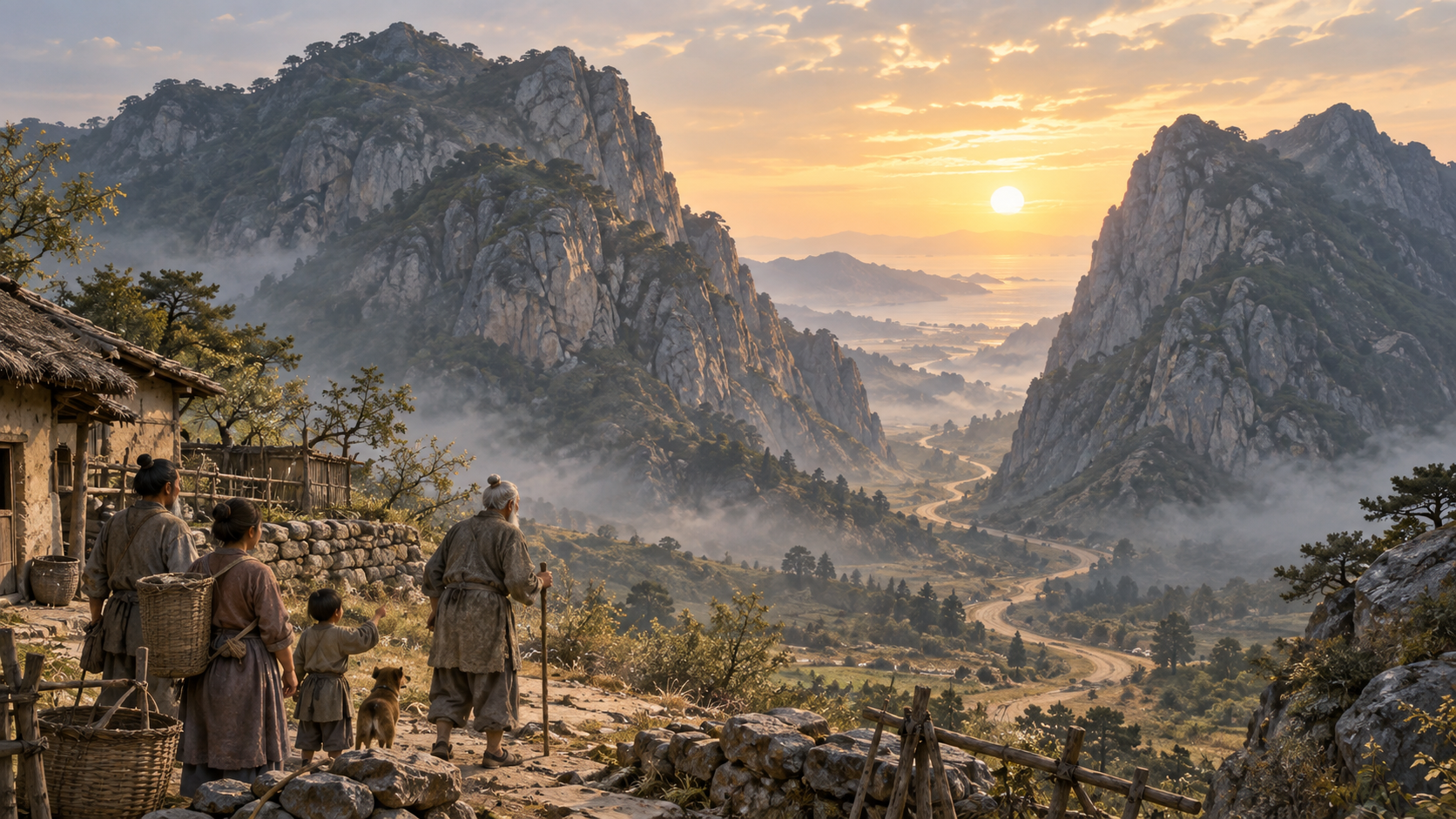
From the front of his home, the old man could see the mountains that made every journey longer. Taihang and Wangwu stood across the route south. To travel, people had to go around them. The man known as the Old Fool of North Mountain was nearly ninety. He had spent a lifetime making that detour. [1]
One day he called his household together. What if they cleared the obstacles and opened a direct road? The family agreed to try. His wife asked the question that made everyone look at the size of the task: how could their strength diminish two enormous mountains when it might not even level a small hill? And where would all the stone and earth go? The answer was to carry it toward the edge of the Bohai Sea. [1]
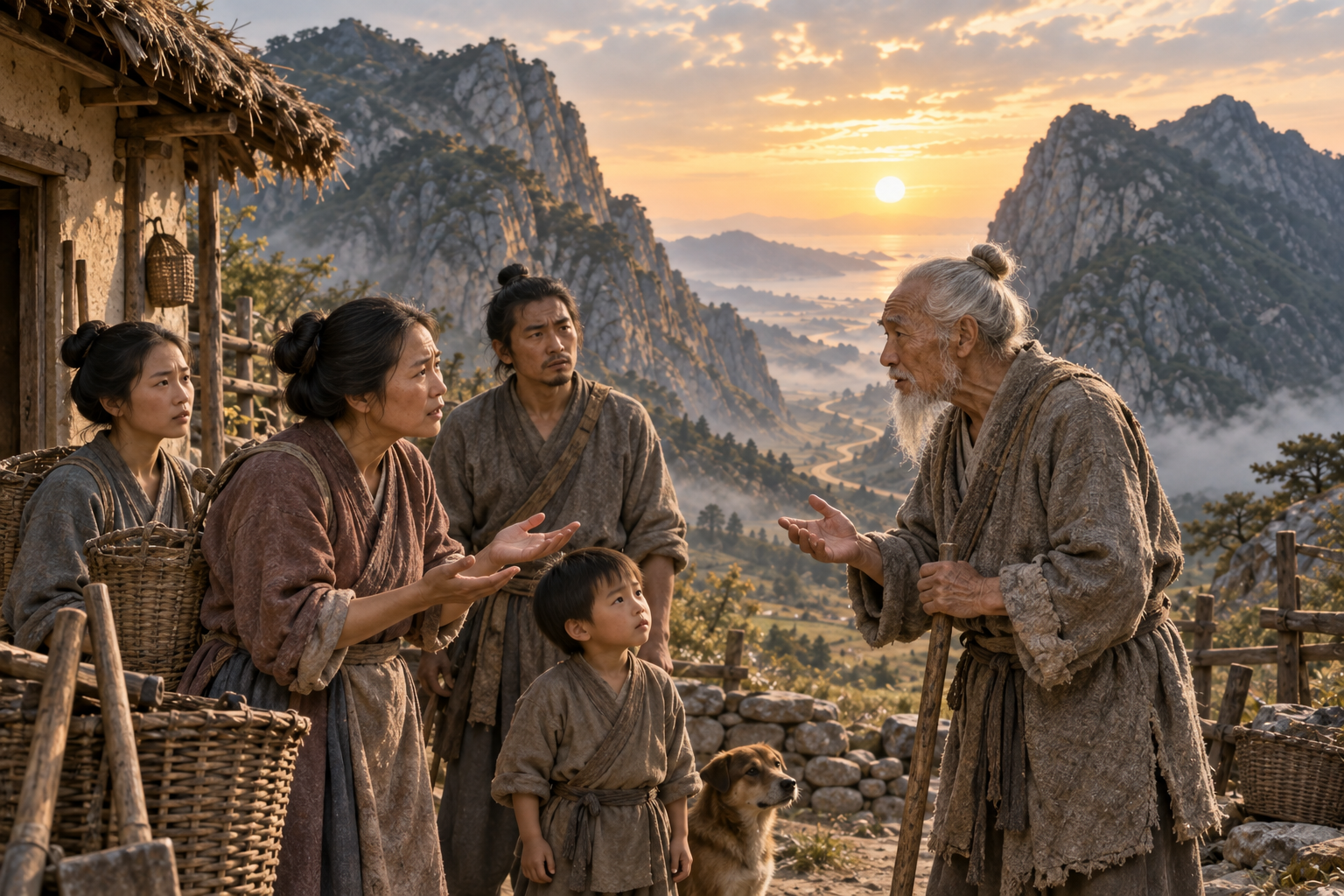
The ancient text gives us the proposal, her objection, and the destination. It does not tell us the color of the morning or what anyone held in their hands. Those belong to our imagined scene. [1]
02 / 04
A basket of earth
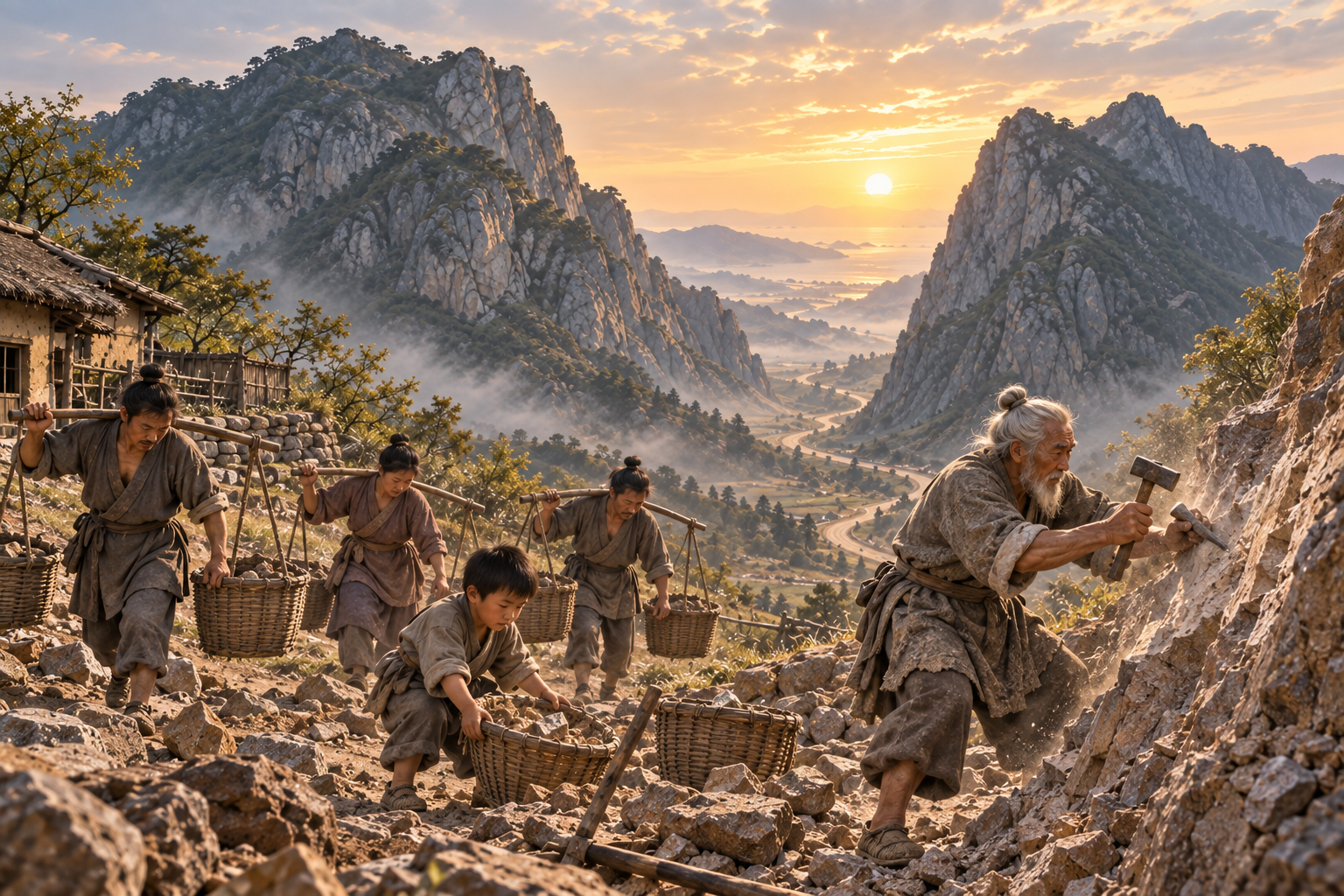
The old man set to work with descendants strong enough to carry loads. They broke rock, dug soil, and moved it in baskets. A neighbor's young son came to help. The distance was so great that the source says the seasons changed before they made a return journey. One basket did not shorten the road in any way a passerby could see. [1]
03 / 04
Two ways to count time
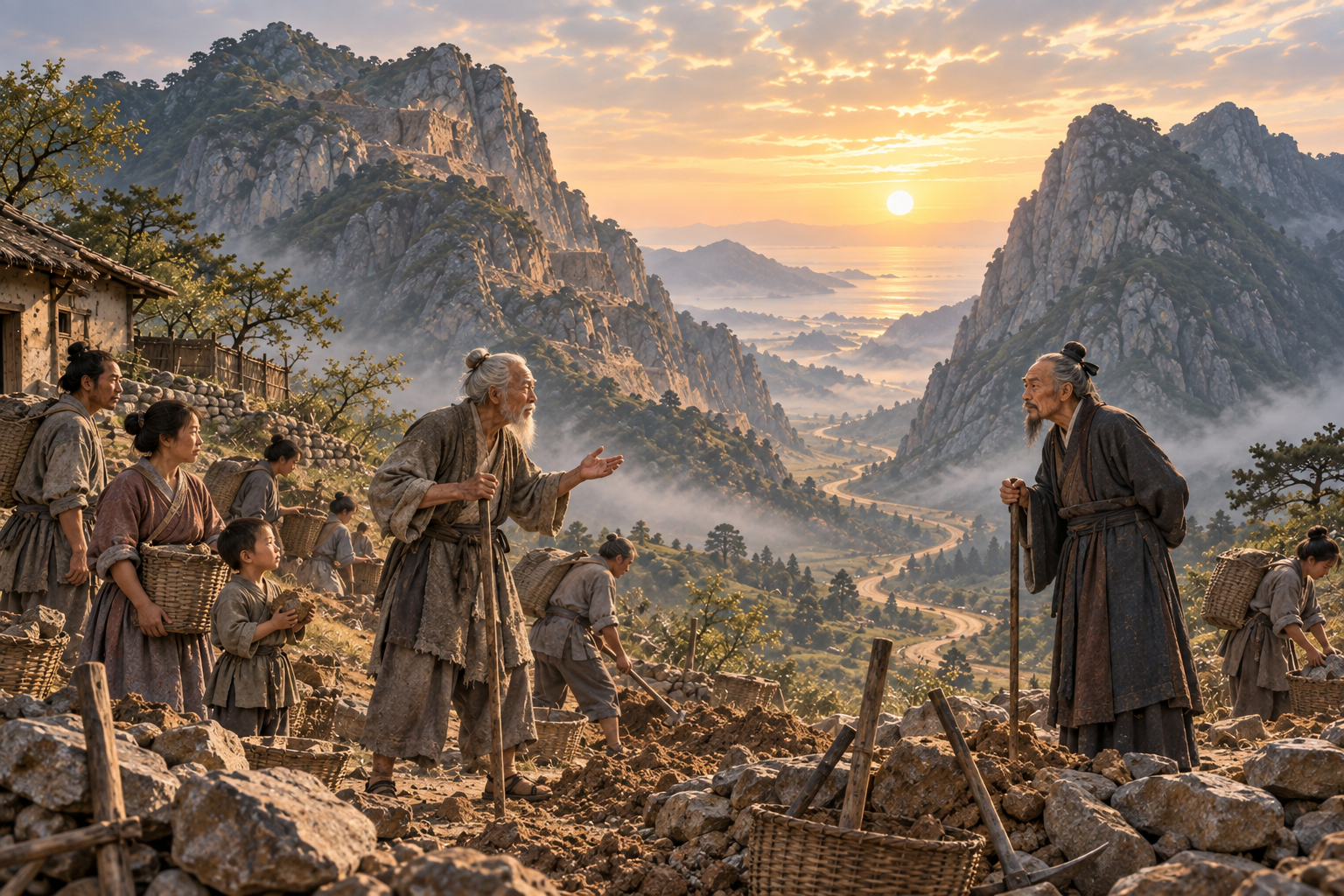
Another old man, whose name in the parable is Wise Old Man of the River Bend, laughed at the attempt. The Old Fool was near the end of his life; how could the force left in him remove even the growth on a mountain, let alone the mountain itself? The reply did not pretend he could finish the work alone. After him would come his son, then grandchildren and their descendants. The family line could continue; the mountains, he argued, would not grow larger. The skeptic had no answer in the story. [1]
It is tempting to turn this exchange into a simple lesson about never giving up. The text asks for a more exact thought. The wife's practical question is not foolish. The journey to the sea is exhausting. The skeptical man can see the scale of the mountains accurately. What changes in the Old Fool's answer is the timescale: a single lifetime is not the only unit in which a decision can matter. [1]
04 / 04
The ending people often leave out
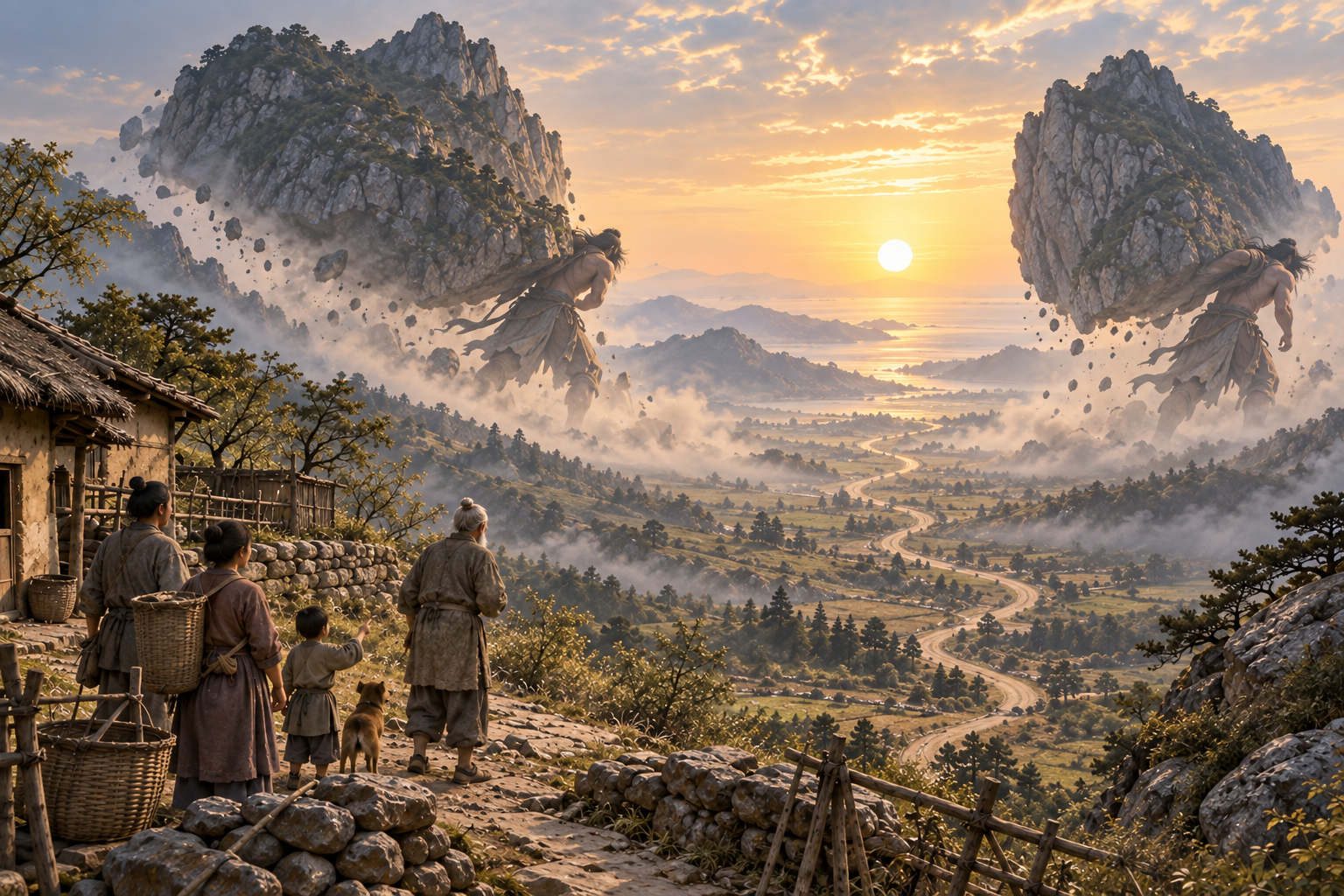
The old man does not personally shovel away the final summit. A spirit carrying snakes hears that he will not stop, and tells the heavenly ruler. Moved by the old man's resolve, the ruler commands the two sons of Kua'e to carry the mountains away. The two peaks are placed in different locations, and the route south is clear. [1]
That supernatural ending is part of the source. It does not turn the tale into a survey of ancient road building, nor does it mean the old man's effort had already physically removed the mountains. The tale joins human persistence to a world in which spirits can respond. We can read its question without mistaking the answer for a historical report: what might a person begin when a result lies beyond the span of one life? [1]
In our imagined last view, a path runs toward open country. The parable does not describe the first traveler on that path. It leaves us instead with a man who chose to lift one basket before he could see the end. [1]
The spoken version
Podcast transcript
Read the full podcast transcript
Storyteller: Welcome to Eastward Stories. Today, two mountains block a road, and a man nearly ninety years old decides to move them. If you know the tale as a lesson in determination, stay for the ending. It is stranger than the version usually told.
Guide: Two mountains? That sounds less like a job than a lifetime sentence. Where does this story come from?
Storyteller: From the “Tangwen” chapter of the Liezi, a collection of philosophical and fantastic tales. Its mountains are Taihang and Wangwu. The man lives north of them. Every trip toward the south takes a long detour. The source calls him the Old Fool of North Mountain. We will keep that title because the story plays with what counts as foolish.
Guide: So we should hear this as a parable, not a report that an ancient road crew really shifted two peaks.
Storyteller: Exactly. The text gives a very clear chain of action and a supernatural conclusion. We can take its argument seriously without pretending it is a construction record. Picture the old man standing outside his home, looking at the mountains. That viewpoint is our invention. What the source gives us is his frustration at having to go around them.
Guide: What does he actually propose to his family?
Storyteller: He gathers the household and asks them to put their strength together, clear the rough ground, and open a direct way south. They agree. His wife asks two practical questions. If they cannot even diminish a small hill, how can they deal with Taihang and Wangwu? And where will the soil and stone go? The family answers that they will carry it toward the Bohai Sea.
Guide: I like that she asks about disposal. It is what any person planning a real excavation would ask first.
Storyteller: Yes. Many short retellings turn every doubter into an obstacle. The wife is doing useful work. She gives the proposal a physical dimension. Stone has weight. A hole creates spoil. The distance to the sea matters. The story does not mock her for noticing those things; it lets the family answer and then begin.
Guide: Who begins? Is it just the old man and his son?
Storyteller: The source says he leads descendants able to carry loads, three men with shoulder poles. They break rock, dig earth, and move it in baskets. A neighbor's son, still young enough to be described as newly losing his milk teeth, jumps in to help. That child is easy to forget, but he matters. The work is not performed by a solitary heroic figure.
Guide: And the journeys are long.
Storyteller: So long that the text says the seasons change before they complete a return. We do not need to invent a daily output rate; the source does not provide one. Imagine carrying a basket, taking a few steps, and seeing two enormous ridgelines still filling the horizon. The sound of a tool against stone, the look of the dust, and the weather are our cinematic additions. The mismatch of scales comes straight from the parable.
Guide: This is where someone comes to tell him to stop, right?
Storyteller: A man called the Wise Old Man of the River Bend laughs at him. He says the Old Fool is in the remaining years of his life and cannot strip so much as a layer from the mountain. How will he remove the whole thing? The challenge is not silly. It measures the project against one person's lifespan.
Guide: I can hear the objection. If a task cannot be completed while you are alive, why start it?
Storyteller: The Old Fool answers by changing the measure. He may die, but a son will remain, and that son will have children. There can be descendants after descendants. The mountains, he says, do not grow larger. The skeptic has no answer in the story. Notice what the Old Fool has not claimed: he does not promise to finish by a named year, and he does not say each basket is enough on its own.
Guide: But is his confidence reasonable? Families do not always keep one project going forever.
Storyteller: In life, that is a fair question. The parable asks us to inhabit a different scale of time for a moment. The old man's logic depends on future people choosing to continue. That choice cannot be guaranteed. We should not convert the story into a modern project plan, complete with imaginary estimates. Its power lies in the clash between what one person can finish and what one person can begin.
Guide: So far, this still sounds like persistence. You said the ending was stranger.
Storyteller: A spirit who holds snakes hears that the old man will not stop. The spirit fears the labor will continue and tells the heavenly ruler. The ruler is moved by the old man's resolve and orders the two sons of Kua'e to carry the mountains away. One goes to the east, one to the south. The direct route is opened.
Guide: In other words, the family does not chip away the final summit.
Storyteller: They do not. If we show a time-lapse in which hundreds of people excavate both mountains down to a flat plain, we change the source. The divine action is not an optional decoration in the ending. It tells us the world of the parable responds to a commitment that seems impossible from a human lifespan.
Guide: Some listeners may prefer a secular version. Can they still take something from it?
Storyteller: Of course, provided we tell them what the text says. A reader can ask what it means to begin an intergenerational undertaking, or why the skeptic's arithmetic and the old man's arithmetic differ. Another reader can dwell on the fantastic ending. The useful conversation comes from keeping all those parts visible, rather than quietly replacing the gods with earthmoving machines.
Guide: How are you going to draw a story like that without pretending the mountains are a real site we can photograph?
Storyteller: Our images will be labeled as original illustrations of a parable. The same two ridgelines, family, baskets, and path stay consistent from scene to scene. We will not put a modern road, excavator, or sign with a real place name in the picture. The divine figures appear only in the last part, because that is when the source introduces them.
Guide: And the wife and the child should be visible, not erased to make one man look grander.
Storyteller: Yes. They make the tale human. In one scene, the wife asks where the rubble will go. In another, the young neighbor helps carry it. These are in the text. A particular hand gesture or camera angle would be invented, and the captions will say so. We can show the Old Fool as small beneath the mountains rather than as a giant who already dominates them.
Guide: I want to return to the wife's question. If the text itself knows that the material must go somewhere, why does it send them all the way to the sea? That seems to make the plan even harder.
Storyteller: It does. The answer names the edge of the Bohai Sea and the north of Yintu. Those are destinations inside the story's geography, not a measured haul route we can plot mile by mile today. The source then says a round trip takes a change of seasons. The length is the point. We should not shorten it in our pictures just so the old man looks efficient. Her question opens the problem of scale; the family's answer accepts that scale rather than pretending the stone will disappear.
Guide: And then a child from next door joins. Why include that detail if the old man's own descendants are meant to carry on?
Storyteller: The text does not explain the child's motive, so we should not invent a speech for him about duty. His presence widens the circle of action. It is no longer only a private family project. A child, too young to carry a heavy adult load, can still take part. In our images we can show a small basket and careful hands. That is an illustration choice, not a measurement supplied by the Liezi. What matters in the passage is that he joins without being ordered in the recorded dialogue.
Guide: The names still bother me. One man is called Foolish and the other Wise. Does the story simply reverse those labels?
Storyteller: It invites us to test them. The Wise Old Man sees a real mismatch between an aging body and two mountains. He is not blind to facts. But he frames the question so narrowly that only the old man's remaining years count. The Old Fool sees that one life is short, then widens the frame to descendants and a mountain that does not grow. His answer also contains an assumption about future commitment. The tale does not give us a spreadsheet proving him right. It makes the argument memorable by giving two people names that challenge our first impression.
Guide: And the divine intervention changes the arithmetic again. The family is counting generations; Heaven moves the mountains in one final action.
Storyteller: Yes. That is why the ending should not be removed when we claim to retell the original. The spirit carrying snakes is worried precisely because the effort might not cease. He reports this to the heavenly ruler. The ruler is moved, and the two sons of Kua'e shoulder the mountains. The old man did not summon them through a technique, nor bargain for a reward in the text. His resolve reaches their world through the spirit's report. That is a marvelous narrative answer, not an engineering calculation.
Guide: Do we know the exact new positions of the mountains?
Storyteller: The passage names a place in the far east and another in the south. It says the region that had been blocked no longer has those ridges. We can show the mountains leaving and the route opening, but we should not draw a modern map with the two peaks pinned to present-day coordinates. The geography is part of a fantastic argument about distance and possibility. A literal map would suggest a kind of evidence the story does not provide.
Guide: In that case, the final image ought to hold both sides of the tale: people who began a hard task and figures who complete it by extraordinary means.
Storyteller: That is our plan. The family stays small below. Above them, two distinct figures carry the two peaks away. We avoid making the old man a superhuman giant or turning the family into a crowd of anonymous laborers. We also avoid making the spirit or the sons look like a borrowed character from a film. This is an original image of a transmitted fable, with its seams between source and invention left visible.
Guide: Then what is the title asking us to remember: the mountains, or the first basket?
Storyteller: Both. The mountain gives the problem its absurd scale. The basket gives the man a first action. He has no proof the task will be finished in his lifetime; the story makes that plain. Still, he calls people together, answers a practical objection, and starts. The last image can show an open path, but the ancient text does not describe its first traveler. That person is left for us to imagine.
Guide: Where can someone read the original passage and see what is yours?
Storyteller: On the Eastward Stories page, we link the Chinese passage in “Tangwen” and list every important adaptation. You can also read our independent Chinese and English stories. The images are an illustrated fable, not a claim of historical reconstruction. Thank you for listening. Next time a problem seems larger than one lifetime, perhaps begin by asking what a first basket would be.
Research notes
Sources & adaptation
- Liezi, Tangwen, the Taihang and Wangwu mountains passage
See source and adaptation notes at the end of the story.
What was adapted
- A philosophical parable, not a documented engineering project.
- The family debate, labor, challenge and divine removal follow the source; weather, viewpoint and gestures are invented.
- The mountains are removed by Kua'e's two sons on the heavenly ruler's command, not by the family's final shovel.
Music credit
“At The End Of All Things” — Scott Buckley · CC BY 4.0。 Track details CC BY 4.0 license